一、OneRank [2026]
《OneRank: Unified Transformer-Native Ranking Architecture for Multi-Task Recommendation》
多任务学习(
Multi-task learning: MTL)在推荐系统中至关重要,能够实现diverse user feedback之间的互补的学习(complementary learning)。尽管现代工业实践已从DNN转向以Transformer为中心的架构,以增强sequence modeling能力和scaling能力,但它们仍然将feature encoding与multi-task prediction解耦,将Transformer视为任务无关的编码器(task-agnostic encoder)。这种设计从根本上限制了性能和scalability,原因在于:(1):在heterogeneous task objectives下造成信息瓶颈(information bottleneck)。(2):引入梯度干扰,导致跷跷板现象(seesaw phenomenon)。(3):强制发生数据流转换(dataflow transition),即attention-based的、context-adaptive的representation learning被转换为static feed-forward task prediction,且information read–write dynamics不兼容。
在本文中,我们提出
OneRank,一种Transformer原生的multi-task ranking框架,消除了encoder–predictor separation,并同时为forward representation learning和backward optimization引入了task-private channels,实现了task-specialized learning,同时最小化任务间干扰(inter-task interferences)。在前向传播中,
OneRank通过task-conditioned information selection、candidate–aware contextualization和controlled cross-task interaction,以自底向上的方式学习task-specific representations。在反向传播中,
cross-task gradient detachment将task-private parameter updates与shared knowledge extraction modules隔离,防止负向迁移(negative transfer)。最后,我们用基于
dynamic matching的评分公式替换静态的task-specific MLP scorers,实现context-aware personalized ranking。
通过将
multi-task reasoning pathways内化到Transformer stack中,OneRank建立了一种具有unified modeling and scalable computation design的新架构范式。在大规模工业数据集上的大量离线和在线实验表明,OneRank在多个任务上显著优于SOTA的基线方法,在保持计算效率的同时大幅提升了ranking效果。多任务学习(
Multi-task learning: MTL)已成为现代推荐系统中事实上的范式(《Multi-task learning for recommender system》、《Multi-task deep recommender systems: A survey》、《Advances and challenges of multi-task learning method in recommender systems: A survey》),其中对dense-but-noisy and sparse-yet-informative feedback进行联合建模,以捕获user preferences的互补方面。早期的深度学习推荐模型(DLRM)(《Entire space multi-task model: An effective approach for estimating post-click conversion rate》、《Entire space multi-task modeling via post-click behavior decomposition for conversion rate prediction》、《A multi-task learning framework for product ranking with BERT》、《Large-scale causal approaches to debiasing post-click conversion rate estimation with multi-task learning》)主要通过两种方式利用task dependencies:(i):通过structured knowledge transfer进行显式的dependency modeling,如ESMM(《Entire space multi-task model: An effective approach for estimating post-click conversion rate》)、ESCM(《ESCM2: Entire space counterfactual multi-task model for post-click conversion rate estimation》)、AITM(《Modeling the sequential dependence among audience multi-step conversions with multi-task learning in targeted display advertising》)和ResFlow(《Residual Multi-Task Learner for Applied Ranking》)。(ii):通过dynamic routing和expert balancing机制进行隐式的knowledge sharing,如MMoE(《Modeling task relationships in multi-task learning with multi-gate mixture-of-experts》)和PLE(《Progressive layered extraction (ple): A novel multi-task learning (mtl) model for personalized recommendations》)。
受大语言模型进展的启发,近期工作(
《Longer: Scaling up long sequence modeling in industrial recommenders》、《Onepiece: Bringing context engineering and reasoning to industrial cascade ranking system》、《Mtgr: Industrial-scale generative recommendation framework in meituan》、《Climber: Toward efficient scaling laws for large recommendation models》、《OneTrans: Unified Feature Interaction and Sequence Modeling with One Transformer in Industrial Recommender》、《Rankmixer: Scaling up ranking models in industrial recommenders》)已转向以Transformer为中心的架构,以利用其强大的sequence modeling能力和良好的scaling behavior。然而,这一
transition并不构成根本性的架构变革。现有方法在很大程度上保留了encoder–predictor设计,可以形式化为representationtask-specific predictors。
这一范式具有以下三个根本性局限:
首先,
shared representationtask-agnostic information bottleneck,其中task-specific signals与shared knowledge纠缠在一起,失去了其身份。将Transformer增加了编码容量,但并未改变这一结构性的约束,使得下游predictorsfused embedding中解耦task-specific information。这种架构选择严重限制了模型在pipeline早期学习task-specific representations的能力,迫使复杂的disentanglement发生在prediction阶段,而建模能力通常在prediction阶段受限。其次,
shared-bottom architectures容易产生跷跷板现象(《Metabalance: improving multi-task recommendations via adapting gradient magnitudes of auxiliary tasks》),即shared parameters上的conflicting gradients可能改善一个任务而降低其他任务。这是因为task-agnostic bottlenecktask-specific optimization方向,这个optimization是通过第三,
encoder–predictor separation强制发生根本性的dataflow和design pattern转换,其中context-adaptive learning被移交给static feed-forward task predictors。具体而言,Transformer通过attention执行迭代式的、上下文相关的information routing。而
DNN-based predictors则寻求静态的、全局非线性的决策边界(decision boundary),适应dynamic user context的能力有限。
这种设计范式的错配破坏了
end-to-end task reasoning和coherent computation scaling。
为了解决这些局限,我们提出
OneRank,一种Transformer原生的multi-task ranking框架,通过将multi-task reasoning内化到Transformer stack本身来消除encoder–predictor split。在前向传播中,
OneRank以自底向上的方式在task-shared pathways之外构建task-private channels:在
input level,具有相互不可见性的task-specific tokens实现早期specialization。在
intermediate level,candidate-aware contextualization通过situational descriptors来聚合cross-candidate signals。在
prediction level,controlled cross-task relational attention在有收益时选择性地注入domain-specific task dependencies。
在反向传播中,
OneRank采用strategic gradient detachment来阻断通过attention的cross-task gradient,将task-specific parameter updates与shared components隔离,有效地将cross-task attention转变为read-only memory从而用于knowledge transfer。在预测时,
OneRank用dynamic matching-based formulation替换static global MLP scorers,其中task-aware global representations通过内积相似度直接与context-conditioned candidate embeddings进行匹配。
这种统一设计在不引入额外架构组件的情况下实现了
context-aware的和task-adaptive的ranking。总之,我们的贡献如下:
我们识别了
Transformer-based MTL recommenders中的关键局限,并提出了OneRank,一种统一框架,它在Transformer原生设计中内化了multi-task reasoning。我们设计了一种自底向上的、
task-aware的计算范式,支持task specialization、task-wise global representation with contextualization、controlled cross-task interaction、以及stable optimization,缓解了information bottleneck和任务间梯度干扰(inter-task gradient interference)。我们用
Transformer原生的matching公式替换了static MLP-based prediction heads,在一致的representation space内实现了context-aware and task-adaptive ranking。在大规模工业数据集上的大量离线和在线
A/B测试实验表明,OneRank在效果和效率上均显著优于SOTA的基线方法。
1.1 相关工作
我们的工作与推荐系统中的
multi-task learning和Transformer-based ranking architectures密切相关。我们简要回顾代表性工作。Multi-Task Learning for Recommendation:Multi-Task Learning已成为现代推荐系统中联合建模diverse user behaviors的关键(《A contrastive sharing model for multi-task recommendation》、《Multi-task learning for recommendation over heterogeneous information network》、《Multitask mixture of sequential experts for user activity streams》、《Mixture of virtual-kernel experts for multi-objective user profile modeling》)。现有方法主要通过两种范式来利用task dependencies。第一种范式侧重于通过
structured knowledge transfer进行explicit dependency modeling。ESMM(《Entire space multi-task model: An effective approach for estimating post-click conversion rate》)利用CTR和CVR之间的条件关系(conditional relationship)来解决data sparsity问题,而ESCM(《ESCM2: Entire space counterfactual multi-task model for post-click conversion rate estimation》)通过反事实推理(counterfactual reasoning)进一步改进。AITM(《Modeling the sequential dependence among audience multi-step conversions with multi-task learning in targeted display advertising》)和ResFlow(《Residual Multi-Task Learner for Applied Ranking》)分别通过attention-based adaptive transfer and residual connections扩展了这一范式。
然而,这些方法依赖
predefined task structures或启发式的迁移规则,限制了适应性。第二种范式侧重于通过
dynamic routing机制进行implicit knowledge sharing。MMoE(《Modeling task relationships in multi-task learning with multi-gate mixture-of-experts》)引入具有task-specific gating的mixture-of-experts,而SNR(《Snr: Sub-network routing for flexible parameter sharing in multi-task learning》)和PLE(《Progressive layered extraction (ple): A novel multi-task learning (mtl) model for personalized recommendations》)提出具有shared and task-specific experts的progressive layered extraction。OnePiece(《Onepiece: Bringing context engineering and reasoning to industrial cascade ranking system》)排序模型通过reasoning tokens连接多个任务,但仍遵循encoder-predictor separation和MLP-based scoring。
尽管具有灵活性,这些方法将
features压缩为task-agnostic shared representations,造成information bottlenecks和gradient conflicts,同时缺乏大规模部署的inherent scaling机制。
Transformer-Based Ranking:受大语言模型的启发,近期工作探索了用于ranking的Transformer。KuaiFormer(《KuaiFormer: Transformer-Based Retrieval at Kuaishou》)侧重于long-sequence modeling,而Climber(《Climber: Toward efficient scaling laws for large recommendation models》)处理heterogeneous sequences。包括
HHFT(《HHFT: Hierarchical Heterogeneous Feature Transformer for Recommendation Systems》)、MTGR(《Mtgr: Industrial-scale generative recommendation framework in meituan》)、OneTrans(《OneTrans: Unified Feature Interaction and Sequence Modeling with One Transformer in Industrial Recommender》)和HyFormer(《HyFormer: Revisiting the Roles of Sequence Modeling and Feature Interaction in CTR Prediction》)在内的统一架构在单一Transformer框架内联合建模feature interactions和sequential patterns。
然而,这些方法保留了传统的
encoder-predictor范式Transformer encoder产生task-agnostic representationsMLP-based task towers。这种设计引入了三个局限:(1):shared bottleneckpredictors解缠(disentangle)冲突的task requirements。(2):shared parameters上的gradient conflicts导致跷跷板现象。(3):从attention-based encoding到static MLP scoring的架构转换阻止了end-to-end context-aware ranking并造成计算瓶颈(computational bottlenecks)。
相比之下,
OneRank通过task-specific tokens with mutual invisibility、candidate-aware contextualization、strategic gradient detachment、以及dynamic matching-based scoring,将multi-task reasoning内化到统一的Transformer架构中,实现了优越的scaling和稳定的multi-task optimization。
1.2 方法论
在本节中,我们介绍
OneRank,一种Transformer原生的multi-task ranking框架,它将multi-task reasoning内化到Transformer架构本身,消除了传统的encoder-predictor splittask-shared pathways之外构建task-private channels,在multiple architectural levels实现task specialization,同时保持有益的knowledge sharing。我们按如下方式组织方法论:
我们首先描述如何将
heterogeneous inputs结构化为统一的token sequence representation。为了实现
early task specialization和缓解gradient conflicts,我们引入具有相互不可见性的task-specific token injection,在input level为每个任务分配dedicated parameters。然后我们设计
candidate-aware contextualization,通过situational descriptors来聚合cross-candidate signals,弥合training-serving gap。为了实现
controlled cross-task knowledge transfer,我们提出灵活的cross-task relational attention,具有strategic gradient detachment和configurable masking strategies。最后,我们提出
joint optimization objectives。
我们在以下小节中详细阐述每个组件。
OneRank的架构如Figure 1、Figure 2所示。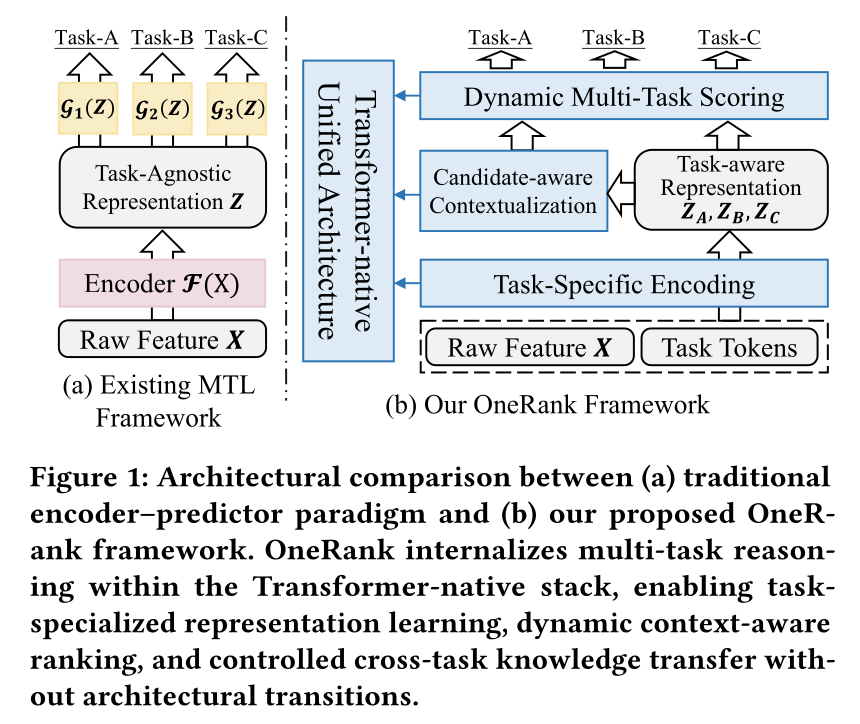
注意:下图错误。在左上侧 的
K/V部分,应该是:左边蓝色的①②,右边红色的①②。因为相同的颜色才是同一种任务。这个MHCA表示:给定taskcandidates的representations,以SD为query从而抽取task representation。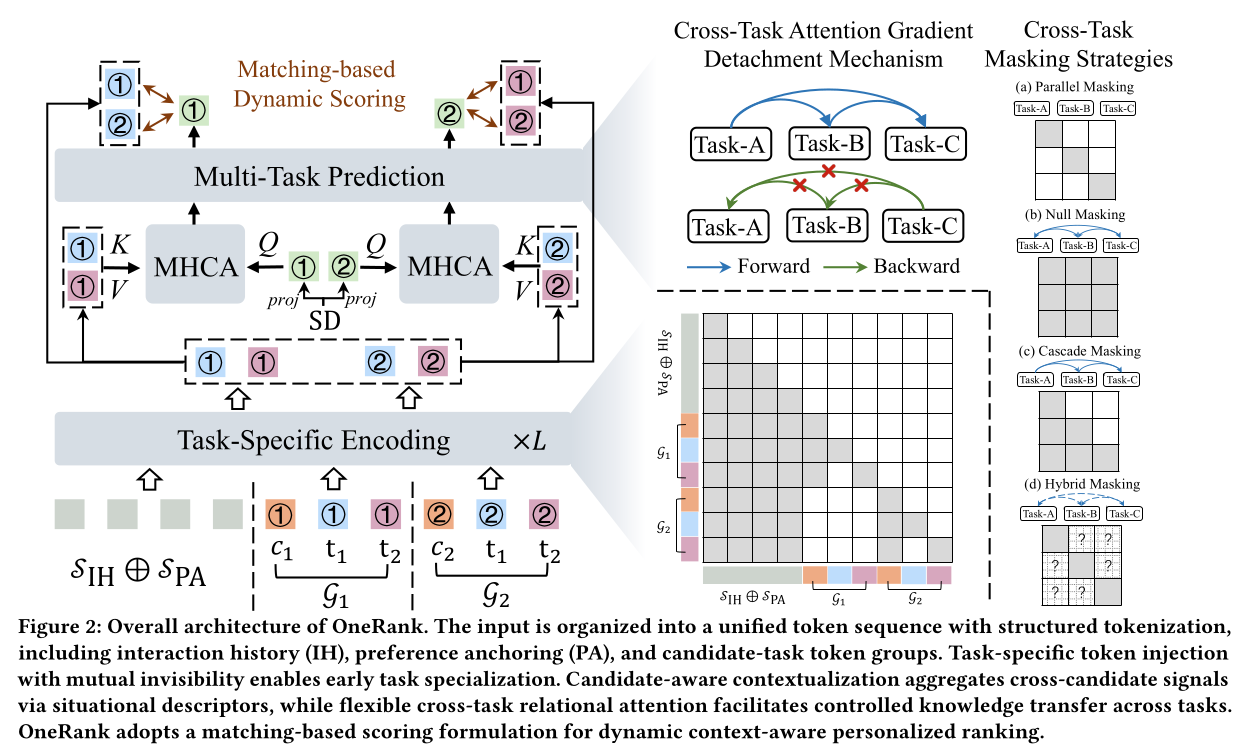
1.2.1 Structured Tokenization
遵循已有范式(
《Onepiece: Bringing context engineering and reasoning to industrial cascade ranking system》),我们采用structured tokenization策略来组织heterogeneous inputs。我们的方法将diverse input modalities转换为a unified token sequence representation,实现sequential patterns和feature interactions的有效联合建模。Interaction History (IH):我们按时间顺序组织user behavioral sequences为interaction。为了捕获temporal dynamics和evolving preferences,我们用可学习的positional encodingsinteraction:其中
embedding函数,embedding维度。完整的
interaction history sequence表示为Preference Anchoring (PA):受大语言模型中检索增强生成(retrieval-augmented generation: RAG)(《Retrieval-augmented generation for large language models》、《A comprehensive survey of retrieval-augmented generation (rag): Evolution, current landscape and future directions》、《Retrieval-augmented generation for ai-generated content: A survey》)的启发,我们用外部知识增强user interaction history。具体而言,我们引入Preference Anchors,包含多个retrieved sequencesdomain knowledge)动态选择而来。注意,这里
retrieved sequences是针对单个样本。即,每个样本在构造inputs时动态检索/选择出来的对于
personalized search,我们检索与当前query相关的top-clicked and top-purchased item sequences。论文并未说明如何从这些
top-clicked and top-purchased item sequences切分出可能的方式包括:
按行为类型切:
top-clicked序列、top-purchased序列分别作为不同anchors,按类目(或品牌):当前
query下不同类目(或品牌)的点击/购买序列,
对于
recommendation,我们选择历史上high-engagement sequences作为补充信号。high-engagement sequences可以理解为:用户历史上高参与度/高互动行为构成的物品序列。但论文没有给出精确定义。通常可能包括:高点击序列、购买序列、加购物车序列、互动序列(收藏、分享、点赞、评论) 等等。但是,如何从这些序列中切分出
每个序列
boundary tokens来封装:其中:
retrieved sequences的数量。learnable tokens。
Preference Anchoring的序列之内如何排序、序列之间如何排序,论文都没有提到。Candidate-Task Token Groups:对于candidate setcandidate itemtoken group,包含candidate embeddingtask-specific tokens。task tokenscandidates之间共享的learnable parameters,其中每个task-specific query template。对于每个candidatetask tokens,形成a candidate-task group:注意,虽然
task token parameterscandidate groups之间共享,但每个group在encoding过程中通过structured attention masking独立操作,允许task tokens能够通过对不同candidate embeddingsshared user context执行注意力机制,提取candidate-specific task representations。一个
candidate set包含candidates,那么就有:其中:
candidates上共享,attend到task token之间互不可见,即:attend到
也就是,
shared user context和attend。Unified Token Sequence:final input将shared user context与所有candidate-task groups拼接:其中:
这种组织方式自然地将
task-shared pathways(user context)与task-private channels(task-specific tokens)分开,便于高效的attention masking和并行计算。
1.2.2 Task-Specific Encoding
为了实现
early task specialization和缓解shared-bottom architectures中的跷跷板现象,我们在input level引入具有相互不可见性的task-specific token injection。与依赖shared representationsshared task-specific token templates注入每个candidate group,通过structured attention机制实现独立的task-specific feature extraction。Structured Attention Mask:为了确保task-specific representation learning,我们构建一个structured attention masktask tokens之间的相互不可见性,同时保持shared user context的可见性:Causal User Context:user context(tokens遵循causal attention进行时间建模,其中每个位置只能关注自身及其之前的位置。注意,
attend到tokens,但是attend到token。Candidate Group Isolation:每个groupgroupsingle-user multiple-candidate parallelization。Tokens可以attend:user context中的所有tokens(带causal masking)。同一
group内的candidate embedding自身(
self-attention)。
Task Token Mutual Invisibility: 即使在同一candidate group内,来自不同任务的task tokens也相互不可见。具体而言,grouptask token只能attenduser context (with causal masking)、candidate embeddinggroup中的其他task tokens。
形式上,设
tokenuser context中的sequential position,设candidate grouptask token(从shared parametertoken positionsmask定义为:Transformer Encoding:我们应用masked Multi-Head Self-Attention (MHSA) with residual connections and layer normalization,以获得更好的训练稳定性:其中:
layer的索引。encoding之后,我们通过从每个candidate group中选择相应task token的output来提取task-specific representations:其中:
candidatetasktask-relevant features。尽管所有
candidate groups共享相同的task token parameterstask token通过attend不同的candidate embeddingsshared user context中整合candidate-specific signals,产生不同的representationsearly task specialization。
1.2.3 Candidate-Aware Contextualization
传统的
point-wise scoring存在training-serving gap:在孤立样本上训练好的模型无法捕获serving时存在的cross-candidate dependencies。我们通过candidate-aware contextualization来解决这一问题,通过situational descriptors聚合cross-candidate signals。Situational Descriptors (SD):我们定义Situational Descriptorscontextual signals,包括用户人口统计信息(user demographics)、query information、以及session metadata(例如time、location)。这作为aggregation的contextual anchor。SD不包含用户的行为序列。这是将静态的信息注入到candidate item。Task-Specific Cross-Candidate Aggregation: 对于每个tasktask-specific parameters来变换SD并聚合candidate information。具体而言,我们使用task-specific投影函数situational descriptor:其中
然后我们采用
task-specific Multi-Head Cross-Attention (MHCA)(《Attention is all you need》)来聚合candidate-aware global information:事实上,这个公式是:
其中:
tasktask-specific multi-head cross-attention。tasktask-wise global representation,在整个candidate set上聚合。
这种设计通过
independent parameter sets来显式地解耦task-specific information flows,确保每个任务在捕获cross-candidate competitive dynamics的同时保持自己的aggregation pathway。candidate在tasklist-wise information。
1.2.4 Multi-Task Prediction
为了实现
controlled cross-task knowledge transfer,同时尊重domain-specific dependencies,我们设计了具有strategic gradient detachment的灵活的cross-task relational attention。与采用fixed task tower structures的传统方法不同,我们的框架允许configurable information flow patterns。Cross-Task Attention with Strategic Gradient Detachment:我们组织从candidate-aware contextualization获得的task representationsconfigurable cross-task attention maskmulti-head self-attention:其中,任务
这是为了建模任务之间的依赖关系。
为了在允许
forward knowledge transfer的同时防止反向梯度干扰(backward gradient interference),我们采用strategic gradient detachment。具体而言,我们自定义cross-task attention的反向算子(backward operator),仅允许对角梯度流(diagonal gradient flow),同时阻断非对角梯度(off-diagonal gradients)。在反向传播过程中,计算任务attention computation中分离来自attended tasksoptimizing任务inter-task gradient conflicts),同时保留有益的forward information transfer,将cross-task attention转变为read-only memory从而用于knowledge transfer。然后我们应用
residual connection和layer normalization:.
Dynamic Matching-Based Scoring:我们通过带残差连接的前馈网络来refine representations:与无论上下文如何都应用
fixed transformations的static MLP-based scoring不同,我们通过inner product similarity来计算task-candidate relevance:其中:
enriched by controlled cross-task interactions)捕获task-aware global context。task-specific encoding)捕获context-conditioned candidate embeddings。
这种
Transformer原生的matching公式动态适应session context,实现context-aware and task-adaptive ranking。representation,它包含了:在给定条件下(用户、上下文)所有candidate在task而
representation。它包含了:在给定条件下(用户、上下文)candidatetaskFlexible Cross-Task Masking Strategies:cross-task attention maskdomain-specific task relationships and expert knowledge来灵活配置。我们讨论以下几种代表性策略:Parallel Masking:当需要不同recommendation tasks之间的independent predictions时,我们强制相互不可见性(global representation,没有cross-task information flow。这种策略适用于探索性场景、或数据充足从而允许独立建模的情况。Null Masking:对于数据充足且任务关系复杂模糊的场景,我们允许所有任务相互关注(bidirectional attention来自主学习task correlations,适用于domain knowledge about task dependencies有限的情况。Cascade Masking:当behavioral dependencies遵循清晰的漏斗结构时,我们按照data-rich-to-sparse cascade施加单向信息流(sparse downstream tasks能够利用upstream tasks的信号。例如,在电子商务中,click -> cart -> purchase的自然递进表现出清晰的因果依赖关系,purchase prediction受益于click and cart signals。Hybrid Masking:对于复杂的现实场景,从业者可以根据领域专业知识(domain expertise)来设计custom masks,从而编码partial visibility或mixed patterns。例如,在behavioral relationships(例如 点赞like、关注follow、评论comment、转发forward)缺乏清晰因果结构的短视频平台中,可以允许engagement-related tasks(点赞 、评论)之间的bidirectional attention,同时保持从丰富的click signals到稀疏的follow actions的unidirectional flow。
总之,我们的灵活的
masking机制基于domain-specific task dependencies实现controlled cross-task interaction,适应从strict cascades到完全自主学习的diverse relationship patterns。
1.2.5 Joint Learning Objectives
通过
dynamic matching机制计算得到relevance scoreslist-wise objectives和point-wise objectives的hybrid learning策略。对于discriminative ranking,我们采用基于InfoNCE的contrastive loss(《InfoNCE: Identifying the gap between theory and practice》、《Towards robust recommendation via decision boundary-aware graph contrastive learning》、《Recgpt technical report》):其中:
candidate set大小。注意,这里的
candidate setcandidate set通常来自于retrieval stage,因此它们与user/request具备一定的相关性,负样本是hard negatives而不是随机负样本,甚至也不是in-batch负样本。对于工业系统所需的
calibrated probability estimation,我们采用二元交叉熵(binary cross-entropy: BCE)损失:其中:
ground-truth label,sigmoid函数。joint training objective结合所有任务的两种损失,公式化为:其中:
list-wise optimization和point-wise optimization。这个公式显式地假设每个任务的损失权重相同。
1.3 讨论
我们的
unified framework相比传统
1.3.1 Bridging the Training-Serving Gap via Context-Aware Dynamic Ranking
传统的
point-wise learning范式(《Personalized Inter-Task Contrastive Learning for CTR&CVR Joint Estimation》、《Prototype feature extraction for multi-task learning》、《Cross-task knowledge distillation in multi-task recommendation》)孤立地优化单个user-item pairs,与models must rank entire candidate sets的serving环境存在根本性错配。OneRank通过integrated context-aware modeling and dynamic scoring来解决这一差距。Explicit Cross-Candidate Dependency Modeling:我们situational descriptor-based global information modeling通过cross-attention聚合整个candidate set的信号,使模型能够捕获competitive dynamics和relative preferences而非absolute scores。global representationtask-specific characteristics,还编码candidate pool的distributional properties,允许模型根据competing items自适应地调整rankings。Dynamic Ranking Scoring:与无论context如何都应用fixed transformations的static MLP predictors不同,我们的基于matching的公式dynamic adaptation。global representationcross-task attention而被refined,并由situational descriptors被informed),捕获了session-specific user intent、query semantics和temporal context。因此,同一user-item pair可以根据contextual variations(例如,morning vs. evening browsing、search vs. browse mode)在不同sessions中获得不同分数,实现真正的个性化排序。此外,内积公式诱导了一个共享几何空间(
shared geometric space),其中task representationscandidate representationsemantic alignment,相比架构分离的MLP tower,促进了更好的gradient flow和更有效的multi-task learning。
1.3.2 Mitigating the Seesaw Phenomenon via Decoupled Optimization
跷跷板现象,即优化一个任务会降低其他任务,源于
multi-task learning中shared parameters上的gradient conflicts。OneRank通过three-level decoupling strategy缓解这一问题:Input-Level Task-Specific Parameters:通过注入具有task-isolated attention masks的可学习task tokensfeature extraction的earliest stage为每个任务分配专用参数(dedicated parameters)。这确保任务从shared context(interaction history、preference anchors)中提取specialized representations,而不会backpropagation through the encoding layers过程中相互干扰gradient flows。Intermediate-Level Information Flow Decoupling:在global modeling阶段,我们同时对situational descriptor projection(cross-candidate aggregation(task-specific parameters。即使任务共享相同的situational descriptor inputdedicated parameter sets保持独立的transformation and aggregation pathways。这种架构设计防止了aggregation阶段的梯度冲突:optimizing任务projection and attention parameters不会直接干扰其他任务的学习,因为每个任务通过自己的parameter space操作。Prediction-Level Gradient Detachment:在final decoding解码阶段,我们的gradient detachment机制允许任务representations(knowledge transfer),同时防止任务optimization isolation)。通过自定义backward operator仅允许对角梯度流(diagonal gradient flow),我们实现了非对称的information transfer:forward sharing实现knowledge transfer,backward isolation消除负面干扰(negative interference)。
1.3.3 Enhanced Flexibility and Efficiency via Unified Architecture
除了解决跷跷板现象和
training-serving gap外,OneRank的unified design在modeling flexibility和computational efficiency方面也具有显著优势。Flexible Task Dependency Modeling:我们的configurable cross-task attention masks相比ESMM的fixed cascades(《Entire space multi-task model: An effective approach for estimating post-click conversion rate》)或MMoE的independent towers(《Modeling task relationships in multi-task learning with multi-gate mixture-of-experts》)等刚性架构提供了前所未有的灵活性。从业者可以通过简单的mask design来编码domain-specific knowledge:电子商务漏斗(e-commerce funnels)的strict cascades、ambiguous engagement patterns的bidirectional attention、或复杂user journeys的hybrid configurations。这种灵活性消除了对architecture search或task-specific model variants的需求,在单一unified framework内实现对diverse scenarios的快速适应。Computational Efficiency and Scalability:通过消除transition,OneRank在单一Transformer原生架构内实现端到端优化,避免了hybrid方法中heterogeneous module transitions的计算开销。我们的single-user multiple-candidate范式在训练期间大幅减少redundant context encoding,而user-specific components(interaction history and preference anchors)的KV-caching实现efficient serving:仅candidate and task tokens需要在线计算,实现低延迟和高GPU利用率。这种unified design释放了Transformer的全部scaling潜力,支持deeper models和larger candidate sets,没有architectural bottlenecks。
总之,
OneRank在统一的Transformer架构内对feature extraction、task-specific representation learning和multi-task decoding的协同设计(co-design),解决了传统的解耦方法的根本局限,为工业multi-task ranking systems提供了优越的建模能力、optimization稳定性、计算效率和适应性。
1.4 离线评估
我们在从
Shopee(领先的电子商务平台)收集的大规模专有数据集上进行离线实验。该数据集涵盖2025年12月连续30天的user interaction日志,包括click、add-to-cart和order等等feedback signals。Table 2总结了数据集统计信息。我们报告click (C)、add-to-cart (A)和order (O)的prediction tasks的AUC和GAUC。完整数据集详情见附录A。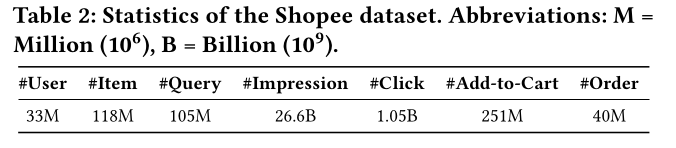
baseline方法:为了提供全面的评估,我们将OneRank与combinations of different encoder architectures and multi-task learning strategies进行比较。这种实验设计使我们能够分离encoder capacity和multi-task optimization strategies的影响,并公平评估OneRank’s unified Transformer-native multi-task ranking architecture的优势。我们考虑以下代表性的
encoder架构:DNN:Shopee中基于deep neural networks的well-optimized production baseline,作为传统DLRM风格架构的基础。MTGR(《Mtgr: Industrial-scale generative recommendation framework in meituan》):Meituan开发的工业级generative recommendation框架,采用基于Transformer的sequence modeling从而用于user behavior understanding。OneTrans(《OneTrans: Unified Feature Interaction and Sequence Modeling with One Transformer in Industrial Recommender》):ByteDance提出的用于feature interaction和sequential modeling的统一的Transformer架构,代表Transformer-based ranking models的SOTA。
在每个
encoder之上,我们评估多种multi-task learning策略:noMTL:独立的single-task training,无multi-task learning,作为衡量multi-task optimization收益的基线。NSE (Naive Shared Embedding):独立的task-specific networks,但所有任务共享一个common embedding table,代表最简单的parameter sharing形式。MMoE(《Modeling task relationships in multi-task learning with multi-gate mixture-of-experts》):Multi-gate Mixture-of-Experts,在shared expert networks上采用task-specific gating networks,实现灵活的task-specific feature extraction。PLE(《Progressive layered extraction (ple): A novel multi-task learning (mtl) model for personalized recommendations》):Progressive Layered Extraction,以渐进方式(progressive manner)组织shared experts和task-specific experts,平衡knowledge sharing和task specialization。DCMT(《Dcmt: a direct entire-space causal multi-task framework for post-click conversion estimation》):面向debiasing的multi-task框架,通过causal-based counter-factual learning技术解决sample selection bias。ResFlow(《Residual Multi-Task Learner for Applied Ranking》):residual-based multi-task learning方法,通过multi-task towers之间的简单residual connections实现灵活的信息流。
实现细节:除非另有说明,所有模型在相同实验设置下实现以确保公平比较。
OneRank采用2-layer Transformer encoder with pre-norm architecture(《Deepseek-v3 technical report》、《Qwen2 technical report》、《Qwen3 technical report》),每层4 attention heads。模型全程使用256的hidden dimension,feed-forward networks设置为hidden size的两倍,遵循标准Transformer配置。最大序列长度设置为256,以平衡计算效率和建模能力。应用可学习的positional encodings(《Parallel Latent Reasoning for Sequential Recommendation》、《Think before recommend: Unleashing the latent reasoning power for sequential recommendation》)来捕获user interaction sequences中的时间依赖关系(temporal dependencies)。Sequence-side features(包括item attributes、category information和behavioral metadata)和situational descriptors(user demographics、query information、session metadata)通过线性层投影到模型维度(256)。OneRank实例化三个task-specific tokens(每个任务一个:click、add-to-cart、order)和三个ranking head tokens。multi-task prediction module应用one layer of task-specific self-attention,后接one layer of cross-task attention with configurable masking,两者都配备FFN模块从而进行非线性变换。什么是
ranking head tokens?论文没有详细说明。读者猜测应该是 $$对于
InfoNCE loss,初始温度0.2。list-wise loss和point-wise loss相等(loss weights。
1.4.1 整体性能
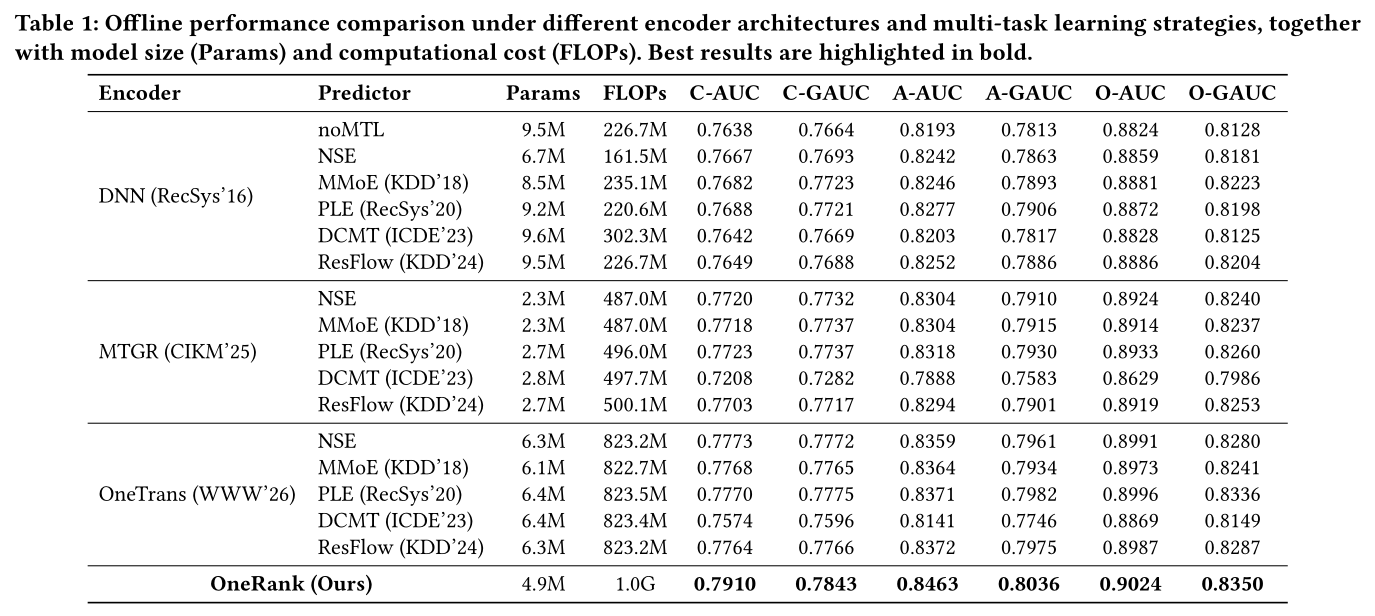
Table 1总结了整体离线性能,从中可以得出三个关键观察。在传统
DNN encoders下,Multi-task learning始终有益。与noMTL baseline相比,所有multi-task learning方法在DNN encoder之上构建时,在click、add-to-cart和order等prediction tasks上均产生明显改进。这一结果证实,联合建模dense and sparse user feedback提供了互补的supervision signals,确立了multi-task learning作为工业推荐系统的必要组件。Stronger encoder architectures进一步放大了multi-task modeling的收益。将DNN-based encoders替换为Transformer-based architectures(如MTGR和OneTrans)在大多数multi-task strategies上带来额外性能增益,突出了expressive sequence和context modeling在multi-task recommendation中的重要性。然而,我们观察到
DCMT在Transformer encoders下表现不佳,可能是因为其debiasing-oriented design可能过度校正sparse tasks并加剧task imbalance,导致与high-capacity models结合时optimization性能不稳定。OneRank通过在Transformer原生框架内统一了representation learning和multi-task ranking从而实现了最佳性能。在所有指标和任务上,OneRank始终优于所有baseline combinations,证明了消除encoder–predictor decoupling并将multi-task reasoning直接内化到Transformer架构中的有效性。值得注意的是,这些增益是在
a compact parameterization和a moderate increase in computation的情况下实现的,突出了有利的performance–efficiency权衡。这些结果验证了我们的核心主张:统一的
Transformer-native ranking范式比外部的encoder-predictor separation架构更适合大规模multi-task recommendation。
1.4.2 Ablation Studies
为了验证
OneRank中每个设计组件的有效性,我们通过移除或替换关键架构模块进行全面的消融研究。Figure 3展示了以下变体的结果:V1:移除task-specific tokens,直接在candidate encodings上应用线性投影。V2:用单个shared token替换task-specific tokens。V3:在V2基础上进一步移除cross-task relational attention。V4:移除cross-task attention中的strategic gradient detachment。V5:用randomly initialized parameters替换situational descriptors。V6:应用full bidirectional attention without selective masking。
从结果中我们观察到:
(1):移除task-specific tokens(V1)导致显著退化,A-AUC从0.8463降至0.8424,O-GAUC从0.8350降至0.8337,验证了early task specialization的必要性。(2):使用single shared token(V2)表现不如完整模型,确认了independent task tokens对于缓解gradient conflicts至关重要。(3):移除cross-task attention(V3)与V2相比显示mixed results,表明cross-task knowledge transfer在与proper task isolation相结合时有益。(4):移除gradient detachment(V4)实现了强性能但在add-to-cart任务上导致不稳定(A-AUC:0.8460 vs. 0.8463),证明了strategic gradient control的必要性。(5):用random parameters替换situational descriptors(V5)导致严重退化,C-AUC降至0.7872,O-GAUC降至0.8318,确认了candidate-aware contextualization对于弥合training-serving gap至关重要。(6):Full bidirectional masking(V6)在所有任务上始终不如controlled masking strategies。
总体而言,这些研究验证了所有提出组件的协同作用对于优越的
multi-task ranking性能至关重要。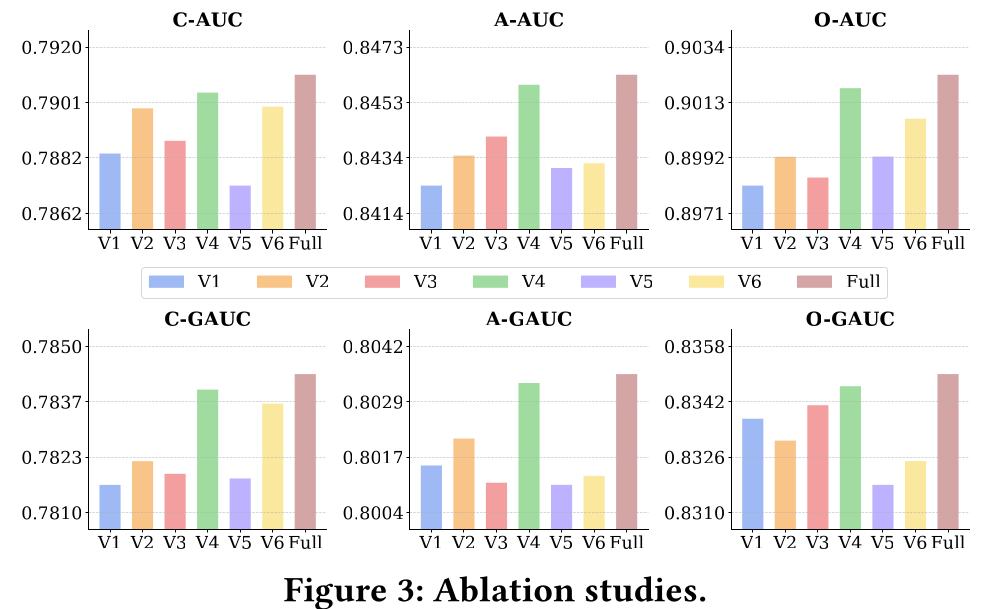
1.4.3 Scaling Analysis
为了研究
OneRank的scaling behavior,我们研究了其在两个fundamental model scaling dimensions下的性能:encoder layer (depth)和hidden dimension (width)。具体而言,我们逐步增加encoder层数和模型维度,同时保持所有其他组件不变。我们报告相对于smallest model configuration的ΔAUC和ΔGAUC绝对性能改进。Scaling Encoder Depth:Figure 4 (left)显示了增加encoder depth的效果。我们观察到:随着
encoder层数的增加,所有feedback signals在AUC和GAUC指标上均持续改进。从
shallow configurations扩展到中等深度时增益最为显著,在更大深度时逐渐饱和,表明边际收益递减。
这一趋势表明更深的
Transformer stacks增强了OneRank建模复杂sequential patterns和task interactions的能力,同时统一的架构在深度增加时保持稳定的optimization。Scaling Hidden dimension:Figure 4 (right)展示了scaling the hidden dimension的影响。增加model width在不同任务上持续改善排序性能。与depth scaling相比,width scaling表现出更平滑和更均匀的增益,特别是对于click相关指标,反映了richer representation capacity对fine-grained user–item interaction modeling的益处。值得注意的是,性能improvements在各任务间保持稳定,表明OneRank有效利用increased model capacity,而没有引入严重的task imbalance或optimization instability。
总体而言,多个任务和指标上的一致
improvements进一步支持了所提出的统一的Transformer-native ranking框架的scalability,使其非常适合大规模工业部署,其中model capacity和性能需要被联合optimized。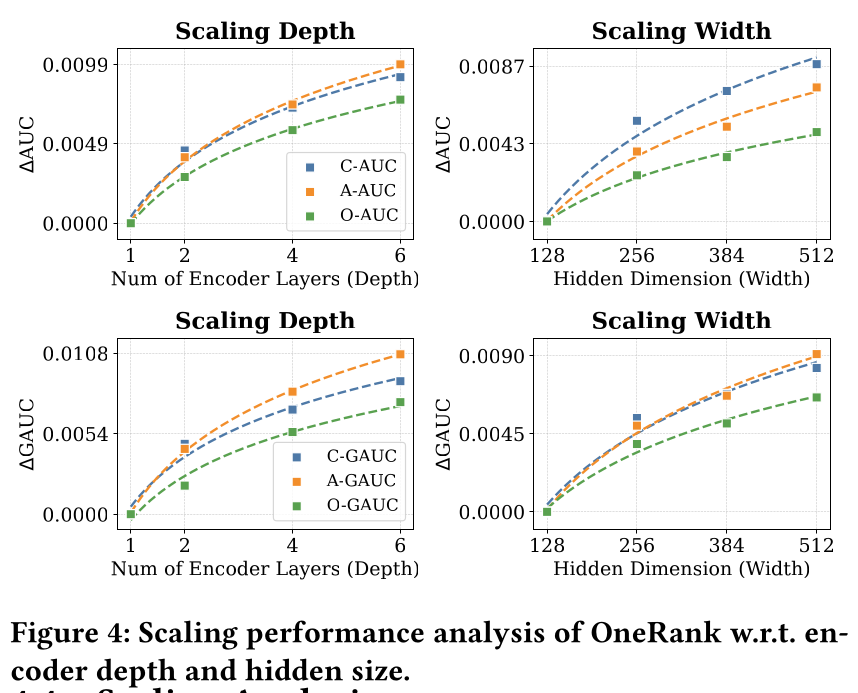
1.4.4 Online A/B Testing
为了验证
OneRank在真实工业环境中的实际效果,我们在Shopee的主要个性化排序场景中进行了为期7天的大规模在线A/B测试,与之前部署的baseline进行比较,其中这个baseline是将精心优化的Transformer encoder与multi-task predictor相结合而来。OneRank完全部署在标准multi-stage ranking pipeline中,通过score fusion来平衡用户体验和业务目标。遵循工业实践,我们将10%的实时流量分配给使用OneRank的实验组,10%分配给baseline对照组。我们沿着两个互补维度评估在线性能:平台收益(GMV/UU、Paid GMV/UU、AR/UU)和用户体验(Bad Query Rate)。详细部署配置见附录B。在线
A/B测试结果总结在Table 3中。OneRank持续改善以业务为中心的指标和以用户为中心的指标,实现了GMV/UU +1.01%的提升、paid GMV per user +1.17%的增长和广告收入+0.81%的增益,同时将Bad Query Rate降低了2.29%。这些结果表明,OneRank不仅提高了货币化效率(monetization efficiency),还改善了工业场景中的recommendation relevance和用户体验。总体而言,观察到的增益验证了
OneRank的实际有效性,并突出了统一的Transformer-native designs在大规模工业推荐系统中scalable and reliable deployment的强大潜力。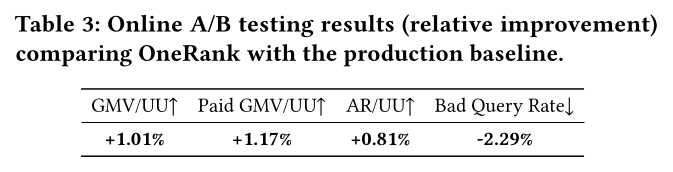
1.5 结论
在本文中,我们识别了现有
multi-task recommender systems中由传统encoder-predictor separation引起的关键局限:task-agnostic information bottlenecks、导致跷跷板现象的gradient conflicts、以及阻止context-aware dynamic ranking and scaling potential的architectural transitions。为了应对这些挑战,我们提出了
OneRank,一种统一的Transformer-native multi-task ranking框架,在连贯的架构设计中内化multi-task reasoning。我们的方法:引入了
task-specific tokens with mutual invisibility以实现early specialization。通过
situational descriptors进行candidate-aware contextualization以弥合training-serving gaps。以及
controlled cross-task attention with strategic gradient detachment以实现灵活的knowledge transfer通过用
dynamic matching formulations替换static MLP-based scoring。
最终,
OneRank在统一的范式内实现上context-aware and task-adaptive ranking。大量离线实验和大规模在线
A/B测试表明,OneRank在多个任务上显著优于SOTA的基线方法,同时保持计算效率,验证了我们统一的Transformer-native design用于scalable工业部署的有效性。
1.6 附录
1.6.1 A. Offline Experimental Setup
Dataset Details:现有公共数据集无法提供现实工业模型评估所需的rich sequential item features、explicit multi-task annotations和ranking-stage candidate sets required。因此,我们在从Shopee(领先的电子商务平台,服务东南亚和拉丁美洲的十亿级用户)收集的大规模专有数据集上进行离线实验。该数据集由2025年12月连续30天的user interaction日志构建,专门为multi-task ranking而设计,涵盖click、add-to-cart和order等等feedback signals。Evaluation Metrics:我们在三种类型的user feedback signals下评估模型性能:click (C)、add-to-cart (A)和order (O)。对于每种feedback类型,遵循先前工作(《Pepnet: Parameter and embedding personalized network for infusing with personalized prior information》、《Long-Sequence Recommendation Models Need Decoupled Embeddings》、《Deep interest network for click-through rate prediction》),我们报告AUC和GAUC,分别记为C-AUC/C-GAUC、A-AUC/A-GAUC和O-AUC/O-GAUC。
1.6.2 B Online A/B Testing Details
Online Deployment Details:OneRank部署在Shopee的标准multi-stage ranking pipeline中,通过a score fusion strategy集成,该策略将multiple task outputs组合为a unified ranking score:其中:
predicted的点击率和转化率。第一项显式优化商品交易总额(
gross merchandise value: GMV)。第二项考虑广告收入。
第三项强制
search relevance and user intent alignment。系数
production中的用户体验和业务目标。
在
online inference中,每个请求可能涉及多达4,096个candidate items。为了实现ranking quality和computational efficiency之间的有利权衡,candidates被分为cross-attention-based ranking,有效将OneRank扩展到large candidate pools,同时保持context-aware list modeling。Evaluation Protocol and Metrics:在线A/B测试在2026年1月8日至1月14日的7天期间进行。遵循标准工业评估实践,我们将10%的实时流量分配给使用OneRank的实验组,10%分配给baseline对照组。遵循先前工作(《Onepiece: Bringing context engineering and reasoning to industrial cascade ranking system》),我们沿着两个互补维度评估在线性能:平台收益(
Platform Benefits),包括GMV/UU(gross merchandise value per user)、Paid Orders/UU(average number of completed paid orders per user,不包括退款)和AR/UU(advertising revenue per user)。用户体验(
User Experience),通过Bad Query Rate衡量,定义为被判定为不相关(irrelevant)的user queries比例,作为推荐准确性和用户满意度的代理指标。
1.6.3 Parameter Sensitivity Analysis
关于
OneRank对Figure 5报告了不同温度0.2左右达到峰值,当温度过小时略有下降。这一趋势在AUC和GAUC指标上一致,并且对于click、add-to-cart和orer等等prediction tasks都成立。这种行为与temperature in contrastive learning中的作用一致:大的温度
similarity distribution,削弱candidates之间的discriminative supervision。而过小的温度
similarity distribution并可能放大噪声或hard negatives,导致suboptimal optimization。适中的温度(约
discrimination strength和training stability之间取得平衡,产生最佳整体性能。
基于此分析,我们将温度
0.2。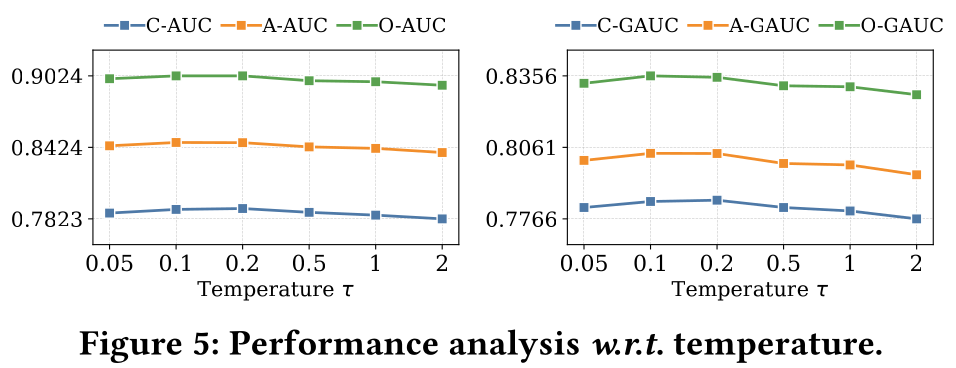
关于公式
Loss Weight的性能:我们进一步研究公式list-wise InfoNCE loss和point-wise BCE loss之间相对权重的影响。Table 4报告了不同loss weight ratios下的性能。我们观察到:为
InfoNCE和BCE分配相等权重在所有任务和评估指标上始终产生最佳结果。当
BCE loss过度加权(1:2)时,性能下降,表明过度依赖point-wise supervision限制了模型捕获relative ranking signals among candidates的能力。相反,强调
InfoNCE(2:1)相比BCE-dominant setting改善了ranking质量,但仍不如balanced configuration。
这些结果表明,
list-wise discrimination和point-wise calibration在OneRank中发挥互补作用,两者的balanced combination导致最稳定的和最有效的optimization。基于此分析,我们采用相等权重策略。