一、NOVA [2021]
《Non-invasive Self-attention for Side Information Fusion in Sequential Recommendation》
序列推荐系统旨在从用户的
historical behaviors中建模用户的不断变化的兴趣,从而进行定制化的time-relevant推荐。与传统模型相比,CNN和RNN等深度学习方法在推荐任务中取得了显著进展。最近,BERT框架也作为一种有前景的方法出现,受益于其处理序列数据时的self-attention机制。然而,原始BERT框架的一个局限是它只考虑自然语言tokens这一种输入来源。在BERT框架下利用多种类型的信息仍是一个开放问题。尽管如此,利用其他side information,例如item category or tag,来进行更全面的描述和更好的推荐,在直觉上是有吸引力的。在我们的试点实验中,我们发现直接将多种side information融合到item embeddings中的朴素方法通常带来很小甚至负面的效果。因此,在本文中,我们提出非侵入式自注意力机制(NOninVasive self-Attention: NOVA),以在BERT框架下有效利用side information。NOVA利用side information生成更好的注意力分布(attention distribution),而不是直接改变item embeddings,后者可能导致信息淹没(information overwhelming)。我们在公开数据集和商业数据集上验证了NOVA-BERT模型,我们的方法可以稳定地优于SOTA的模型,且计算开销可忽略不计。推荐系统旨在
model users’ profiles以进行个性化推荐。它们设计起来具有挑战性,但具有商业价值。序列推荐任务是在给定用户historical behaviors的情况下,预测用户下一个会感兴趣的item(《Deep learning-based sequential recommender systems: Concepts, algorithms, and evaluations》)。与user-level或similarity-based的静态方法相比,序列推荐系统还对用户不断变化的兴趣进行建模,因此被认为对real applications更具吸引力。最近,有一种将神经网络方法应用于序列推荐任务的趋势,例如
RNN和CNN框架(《Deep learning-based sequential recommender systems: Concepts, algorithms, and evaluations》)。神经网络现在被广泛应用,并且通常表现强于传统模型,例如 (《The YouTube video recommendation system》)、(《Amazon. com recommendations: Item-to-item collaborative filtering》)、(《BPR: Bayesian personalized ranking from implicit feedback》)、(《Matrix factorization techniques for recommender systems》)、(《Factorizing personalized markov chains for next-basket recommendation》) 和(《Fusing similarity models with markov chains for sparse sequential recommendation》)。正如
《Deep learning-based sequential recommender systems: Concepts, algorithms, and evaluations》所述,在人工神经网络家族中,基于Transformer的模型(《Attention is all you need》)被认为在处理序列数据方面更先进,因为它们具有self-attention机制。像《BERT4Rec: Sequential recommendation with bidirectional encoder representations from transformer》、《Behavior sequence transformer for e-commerce recommendation in Alibaba》、《POG: Personalized Outfit Generation for Fashion Recommendation at Alibaba iFashion》这样将Transformer应用于序列推荐任务的研究已经证明了它们优于CNN和RNN等其他框架(《Session-based recommendations with recurrent neural networks》)。BERT(《Bert: Pre-training of deep bidirectional transformers for language understanding》)是一种领先的双向自注意力Transformer模型,《BERT4Rec: Sequential recommendation with bidirectional encoder representations from transformer》借助它达到了SOTA准确率,明显高于单向Transformer方法(《Improving language understanding by generative pre-training》、《Self-attentive sequential recommendation》)。尽管
BERT框架已经在许多任务上取得了SOTA性能,但它尚未被系统地研究用于利用不同类型的side information。直观上,除了item IDs之外,利用side information,例如ratings和item descriptions,来进行更全面的描述从而获得更高的预测准确率,是很有吸引力的。然而,BERT框架最初被设计为只接受一种类型的输入(即word IDs),这限制了side information的使用。通过试点实验,我们发现现有方法通常以侵入式方式利用side information(Figure 1),但效果甚微。理论上,side information应该通过提供更多数据而有益。尽管如此,设计能够有效利用额外信息的模型仍然具有挑战性。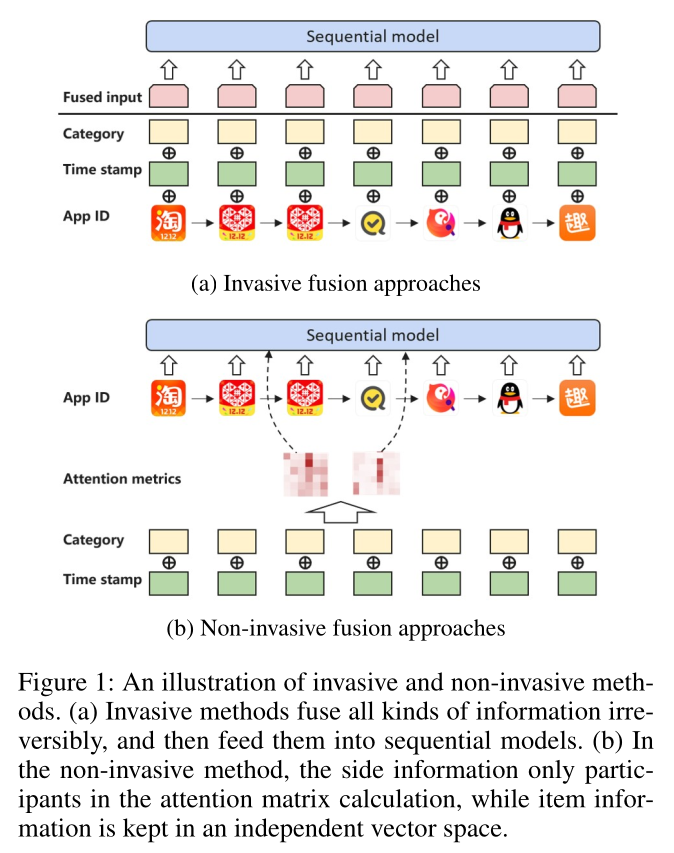
因此,在本研究中,我们研究如何在成功的
BERT框架下高效利用各种side information。我们提出一种新颖的非侵入式自注意力机制(Non-inVasive self-Attention: NOVA),它可以持续提高带有side information的预测准确率,并在我们所有实验中达到SOTA的性能。如Figure 1所示,使用NOVA时,side information作为self-attention模块的辅助,用于学习更好的注意力分布(attention distribution),而不是被融合到item representations中,后者可能导致诸如信息淹没(information overwhelming)之类的副作用。我们在实验室数据集和一个从真实应用商店收集的私有数据集上验证了NOVA-BERT设计。结果证明了所提出方法的优越性。我们的三个主要贡献是:我们提出
NOVA-BERT框架,它可以为序列推荐任务高效采用各种side information。我们还提出非侵入式自注意力(
non-invasive self-attention: NOVA)机制,这是一种新颖的设计,使self-attention能够用于复合的序列数据。进行了详细实验和部署以证明
NOVA-BERT的有效性。我们还加入了可视化分析以获得更好的可解释性。
核心思想:使用所有信息(包括
side information,item ID)来生成attention matrix,但是value projection仅仅作用在id representation上。细节部分主要集中在如何生成attention matrix。
1.1 相关工作
推荐系统的技术已经发展了很长时间。最近,研究人员倾向于在推荐系统领域采用神经网络,因为它们具有强大的能力(
《Deep learning-based sequential recommender systems: Concepts, algorithms, and evaluations》)。此外,在DNN中,趋势也从CNN转向RNN,然后转向Transformer(《Attention is all you need》)。基于Transformer的模型之一BERT(《Bert: Pre-training of deep bidirectional transformers for language understanding》)被认为是一种先进的序列神经网络,因为它具有双向自注意力机制。《BERT4Rec: Sequential recommendation with bidirectional encoder representations from transformer》通过达到SOTA性能证明了BERT的优越性。在序列推荐领域,充分利用
side information以提高准确率也是一个长期讨论的话题。如Table 1所示,在CNN、RNN、注意力模型和BERT等不同框架下,若干先前工作尝试利用side information。尽管如此,大多数工作在使用side information时,没有过多研究side information应该如何添加。几乎所有工作都使用一种我们称为 “侵入式” 融合('invasive' fusion)的简单实践。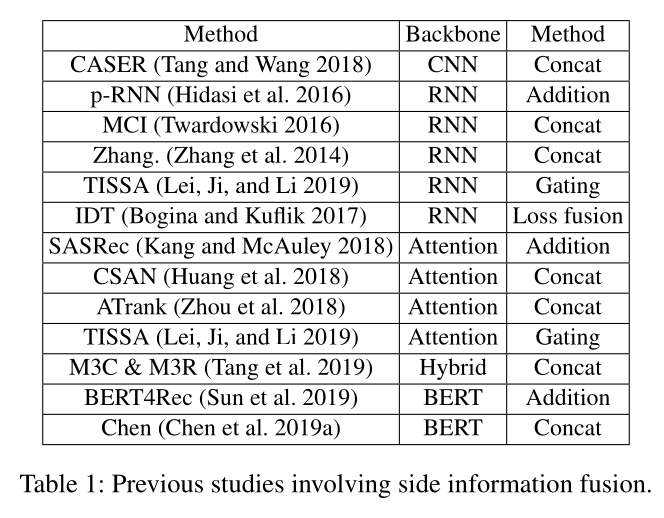
侵入式方法(
Invasive approaches):大多数先前工作,如《Parallel recurrent neural network architectures for feature-rich session-based recommendations》,直接将side information融合到item representations中,如Figure 1(a)所示。它们通常使用fusing操作(例如summation、concatenation、gated sum)将额外信息与item ID信息合并,然后将mixture馈入神经网络。我们称这种直接合并实践为"invasive approaches",因为它们改变了original representations。如
Table 1所示,先前的CNN和RNN工作已经尝试通过concatenation和addition等操作直接将side information融合到item embeddings中来利用side information。其他一些工作,如GRU(《TiSSA: A Time Slice Self-Attention Approach for Modeling Sequential User Behaviors》)和《Parallel recurrent neural network architectures for feature-rich session-based recommendations》,提出了更复杂的feature fusion gate机制和其他训练技巧,试图使feature selection成为可学习的过程。然而,根据他们的实验结果,简单方法无法在各种场景下有效利用丰富的side information。尽管《Parallel recurrent neural network architectures for feature-rich session-based recommendations》通过为每种side information部署并行的子网络从而提高了预测准确率,但模型变得笨重且不灵活。另一项研究
《Incorporating Dwell Time in Session-Based Recommendations with Recurrent Neural Networks》没有直接改变item embeddings,而是通过称为item boosting的技巧将停留时间(dwell time)纳入RNN模型。总体思想是让loss function感知停留时间。用户看一个item的时间越长,他/她就越感兴趣。然而,这个技巧严重依赖启发式方法,并且仅限于behavior-related side information。另一方面,一些item-related side information(例如价格)描述item的内在特征,它们不像停留时间,不能轻易被这种方法利用。
1.2 方法
在本节中,我们详细介绍研究领域和我们的方法。
首先,我们说明研究问题并解释
side information、BERT和自注意力。然后,我们提出我们的非侵入式自注意力和不同的融合操作。
最后,我们说明
NOVA-BERT模型。我们将非侵入式自注意力(NOn-inVasive self-Attention)简称为NOVA。
1.2.1 问题陈述
给定用户与系统的
historical interactions,序列推荐任务询问下一个将被交互的item,或下一个将被做出的action。令historical interactions可以表示为一个按时间顺序排列的序列:其中:
behavior)(例如,下载一个APP)。当只有一种类型的actions且没有side information时,每次interaction可以简单地由一个item ID来表示:其中
item的ID。items的词汇表(vocabulary)。items的总数。给定用户的历史
next item:.
1.2.2 Side Information
Side information可以是任何为recommendations提供额外有用信息的内容,可以分为两种类型:item-related或behavior-related。Item-related side information是内在的,除了item ID之外还描述item本身(例如,价格、生产日期、生产者)。Behavior-related side information与用户发起的interaction绑定,例如action类型(例如,purchase、rate)、执行时间、或user feedback scores。每个interaction的顺序(即原始BERT中的position ID)也可以被视为一种behavior-related side information。
如果包含
side information,一次interaction变为:其中:
interaction的一个behavior-related side information。一共有behavior-related side information。item,包含一个ID和若干item-related side informationitem-related side information。
Item-related side information是静态的,存储每个particular item的内在特征。因此词汇表可以重写为:目标仍然是预测
next item’s ID:其中:
behavior-related side information,如果考虑behavior-related side information的话。注意:无论
behavior-related side information是被假设的还是被忽略的,模型仍然应该能够预测next item。
1.2.3 BERT and Invasive Self-attention
BERT4Rec(《BERT4Rec: Sequential recommendation with bidirectional encoder representations from transformer》)首次将BERT框架用于序列推荐任务,达到了SOTA性能。如Figure 2所示,在BERT框架下,items被表示为向量,称为embedings。在训练期间,一些items被随机掩码,BERT模型将尝试使用multi-head self-attention机制(《Attention is all you need》)恢复它们的vector representations,从而恢复item IDs:其中:
softmax函数,query, key, value派生而来的组件。
BERT遵循encoder-decoder设计,为input sequence中的每个item生成contextual representation。BERT采用embedding layer存储item。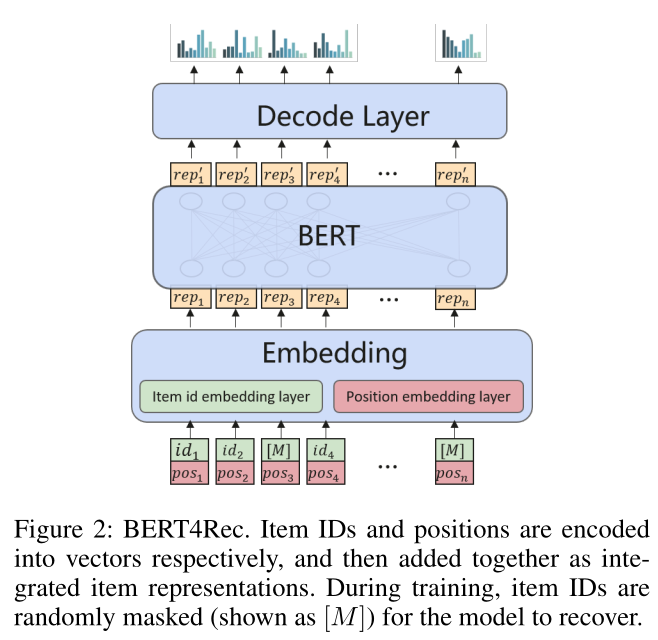
为了利用
side information,像《BERT4Rec: Sequential recommendation with bidirectional encoder representations from transformer》、《Behavior sequence transformer for e-commerce recommendation in Alibaba》这样的传统方法使用单独的embedding layers将side information编码为向量,然后使用fusion functionID embeddings中。这种侵入式方法将side information注入到原始embeddings中,并生成a mixed representation:其中:
interaction的integrated embedding。embedding layer。
The sequence of the integrated embeddings被馈入模型,作为the input of user history。BERT框架将通过self-attention机制逐层更新representations:在原始
BERT(《Bert: Pre-training of deep bidirectional transformers for language understanding》)和Transformer(《Attention is all you need》)中,self-attention操作是位置不变的函数。因此,a position embedding被添加到每个item embedding中以显式地编码位置信息。Position embeddings也可以被视为一种behavior-related side information(即interaction的顺序)。从这个角度来看,原始BERT也将positional information作为唯一的side information,使用加法作为fusion function
1.2.4 Non-invasive Self-attention (NOVA)
如果我们端到端地考虑
BERT框架,它是一个带有堆叠自注意力层(stacked self-attention layers)的一个自编码器(auto-encoder)。相同的embedding map同时用于编码item IDs和解码restored vector representations。因此,我们认为侵入式方法具有复合嵌入空间(compound embedding space)的缺点,因为item IDs与other side information不可逆地融合。混合来自IDs和other side information的信息可能会使模型不必要地难以解码item IDs。相应地,我们提出一种新颖的方法,称为非侵入式自注意力(
non-invasive self-attention: NOVA),以保持embedding space的一致性,同时利用side information更有效地建模序列。其思想是修改self-attention机制,并仔细控制self-attention组件的信息来源,即querykeyvalue1.2.3节中定义的integrated embeddingNOVA还保留一个pure ID embeddings的分支:因此,对于
NOVA,user history现在由两组representations组成:pure ID embeddings和integrated embeddings:NOVA从integrated embeddingspure item ID embeddingsbatch size,embedding size(即,NOVA可以形式化为:其中
其中:
NOVA与侵入式side information fusing方式的比较如Figure 3所示。逐层来看,沿NOVA layers的representation保持在一个一致的向量空间the context of item IDs纯粹形成。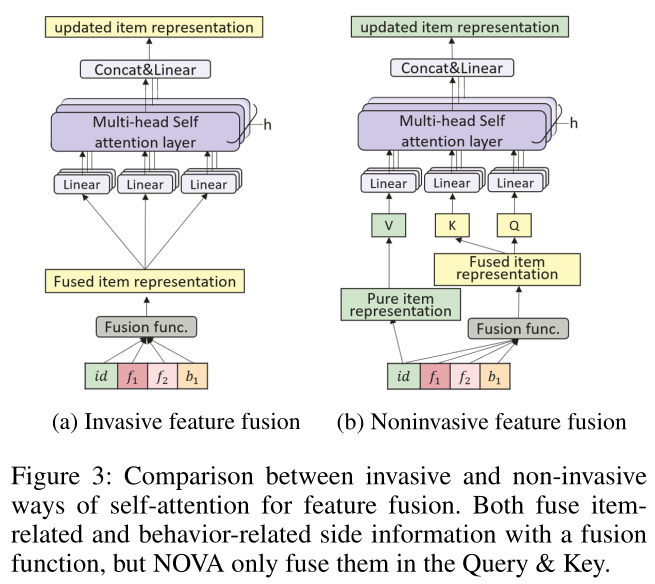
1.2.5 Fusion Operations
NOVA以不同于侵入式方法的方式利用side information,将其视为an auxiliary,并使用fusion functionside information融合到Keys和Queries中。在本研究中,我们还研究了不同种类的fusion function及其性能。如上所述,位置信息也是一种
behavior-related side information,原始BERT使用直接的加法操作利用它:此外,我们定义
'concat' fusor来拼接所有side information,随后接一个全连接层以统一维度:其中:
受
《TiSSA: A Time Slice Self-Attention Approach for Modeling Sequential User Behaviors》启发,我们还设计了一种带有trainable coefficients的gating fusor,trainable coefficients是从context中导出的:其中:
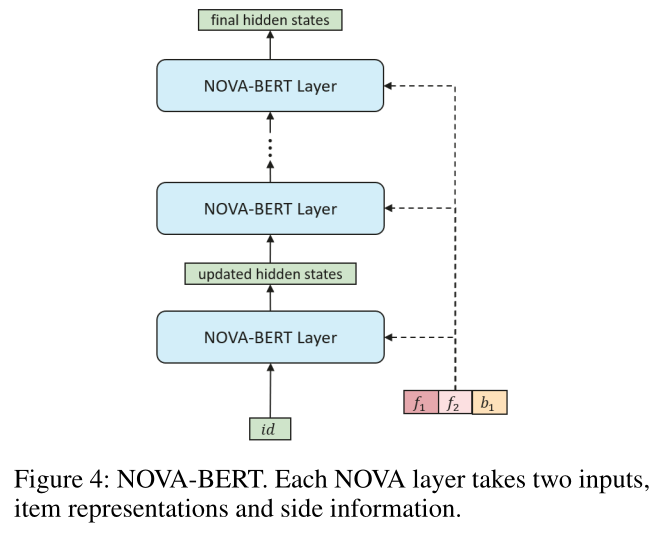
1.2.6 NOVA-BERT
如
Figure 4所示,我们在BERT框架下使用所提出的NOVA操作来实现NOVA-BERT模型。每个NOVA layer接受两个输入:the supplementary side information、the sequences of item representations,然后输出相同形状的updated representations,这些updated representations将被馈入下一层。对于第一层的输入,
item representations是pure item ID embeddings。由于我们仅使用side information作为辅助来学习更好的注意力分布,side information不会沿NOVA layer传播。相同的一组side information被显式地提供给每个NOVA layers。NOVA-BERT遵循《Bert: Pre-training of deep bidirectional transformers for language understanding》中原始BERT的架构,只是将self-attention layers替换为NOVA layers。因此,额外的参数和计算开销可以忽略不计,主要由轻量级fusion function引入。我们相信,使用
NOVA-BERT,the hidden representations被保持在相同的embedding space中,这将使解码过程成为homogeneous vector search并有利于预测。下一节的结果也从经验上验证了NOVA-BERT的有效性。注意:
对于
integrated embeddings,相同的side information被用于每一层。integrated embeddings中包含了id embedding,这个id embedding使用逐层refined ID embedding(即,“这些updated representations将被馈入下一层”)。不同的层使用相同类型的
Fusion Operations,但是参数不同。例如,如果选择使用concat融合,那么它的FC函数在每一层是不同的,就跟传统的BERT Layer一样。不同的层使用不同的
BERT Layer一样。
对于
pure ID embeddings,每一层都是用不同的id representation,后一层的input使用前一层的output。即,“这些updated representations将被馈入下一层”)
1.3 实验
在本节中,我们在公开数据集和私有数据集上评估
NOVA-BERT框架,旨在从以下方面进一步讨论NOVA-BERT:有效性:
NOVA-BERT方法是否优于传统的侵入式feature fusion方法?全面性:
NOVA-BERT的组件如何促进improvements(例如,不同类型的side information、fusion function)?可解释性:
side information如何影响注意力分布从而提高预测准确率?效率:
NOVA-BERT在未来真实世界部署中的效率如何?
数据集:我们在公开
MovieLens数据集和一个称为APP的真实世界数据集上评估我们的方法。关于数据集的详细描述请参见Table 2。我们按时间顺序对
rating/downloading records进行排序,以构建每个用户的interaction history。遵循《Self-attentive sequential recommendation》、《BERT4Rec: Sequential recommendation with bidirectional encoder representations from transformer》的做法:我们使用每个用户记录中除最后两个元素之外的前导子序列(
heading subsequence)作为训练集。序列中倒数第二个
item被用作验证集,用于调优超参数和寻找最佳checkpoint。这些序列中的最后一个元素构成测试集。
少于五个元素的短序列被丢弃,以消除冷启动问题的干扰。实验旨在聚焦
side information fusion,并与其他方法进行公平比较。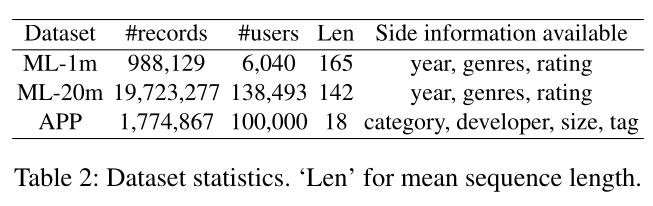
Hyper-parameter Settings:对于本研究中的所有模型,我们使用
Adam优化器来训练它们,学习率为1e-4,训练200 epochs,batch size = 128。我们固定随机数种子以减轻随机性引起的变化。学习率通过线性衰减调度器来调整,带有5%线性预热。我们还应用网格搜索以最小化实验结果的
bias。搜索空间包含三个超参数:最终,我们使用
4 heads和3 layers,以及对MovieLens数据集采用512 hidden size、对APP数据集采用256 hidden size。
评估指标:遵循
《Self-attentive sequential recommendation》,我们采用两个广泛使用的评估指标:Hit Ratio(HR@k)和Normalized Discounted Cumulative Gain (NDCG@k),其中item给出预测分数,表示推荐程度。一些实践,例如
《BERT4Rec: Sequential recommendation with bidirectional encoder representations from transformer》,使用较小的candidate set,例如ground truth item加上100个随机采样的negative items,negative items的概率与流行度成比例。在试点实验中,我们发现这种做法可能导致严重bias。例如,冷门的ground-truth item在other negative candidates中很明显,而这些negative candidates是因为高流行度而被抽取的。模型倾向于利用宽松的指标(loose metric)。因此,我们使用ranking-all metric重新运行基线。
1.3.1 实验结果
如前所述,
《BERT4Rec: Sequential recommendation with bidirectional encoder representations from transformer》已经证明了BERT框架在广泛场景范围内的卓越性能。因此,在本文中,我们选择他们的SOTA方法作为基线,并聚焦于在BERT框架下利用side information。我们还检查了加法、拼接和门控的融合函数。在
Table 3中,NOVA-BERT在三个数据集和所有指标上都优于所有其他方法。与仅利用position ID的Bert4Rec相比,侵入式方法使用了几种side information,但改进非常有限甚至不利。相反,NOVA-BERT可以有效利用side information,并稳定地优于所有其他方法。然而,
NOVA带来的改进在不同数据集上规模不同。在我们的实验中,对于更大、更稠密的数据集,改进的效果减小。对于
ML-1m任务,NOVA with gating fuser在HR@10上比基线高出13.51%,而所有侵入式方法都比基线表现更差。然而,在
ML-20M和APP任务中,非侵入式方法带来的相对改进分别降至3.19%和1.48%。
我们假设,在更丰富的语料库中,模型可能仅从
item context本身就能学习到足够好的item embeddings,留给side information进行补充的空间较小。此外,结果还证明了
NOVA-BERT的鲁棒性。无论采用何种融合函数,NOVA-BERT都能持续优于基线。最佳融合函数可能取决于数据集。一般来说,门控方法具有很强性能,可能受益于其可训练的门控机制。结果还表明,对于真实世界部署,融合函数的类型可以是一个超参数,应该根据数据集的内在属性进行调优,以达到最佳在线性能。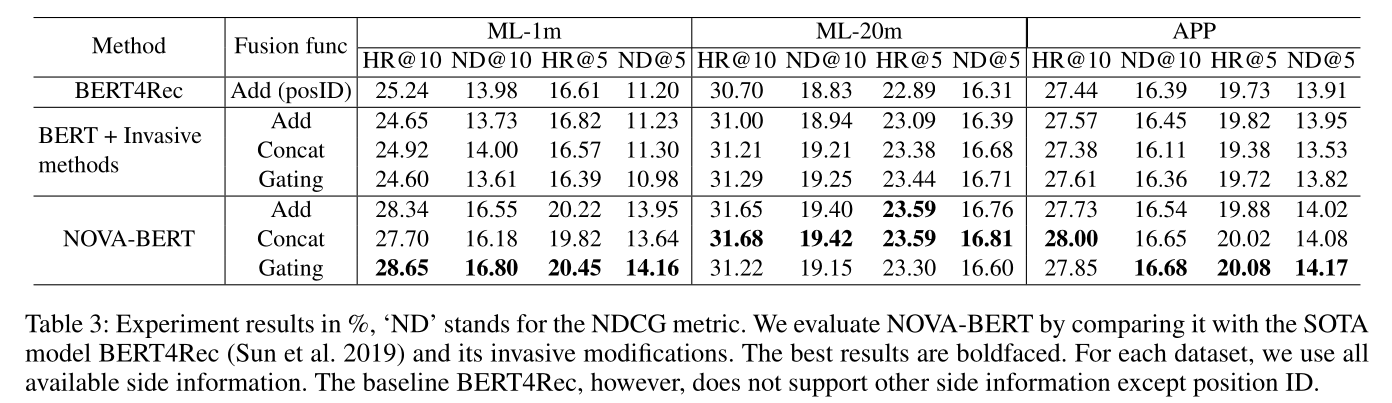
1.3.2 不同 Side Information 的贡献
在
1.2.2节中,我们将side information分类为item-related和behavior-related。我们还研究了在ML-1m任务下这两类side information的贡献。根据定义,出版年份和类别是item-related的,而rating score是behavior-related。Table 4显示了不同类型side information的结果。原始
BERT框架除position ID外不考虑其他side information,在第一行中记为None。当给出完整
side information时,NOVA-BERT呈现出最显著的改进。同时,单独来看,
item-related side information和behavior-related side information对准确率带来的好处不明显。由于
item-related side information(年份和类型)是电影的内在特征,它可能从大量data sequences中被潜在推导出来,因此导致相似的准确率。另一方面,如果
behavior-related side information也被结合,改进明显大于任一类型单独带来的改进之和。
这一观察表明,不同类型
side information带来的影响不是独立的。此外,NOVA-BERT从synthesis side information中获益更多,并且具有很强的能力利用丰富数据而不受信息淹没(information overwhelming)所困扰。在
ML-1m的情况下,comprehensive side information可以在NOVA-BERT下最大程度提升准确率。然而,有理由相信,不同类型side information的贡献也取决于数据质量。因此,我们也将side information selection视为一个数据集相关因素。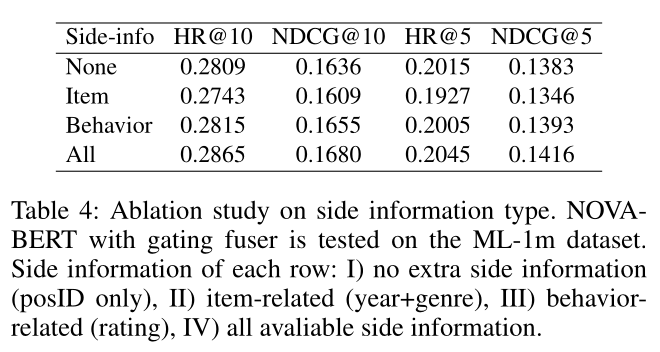
1.3.3 注意力分布的可视化
为了对
NOVA-BERT的可解释性进行更多讨论,我们可视化了bottom NOVA layer的注意力分布。在Figure 5中,我们展示了6个随机选择样本(列)的注意力分数比较,每一行代表multi-head self-attention中的一个head。每个像素表示从row item到column item的注意力强度。一行中的所有注意力分数之和为1。在
Figure 5(a)中,可视化了原始BERT4Rec模型的注意力分数。在
Figure 5(b)中,我们展示了NOVA-BERT的注意力分数。
模型被馈入所有可用类型的
side information。如图所示,
NOVA-BERT的注意力分数在局部性方面显示出更强的模式,大致沿对角线集中。另一方面,在基线模型的图中没有观察到这一点。根据我们在整个数据集上的观察,这种对比是普遍的。我们注意到,side information导致模型在early layers形成更明确的注意力。这一观察表明,NOVA-BERT将side information作为calculating attention matrix的辅助,可以学习有针对性的注意力分布,从而提高准确率。此外,我们还进行了案例研究,以更深入地了解
NOVA的注意力分布,并进行了更详细的分析。详情请参见附录。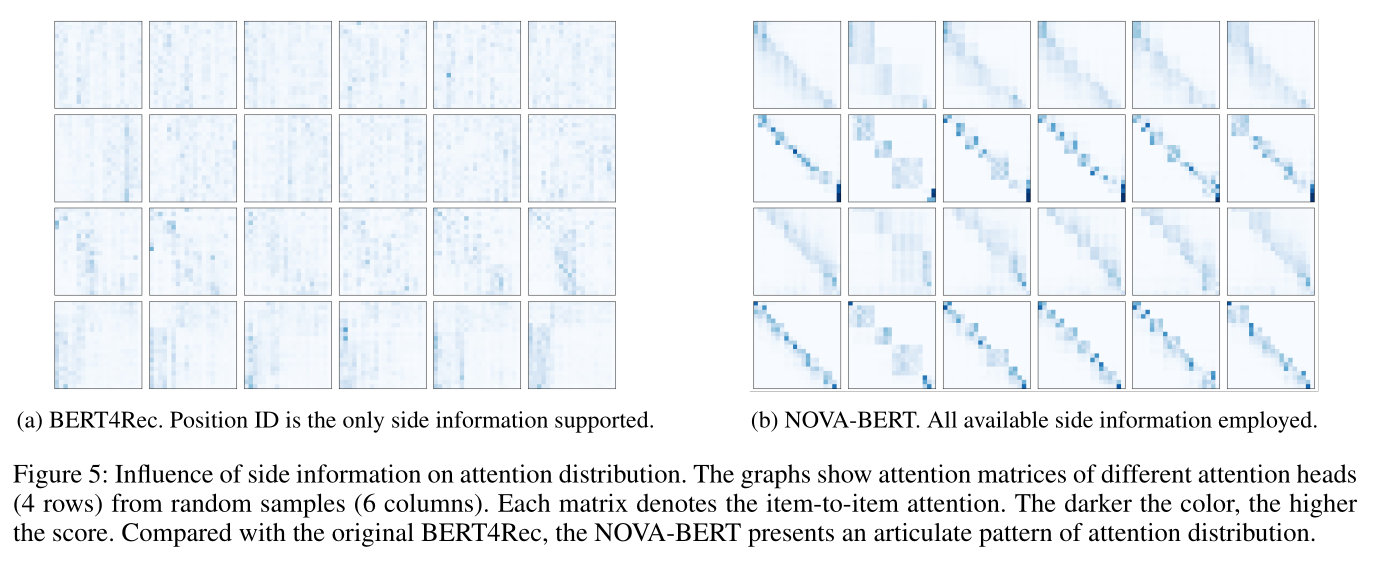
关于
NOVA注意力矩阵的更多解释:由于复杂的高维embedding space和错综复杂的网络架构,很难完全理解一个item如何以及为何关注另一个item。然而,从可视化结果中,我们发现,在提供side information的情况下,NOVA-BERT倾向于学习更结构化的注意力分数模式。由于深度神经网络的有限可解释性,我们不能断言
NOVA-BERT的注意力模式绝对更好。尽管如此,我们发现观察到的模式类似于《Revealing the dark secrets of bert》研究中的模式,该研究呈现了一种相关性:这种注意力分布与自然语言处理任务中更好性能之间的相关性。此外,NOVA-BERT在序列推荐任务中也显示出这种相关性,表明注意力确实被智能地分布。
1.4 NOVA-BERT 的部署与成本
根据我们的在线测试,
NOVA-BERT在真实世界场景中持续超越当前部署的方法。在Table 5中,列出了NOVA-BERT和部分基线模型的效率结果。我们根据FLOPs和大小来评估模型,其中 “加法” 为fusion function。如表所示,NOVA-BERT几乎没有额外计算开销,并且与侵入式方法具有相同的大小。此外,由于NOVA-BERT得到并行计算和GPU加速的良好支持,推理时间也大约与原始BERT相同。我们还声称,由于参数主要由额外embedding layers所带来,对于部署,我们可以使用look-up table来替换embedding layers,从而得到与原始BERT相似的模型大小。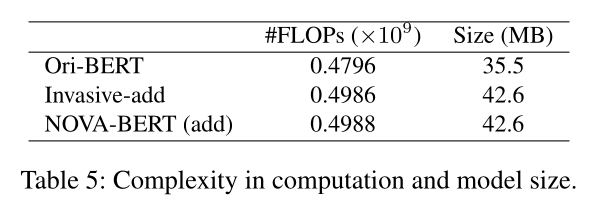
1.5 结论与未来工作
在这项工作中,我们提出了
NOVA-BERT推荐系统和非侵入式自注意力机制(non-invasive self-attention: NOVA)。所提出的NOVA机制没有将side information直接融合到item representations中,而是将side information用作方向指导,并将item representations保持在其向量空间中不被掺杂。我们在实验数据集和工业应用上评估了NOVA-BERT,以可忽略的计算和模型大小开销实现了SOTA性能。尽管所提出的方法达到了
SOTA性能,但仍有几个有趣的方向值得未来研究。例如,在每一层融合side information可能不是最佳方法,并且也期望更强的fusing functions。此外,我们将继续研究和改进我们的方法,以获得更高的在线性能,并将其部署到工业产品中。