一、ASIF [2024]
《Aligned Side Information Fusion Method for Sequential Recommendation》
将
items的上下文信息(即side information)与ID相结合,已成为提高推荐系统性能的重要途径。现有的self-attention-based side information fusion方法可分为early fusion、late fusion和hybrid fusion。在实践中:naive early fusion可能会干扰the representation of IDs,导致负面影响。而
late fusion则缺少effective interactions between IDs and side information。人们提出一些
hybrid方法来解决这些问题,但它们仅在计算attention scores时使用side information,这可能导致information loss。
为了在没有噪声干扰(
noisy interference)的情况下充分发挥side information的潜力,我们提出了一种用于sequential recommendation的Aligned Side Information Fusion: ASIF方法,由两个部分组成:Fused Attention with Untied Positions与Representation Alignment。具体来说:我们首先解耦
positions,以排除attention scores中的噪声干扰。其次,我们采用
contrastive objective来保持ID和side information之间的语义一致性(semantic consistency),然后使用正交分解(orthogonal decomposition)来提取同质部分(homogeneous parts)。
通过
aligning the representations and fusing them together,ASIF在不干扰ID的情况下充分利用了side information。在四个数据集上的离线实验结果证明了ASIF的优越性。此外,我们成功地将该模型部署在Alipay的广告系统中,在clicks和Cost Per Mille: CPM上分别获得了1.09%和1.86%的提升。Sequential recommendation在电子商务、广告和搜索系统等工业场景中发挥着重要作用,其主要目标是对用户的historical behavior进行建模,以预测用户可能感兴趣的next item。在各种解决方案中,attention-based models由于出色的性能逐渐成为主流。早期的
self-attention-based models如BERT4Rec(《BERT4Rec: Sequential recommendation with bidirectional encoder representations from transformer》)和SASRec(《Self-attentive sequential recommendation》)只考虑item IDs,缺乏捕获IDs之外item attributes的能力。当IDs频繁变化时,这种局限性变得明显。例如,在Alipay会员页面的典型推荐场景中,向用户展示可使用积分和金钱兑换的items。商品池会随着广告活动而频繁更新,导致item IDs快速变化。categories和brands等Attributes提供了用户long-term preferences的更稳定的representation。因此,我们旨在将side information纳入推荐模型以提升性能。基于
fusion locations的不同,现有的self-attention-based side information fusion方法可分为三类:early fusion、late fusion和hybrid fusion。early fusion在将ID与side information馈入attention block之前将它们融合在一起。相比之下,
late fusion在item-level sequences和feature-level sequences上分别应用分离的self-attention blocks,并在final stage才进行融合。
已有研究指出,
early fusion并不总是能提升性能,反而可能损害ID的representation,导致一种称为信息入侵(information invasion)的现象(《Noninvasive self-attention for side information fusion in sequential recommendation》)。另一方面,late fusion缺少了ID与side information之间的交互,并丢失了一些先验信息(prior information)。因此,最近出现了一些hybrid-fusion方法。它们通过在attention score calculation中纳入side information来避免信息入侵,并探索了attention correlations的有趣结构。尽管取得了显著改进,这些方法仍然存在两个局限:
(1):ID和attributes之间的correlations可能不同,有些强有些弱,这使得难以消除干扰并有效学习有意义的correlations。(2):完全将side information排除在final representation之外以防止信息入侵的方法,可能会无意中丢弃side information本身内含的关键信息。
在这项工作中,我们尝试通过减轻噪声干扰来增强
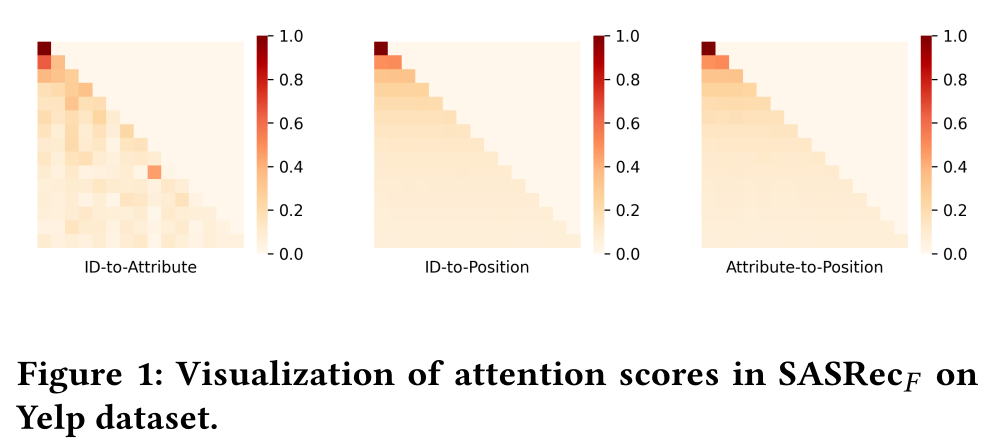
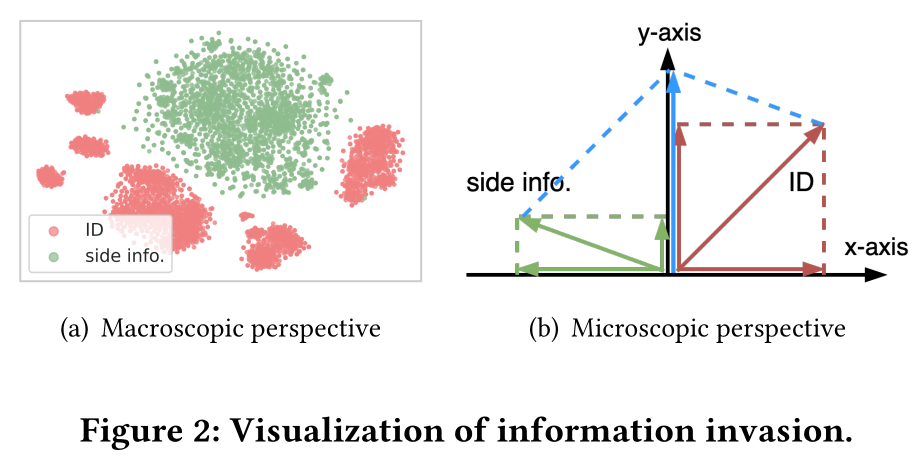
the utilization of side information。受《Rethinking Positional Encoding in Language Pre-training》启发,我们扩展了early-fusion方法the fusion form of attention scores。如Figure 1所示,ID与attributes有强关联,而position encoding与others之间的correlations相对较弱。这表明,将position作为常规side information来融合的常见方式,可能会给attention scores引入噪声。我们还检查了Yelp数据集上ID和side information的representation spaces,为information invasion提供解释。从宏观角度来看,我们可以观察到两个分布之间存在显著差异(见
Figure 2(a)),表明融合后的representation space将显著偏离original ID space。从微观角度来看,通过同时将
ID embeddings和side information embeddings投影到坐标系上,我们发现如果两者在某些轴上的方向相反,这些向量段可能会相互抵消,导致信息丢失(见Figure 2(b))。
为解决上述问题,我们提出了一种名为
Aligned Side Information Fusion: ASIF的新方法。首先,我们引入了
Fused Attention with Untied Positions,它在计算attention score时将ID-attributes与position encoding分离,消除noise interference并保留the strong correlation。其次,我们提出了
Representation Alignment,包括两个步骤:Representation Space Alignment: RSA和Homogeneous Information Extraction: HIE。RSA方法对序列内interaction粒度上的paired ID and attribute采用contrastive objective,以确保它们的语义一致性(semantic consistency)。尽管
RSA操作使两个分布更加接近,但仍然无法避免异质部分(heterogeneous parts)的存在。因此,HIE对ID和side information执行正交分解(orthogonal decomposition)以提取同质部分(homogeneous parts),从而避免信息入侵。
总之,我们的主要贡献可总结如下:
我们精心设计了
ASIF框架,基于Fused Attention With Untied Position和Representation Alignment,通过利用side information来提升推荐性能。在
Representation Alignment方面,我们提出了RSA和HIE。通过使用contrastive loss和orthogonal decomposition,我们在宏观和微观两个方面对齐了ID和side information的representation space,有效防止了信息入侵问题。离线和在线实验证明了我们提出方法的有效性。
主要技术要点:
修改了
attention计算,其中计算两个attention matrix,三次更新:考虑了
item IDs的embedding矩阵和attributes的embedding矩阵之间的对比损失。考虑将
attribute representation投影到
1.1 相关工作
Sequential Recommendation:Sequential recommendation旨在基于用户的historical behaviors来预测最有可能被交互的next item。随着近年来深度学习技术的发展,许多基于神经网络的方法开始涌现,如基于卷积神经网络(CNN)的模型(《Personalized top-n sequential recommendation via convolutional sequence embedding》、《A simple convolutional generative network for next item recommendation》)、基于循环神经网络(RNN)的模型(《Personalizing session-based recommendations with hierarchical recurrent neural networks》)、基于图神经网络(GNN)的模型(《Sequential recommendation with graph neural networks》)、和attention-based models。其中,self-attention-based的方法取得了显著进展。SASRec(《Self-attentive sequential recommendation》)将self-attention引入sequential recommendation模型以捕获long-range dependencies。BERT4Rec(《BERT4Rec: Sequential recommendation with bidirectional encoder representations from transformer》)采用完形填空目标(Cloze objective),并通过双向自注意力机制提升了性能。最近的
sequential recommendation方法也使用contrastive learning来增强数据,包括CL4SRec(《Contrastive learning for sequential recommendation》)和DuoRec(《Contrastive learning for representation degeneration problem in sequential recommendation》)。
这些工作仅利用
item ID,忽略了与item关联的其他attributes,而这些attributes可能有助于提取comprehensive sequence patterns。Side Information Fusion for Sequential Recommendation:不同于仅使用item IDs的上述方案,side information(如其他item attributes和ratings)被纳入考虑以捕获有意义的supervision signals。《S3-rec: Self-supervised learning for sequential recommendation with mutual information maximization》)注意到attributes中包含的重要信息,并设计了四个辅助的self-supervised tasks来学习内在关系(intrinsic relationship)。除了在auxiliary tasks中利用side information外,端到端的fusion方法也开始被探索。按照
multi-modal fusion的分类体系(《Multimodal fusion for multimedia analysis: a survey》、《Multi-modal machine learning: A survey and taxonomy》),我们将self-attention-based side information fusion方法分为三类:early fusion、late fusion和hybrid fusion。在
early fusion中,ID和side information在模型的shallow layers进行组合,然后馈入到网络中并生成outputs。例如,《S3-rec: Self-supervised learning for sequential recommendation with mutual information maximization》)将ID和attributes组合起来并作为input馈入到self-attention block中(见Figure 3(a))。在
late fusion中,ID和side information的网络是独立的,fusion发生在predict layer之前。FDSA(《Feature-level Deeper Self-Attention Network for Sequential Recommendation》)是late-fusion方法,它在item-level sequences和feature-level sequences分别上应用分离的self-attention blocks,并在最后阶段才拼接它们的hidden states(见Figure 3(b))。
early fusion和late fusion都有各自的局限。前者无法排除噪声干扰并可能导致信息入侵(information invasion),而后者缺乏ID与attributes之间的有效交互。Hybrid fusion介于两者之间,允许ID和side information在中间层进行交互。NOVA(《Noninvasive self-attention for side information fusion in sequential recommendation》)首次定义了naive early fusion导致的information invasion问题,并提出仅在attention scores的计算中纳入attributes来缓解它(见Figure 3(c))。然而,它将position视为常规的attribute,给mixed attention引入了噪声。此外,
DIF-SR(《Decoupled side information fusion for sequential recommendation》)将IDs and side information的attention scores解耦,允许higher-rank attention matrices和灵活的梯度(见Figure 3(d))。不幸的是,它放弃了ID和attributes之间的隐式cross-relationships。
这两种方法都仅在
attention scores中使用side information,在value matrices中完全丢弃它,这可能导致信息损失。我们的工作旨在填补这些空白,在减少噪声干扰的同时增强side information的利用。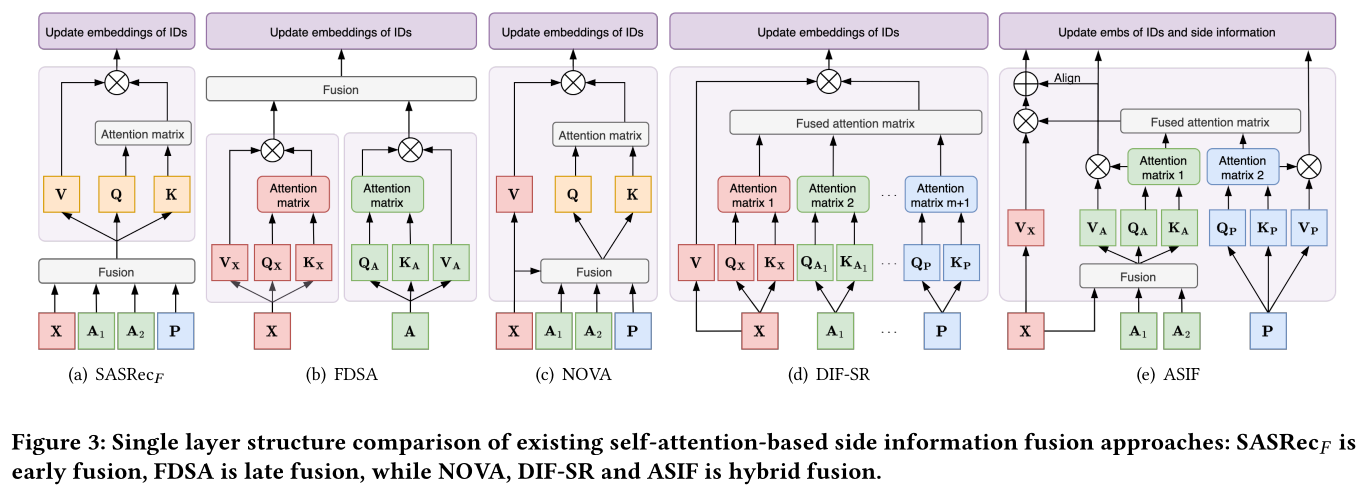
1.2 方法
ASIF的整体框架如Figure 4所示,接下来将介绍细节。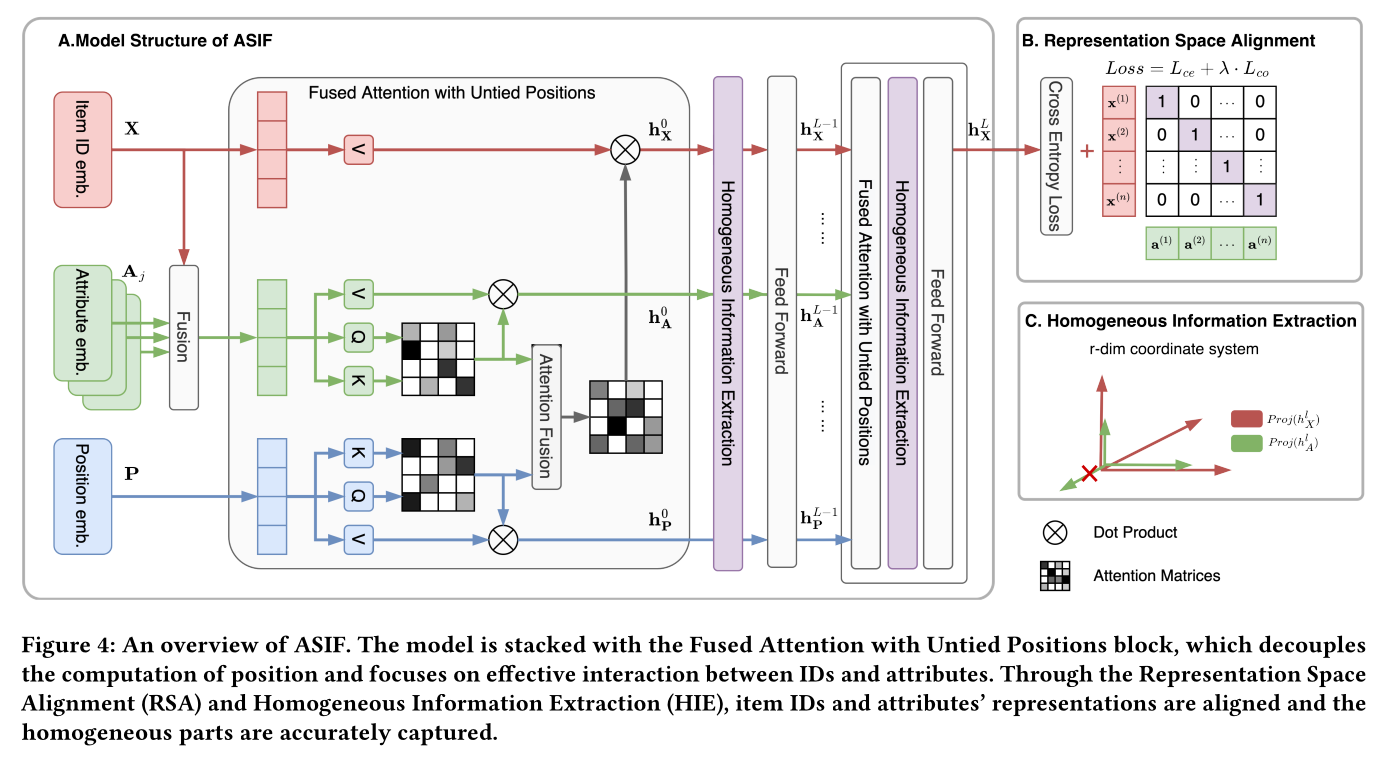
1.2.1 问题定义
在
sequential recommendation with side information中,设user set、item set、item ID set和set of the j-th type of attributes。设historical sequence of interactions,其中user interaction sequence中的第item,side information,则item ID,给
interaction historysequential recommendation的目标是预测用户next item。它可以形式化为:对于用户all candidate items上的概率:.
1.2.2 Fused Attention with Untied Positions
对于
attention-based models,纳入side information的朴素方式是将其与item ID融合并馈入到attention block中(见Figure 3(a))。NOVA遵循此结构但将side information从value matrix中排除(见Figure 3(c)),而DIF-SR建议对多种side information representations和IDs representations采用decoupled attention calculation(见Figure 3(d)),以确保灵活的梯度。然而,根据
Figure 1,ID与attributes有强关联性(strong relationship);但position encoding与IDs and attributes的关联性较弱,这可能使得position encoding不适合与其他项进行融合。因此,我们提出了Fused Attention (FA) with Untied Positions (UP)(见Figure 3(e))。设
item IDs的embedding matrices和item attributes的embedding matrices,我们首先将它们融合并计算correlation matrix:其中:
fusion函数,例如:
接下来,我们计算
position encoding的correlation matrix为:其中:
absolute position embedding matrix。
然后,我们融合两个
correlation matrices并得到最终的注意力公式如下:其中:
item IDs的hidden state。这里的
correlation matrices通过加法来融合。最后,我们认为
side information足够重要,值得充分学习,因此我们也在不同的Transformer layers之间传递和更新它们,如下所示:其中:
attributes和hidden states和positions的hidden states。
Item Fused Representation、position representation,它们作为第一层的.
1.2.3 Representation Alignment
从宏观和微观角度来看,入侵现象(
invasion phenomenon)的发生可能分别源于过度的分布偏差(distribution deviation)和向量偏移(vector offset)。为解决此问题,我们提出了Representation Space Alignment: RSA和Homogeneous Information Extraction: HIE来对齐the representations of IDs and attributes。RSA的目标是缩小item IDs和attributes这两者representation space的并集,以提高interaction粒度上的semantic consistency(见Figure 5(a))。即,尽可能让这二者的
representation space重叠起来。HIE提取attributes中与item IDs同质的信息,并将其融合到IDs representation中(见Figure 5(b))。
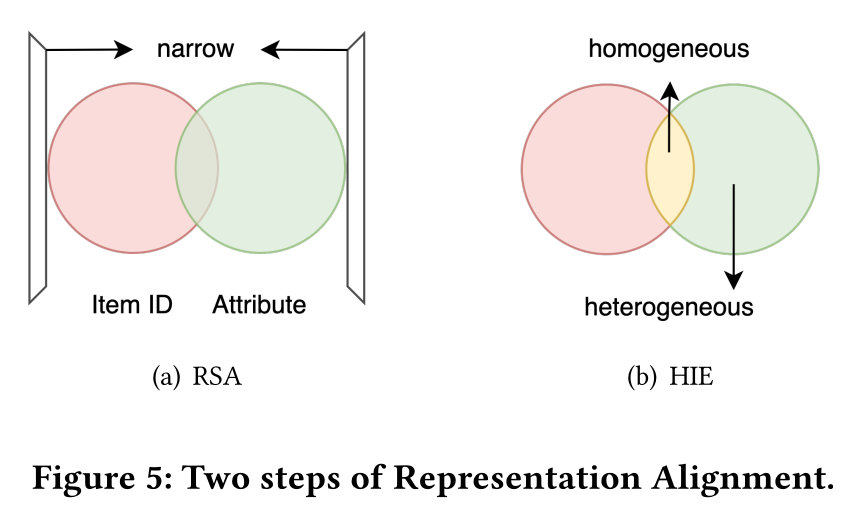
Representation Space Alignment: RSA:受CLIP的alignment operation(Learning transferable visual models from natural language supervision》)的启发,我们利用对比损失(contrastive loss)来对齐item IDs和attributes的embedding spaces,旨在使两个分布更加接近(见Figure 5(a))。然而,与CLIP不同的是,我们的alignment发生在序列内的interaction粒度上,而不是样本粒度上。具体来说,item IDs的embedding矩阵和attributes的embedding矩阵:其中:
item ID embdding和attribute embedding。接下来,我们计算两个
embeddings之间的余弦相似度以得到final matching scores如下:其中:
最后,我们计算
contrastive loss,形式如下:其中:
ground truth,它是一个单位矩阵paired item IDs and attributes是正例。
这里的
embedding table上进行,而不是在每一层的id representationattribute representationHomogeneous Information Extraction: HIE:space alignment使两个分布更接近,但仍然无法避免heterogeneous part的存在。因此,我们提出对每一层的hidden states进行正交分解以提取homogeneous parts(见Figure 5(b))。直观上,如果
an attribute's representation与an ID's representation的方向相同,则应最大程度地保留它。否则,可能存在冲突,应将其丢弃。因此,我们需要一个comparison粒度,该坐标系需要充分容纳a user's interaction sequence中所有的IDs' representations。具体来说,我们首先对
ID的hidden state进行QR分解:其中:
然后,我们将两个
hidden states都映射到coordinate matrices),如下所示:其中:
因此我们可以得到
homogeneous part其中:
indicator function),如果值大于0则输出1,否则输出0。
为什么不考虑
negative部分,即:0时输出1、小于0时输出-1?这是因为HIE的目标不是 “完整保留属性信息”,而是只抽取属性中与ID同质的、同向的那部分信息,用来补充ID representation。因此negative分量按定义就是异质的或冲突的分量,应该被丢弃,而不是翻转为-1后继续融合。由于
item representation中,公式由于用户的平均序列长度通常小于
QR分解前的参数冗余。QR分解的原始复杂度2ms延迟。此外,
QR分解在数学上大多数是可导的,现代深度学习框架也支持其反向传播:只要representation不共线)。
1.3 Model Prediction and Learning
经过
Transformer结构后,我们得到item ID的final hidden stateprediction score为:其中:
candidate item matrix。position的item representation,那么prediction。在训练期间,这就是自回归训练:训练时对多个历史位置分别做next-item监督。但是,在推理时只用最后一个位置的prediction。对于序列推荐任务,我们采用交叉熵损失函数:
其中:
ground truth和预测概率。最后,结合
RSA中的contrastive loss,我们定义带balance coefficient.
1.4 离线实验
在本节中,设计了离线实验来评估
ASIF的性能和有效性。数据集:我们在三个公开数据集和一个工业数据集上进行实验:
Yelp数据集是一个知名的商业推荐数据集。Category of business和position被视为side information。Amazon Beauty数据集收集自Amazon评论数据集。Category of the goods和position信息作为补充的属性。AliEC是Alibaba提供的Taobao展示广告数据集。我们使用category和position作为side information。Industrial dataset收集自Alipay商业广告系统中的一个场景,经过脱敏和加密处理,不包含任何个人可识别信息(Personal Identifiable Information: PII)。position以及item’s entity(如category和brand)被用作side information。
遵循相同的数据预处理方式(
《Self-attentive sequential recommendation》、《Decoupled side information fusion for sequential recommendation》、《S3-rec: Self-supervised learning for sequential recommendation with mutual information maximization》),我们移除公开数据集中出现次数少于五次的全部items和users。对于industrial dataset,由于item IDs频繁更新,我们保留所有出现过的users和items。所有处理后数据集的统计信息汇总于table 1。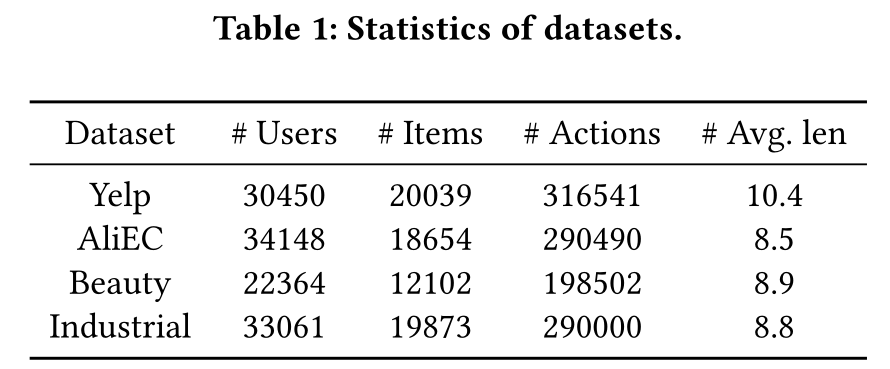
Baseline方法:我们将我们的模型与以下SOTA的序列推荐方法进行比较。Methods without side information:我们采用如下模型作为基线:GRU-based的模型GRU4Rec(《Session-based recommendations with recurrent neural networks》)。self-attention-base的模型BERT4Rec(《BERT4Rec: Sequential recommendation with bidirectional encoder representations from transformer》)、SASRec(《Self-attentive sequential recommendation》)、LightSANs(《Lighter and better: low-rank decomposed self-attention networks for next-item recommendation》)。CNN-based的模型Caser(《Personalized top-n sequential recommendation via convolutional sequence embedding》)。MLP-based的模型FMLP(《Filter-enhanced MLP is all you need for sequential recommendation》)。
Naive early-fusion methods:GRU4Rec、SASRec、LightSANs和FMLP的naive early-fusion变体,它们在馈入网络之前先将ID和side information融合在一起。Advanced self-attention-based side information fusion methods:我们包括late-fusion方法FDSA(《Feature-level Deeper Self-Attention Network for Sequential Recommendation》)、hybrid-fusion方法NOVA(《Noninvasive self-attention for side information fusion in sequential recommendation》)和DIF-SR(《Decoupled side information fusion for sequential recommendation》),它们与我们的工作高度相关。为了公平比较,我们按照(《Decoupled side information fusion for sequential recommendation》)中的方式基于SASRec实现NOVA。其他相关方法:
CL4SRec(《Contrastive learning for sequential recommendation》)和DuoRec(《Contrastive learning for representation degeneration problem in sequential recommendation》)是使用contrastive learning objectives的序列推荐模型。
评估指标:遵循先前工作(
《Self-attentive sequential recommendation》、《Decoupled side information fusion for sequential recommendation》),采用leave-one-out策略进行评估。对于每个用户序列,我们使用the last item进行测试,the second last item进行验证,其余items用于训练。模型以full ranking manner进行评估,如(《Lighter and better: low-rank decomposed self-attention networks for next-item recommendation》、《Noninvasive self-attention for side information fusion in sequential recommendation》、《Decoupled side information fusion for sequential recommendation》)中所做,而非negative sampling,后者常因bias而受批评(《A Case Study on Sampling Strategies for Evaluating Neural Sequential Item Recommendation Models》、《On sampled metrics for item recommendation》)。我们采用两个广泛使用的指标:top-K Hit Rate: HR@K和top-K Normalized Discounted Cumulative Gain: NDCG@K,其中K = {10, 20}。实现细节:我们在开源推荐框架
Recbole(《Recbole: Towards a unified, comprehensive and efficient framework for recommendation algorithms》)上运行所有模型,并使用相同的设置进行评估。我们将所有数据集的最大序列长度设为
50,embedding size设为256。所有网络都是
3层、4 heads,采用Adam优化器,训练200 epochs,batch size = 2048,学习率为1e-4。side information fusion methods的fusion函数在sum、concat和gating中搜索。对于其他超参数,我们遵循先前论文中提到的最佳设置。
1.4.1 性能比较
整体性能:
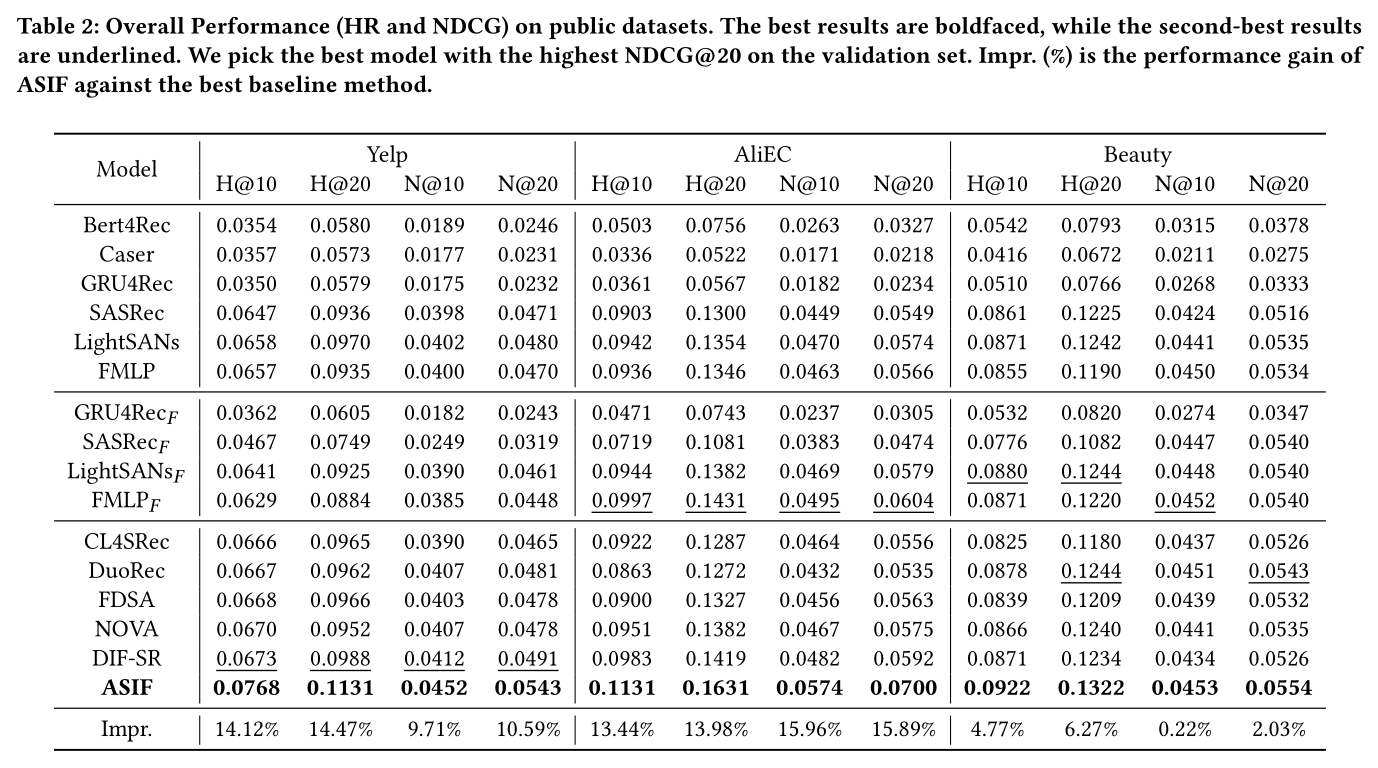
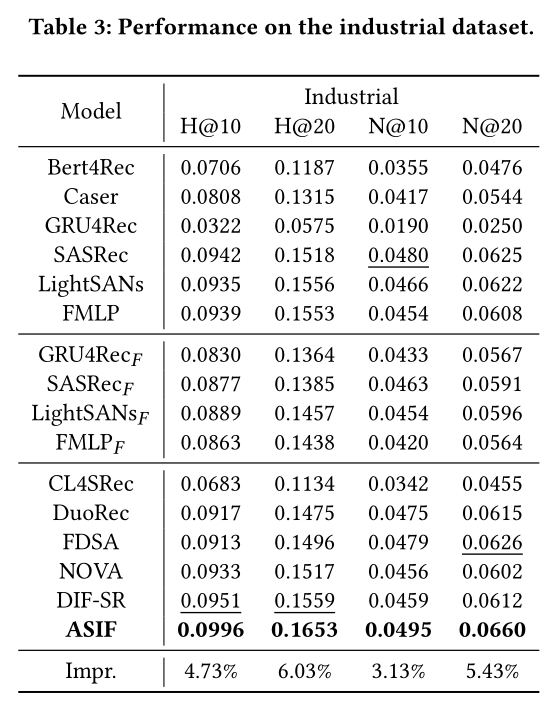
Table 2和Table 3报告了三个公开数据集和一个工业数据集的整体性能。我们可以从四个方面观察到:(1):符合直觉的是,一些fusion方法比仅使用ID的方法表现更好,表明side information可以通过捕获更好的sequence patterns来提升模型性能。这强调了side information fusion工作的重要性。(2):相反,在普通自注意力框架下,side information,但在所有数据集上与SASRec相比都带来了显著的下降,表明self-attention-based naive early-fusion方法确实存在信息入侵(information invasion)。(3):NOVA和DIF-SR经过精心设计以缓解invasion现象,因此取得了比SASRec更好的结果。同时,我们注意到,由于FDSA将ID和feature分成两个通道导致缺乏interaction,其效果并不显著优于NOVA和DIF-SR。(4):可以清楚地看到,ASIF在所有数据集上都取得了显著优于其他SOTA基线方法的结果。这些结果证明了ASIF在消除噪声干扰(noisy interference)、以及解决side information fusion中的information invasion问题方面的效率和有效性。
消融研究:我们通过消融研究分析了
ASIF每个组件的有效性。Table 4显示了ASIF及其消融版本在三个公开数据集上的性能。w/o Representation Space Alignment (RSA):我们禁用contrastive loss以验证RSA的有效性。显著的下降意味着:适当地使两个空间更接近有助于缓解invasion现象,从而提升性能。w/o Homogeneous Information Extraction (HIE):没有HIE组件,attributes信息和position信息仅仅参与attention scores的计算,而不是直接集成到the hidden state of item representation中。在这种情况下,所有数据集上的指标均下降。w/o Untied Positions (UP):此版本移除了独立的position channel,并将position视为普通的attribute。可以观察到,position encoding与其他项之间的交互增加了噪声,导致性能下降。w/o Fused Attention (FA):我们将IDs and attributes的correlation calculation解耦,即各自学习其自身的correlation matrix。结果显示大多数指标下降。这意味着保留IDs与attributes之间的交叉性(intersectionality)是必要的。即移除
在
Table 4中,ASIF的四个消融版本均显著优于RSA和HIE是ASIF中最有效的组件,证明side information中确实存在有效信息,应将其仔细地融入item representation中。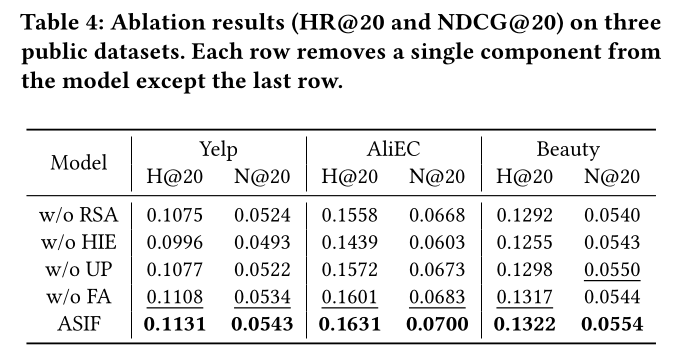
超参数研究:
loss balance参数prediction loss和contrastive loss的平衡。Figure 6中报告了在三个数据集上对于
Beauty数据集,性能在不同而在
Yelp和AliEC数据集上,我们的ASIF在
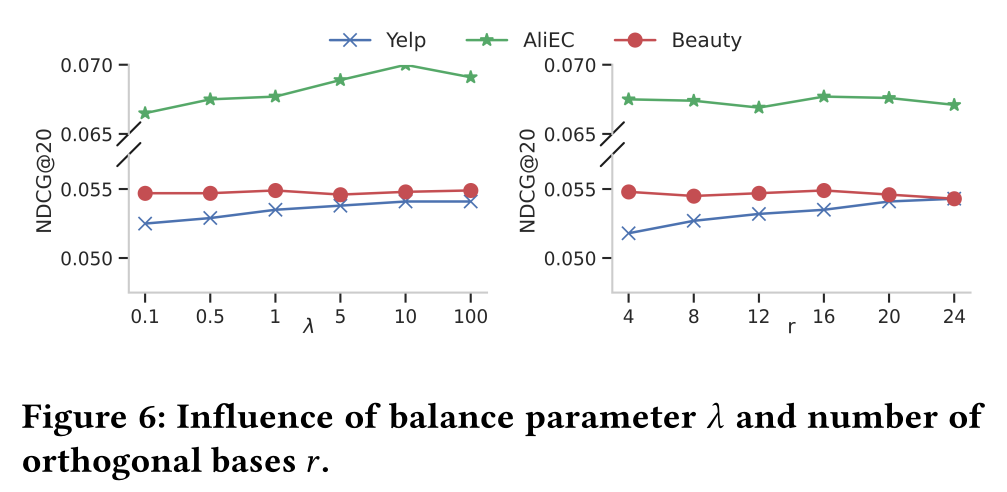
正交基的数量
ASIF随基数量Figure 6中。较大的基数量通常意味着更精细的正交分解粒度。然而,更精细的粒度并不总是意味着更好。如我们所见,三个公开数据集的最佳正交基数量大约在
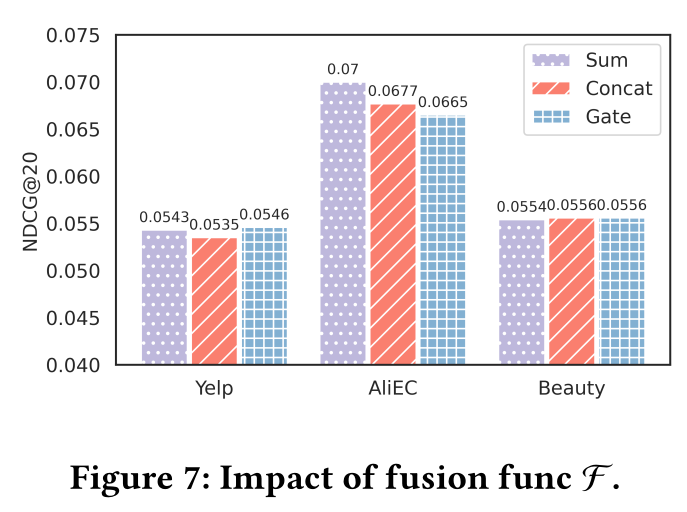
16到24之间。fusion functionSum、Concat和Gate的性能。Figure 7展示了结果,显示采用所有三种融合函数的ASIF都优于文中所提的SOTA基线。这凸显了ASIF的稳健性和优越性。加法融合的效果更好。这里采用加法。
案例研究:为了对
ASIF的可解释性进行更多讨论,我们使用与Figure 1中ASIF的correlations。如Figure 8所示,ID-to-ID、ID-to-Attribute、以及Attribute-to-Attribute的correlations显示出强模式,表明ASIF在排除position encoding的噪声干扰后具有更好的捕获数据间关联的能力。此外,我们在
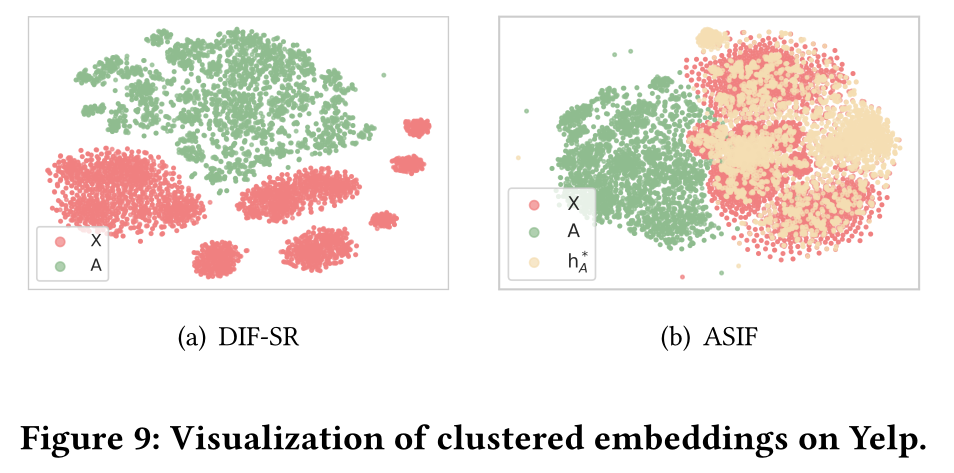
Figure 9(b)中可视化了Yelp数据集上ASIF的clustered embeddings。与Figure 9(a)中DIF-SR的和Figure 2(a)中ID和side information的representation spaces在对齐后更加接近;然后经过Homogeneous Information Extraction后,the homogeneous part基本上与ID representation对齐了。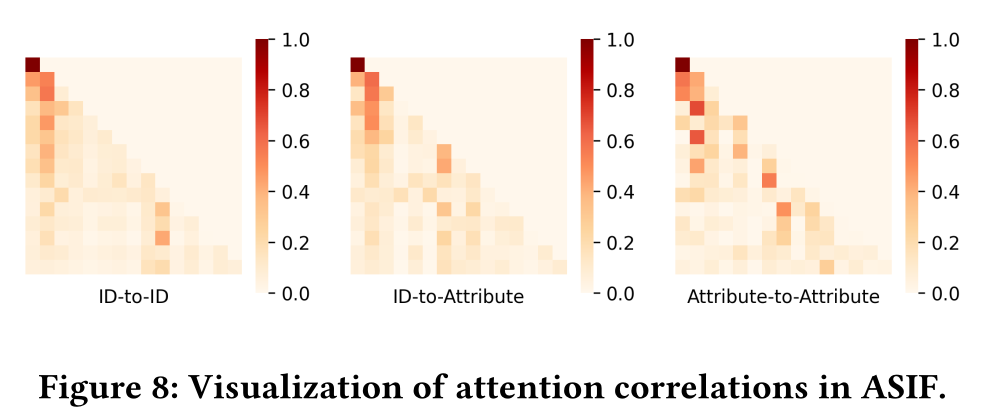
1.5 在线部署
在在线广告系统中,点击率(
Click-Through Rate: CTR)prediction任务是重要组成部分,负责预测用户点击candidate items的概率。Xlight是Alipay中的流量平台,为小程序商家等提供广告服务。为了进一步验证所提模型ASIF的有效性,我们将其部署到如Figure 10所示的广告系统中。在Alipay的会员场景中,大多数广告是真实商品,以积分加现金的形式向用户销售。为了使
ASIF充分发挥其在side information fusion方面的优越性,我们选择商品的类别和品牌作为该场景中被推荐items的side information。对于离线训练,
ASIF收集过去7天内的recent click samples作为训练数据集。对于在线服务,当用户访问会员页面时,系统会从
online feature service platform发起对user’s historical behavior的请求,截断长度为50。
ASIF将对从广告池中检索到的部分广告估算pCTR。在Xlight的实时竞价和排序系统中,每个广告将根据其Effective Cost Per Mille: eCPM进行排序,eCPM基于pCTR和bid来估算。因此,CTR的准确预估对Xlight平台至关重要。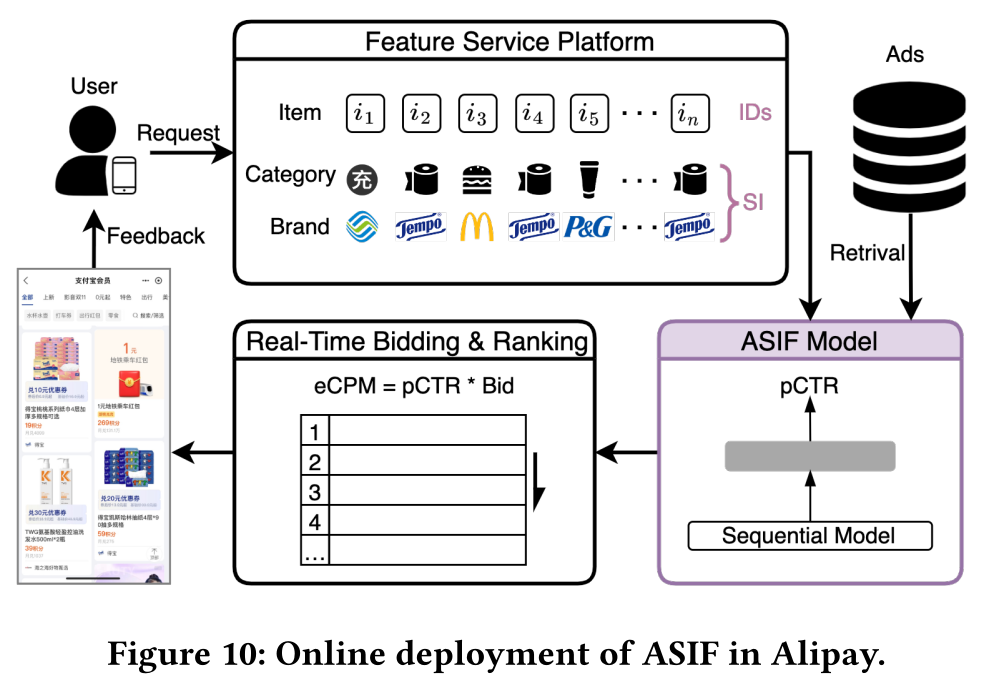
由于工业限制,无法在线比较所有基线模型。因此,我们选择
SASRec作为基线模型进行比较。经过两周的在线A/B测试,我们的模型将点击量提高了1.09%,并在Cost Per Mille: CPM上实现了1.86%的显著增长。同时,它使多日online AUC提升了0.97%,且额外计算成本可忽略不计(p99 latency 2ms)。总之,结合离线评估,ASIF在真实工业场景中表现出强大的性能。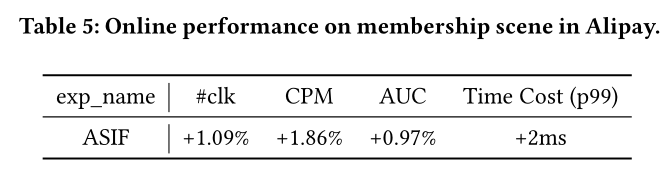
1.6 结论
在本文中,我们提出了一种用于序列推荐中
side information fusion的新方法ASIF。我们的方法解决了mixed embedding space中噪声干扰(noisy interference)和信息入侵(information invasion)的挑战。具体来说:我们首先引入了
Fused Attention with Untied Positions,它单独计算position correlations,以避免mixed attention scores中的噪声干扰。其次,我们提出了
Representation Alignment,包括RSA和HIE,以解决信息入侵问题。RSA使用contrastive objective来对齐IDs embedding space和attributes embedding space,以提高它们在interaction level上的语义一致性。HIE采用正交分解提取属性中的homogeneous part,然后将其集成到item representation中,进一步增强the utilization of side information。
通过大量实验,我们证明了我们提出的方法在
side information fusion方面超越了以往的方法,可视化和消融实验证明了其合理性。在Alipay广告系统上的在线A/B测试显示,ASIF在点击量上获得了1.09%的提升,在CPM上获得了1.86%的提升。在未来的研究中,我们旨在进一步改进denoising技术,并探索自动化的方法来增强the utilization for side information fusion。