一、 IAT [2026]
《IAT: Instance-As-Token Compression for Historical User Sequence Modeling in Industrial Recommender Systems》
尽管复杂的
sequence modeling范式在推荐系统中取得了显著成功,但手工设计的sequential features的信息容量限制了性能上限。为了更好地通过encoding historical interaction patterns来提升用户体验,本文提出了一种新颖的两阶段sequence modeling框架,称为Instance-As-Token: IAT。IAT的第一阶段将每个historical interaction instance的所有特征压缩成一个统一的instance embedding,该embedding将interaction characteristics编码到一个紧凑但信息丰富的token。我们提出了时间顺序(temporal-order)和用户顺序(user-order)两种压缩方案,后者更能满足下游sequence modeling的需求。第二阶段涉及下游任务通过时间戳(
timestamps)来获取固定长度的compressed instance tokens,并采用标准的sequence modeling方法来学习长期偏好模式(long-range preferences patterns)。
大量实验表明,
IAT显著优于SOTA的方法,并展现出优越的in-domain、cross-domain的可迁移性。IAT已成功部署在真实的工业推荐系统中,包括电子商务广告、商场营销(shopping mall marketing)、以及直播电子商务,在关键业务指标上带来了显著提升。在现代推荐系统中,
modeling short-term and long-term interaction sequences已被广泛证明可以提高推荐效果和用户满意度。Figure 1左侧展示了ranking models的主流架构。现有研究主要聚焦于设计更复杂的modeling范式,为超长序列构建高效的架构,提出sequential features与non-sequential features之间增强feature interaction的机制,以及在推荐系统中验证scaling laws和generative retrieval。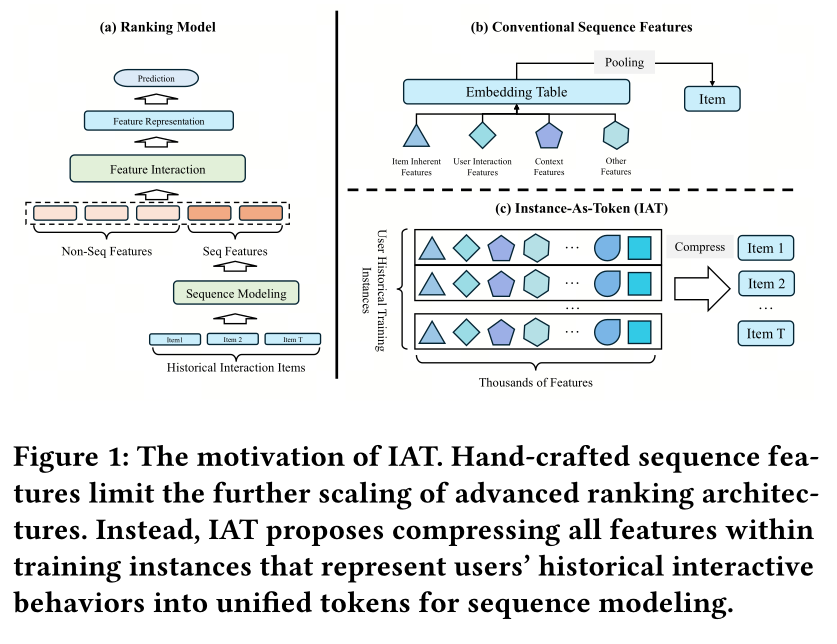
然而,这些努力主要关注于
high-level model design,仍然依赖于low-level sequential feature engineering方法。现有的sequential features通常源自一组手工设计的特征,如Figure 1(b)所示,包括inherent item features(如price、category)、user-item interaction features(如interaction type、frequency)和context features(如timestamp)。一方面,存储、传输和计算方面的
resource constraints使得大规模构建此类手工特征变得困难,细粒度特征被排除在外,导致sparse feature representations和建模性能下降。另一方面,
sequential feature engineering——包括特征设计、开发和验证——通常涉及长周期,导致feature expansion的高昂的工业成本(industrial costs)。
这两个方面限制了
historical interaction sequences中的信息密度,并进一步阻碍了现代架构的effective scaling。为解决上述问题并更好地促进
upper interaction modules的学习过程,我们提出了一种侧重于enhancing the information capacity of sequences的新颖的sequence modeling框架。其动机是利用一个稠密的且信息丰富的embedding来表示a specific historical interaction,而不是依赖于手工设计的特征,其中手工设计的特征携带sparse and limited information,如Figure 1 (c)所示。现代工业推荐系统中的training instances可以全面地描述historical interaction patterns,通常包含数千个特征。我们的目标是将historical training instances of a user压缩成dense representations,并将这些representations用作下游sequence modeling的tokens。该框架被命名为Instance-As-Token: IAT,由以下两个阶段组成。IAT Compression:此阶段通过特定的Compression机制为每个training instance生成紧凑的instance embedding: InsEmb。作为一个直观的解决方案,我们通过将compression layer和decompression layer应用于a base model的final feature representation来训练一个temporal-order source model,并将intermediate compressed representations存储为InsEmb。除此之外,我们进一步提出了
user-order source model,该模型按用户顺序来组织training instances,并引入了一个Source Instance Transformer: SIT模块来完成sequence modeling过程。SIT显著提升了source model的性能,同时为generated InsEmb赋予sequence modeling capability,因此在应用于下游模型时展现出卓越的performance transferability。一些用于描述
historical training instances的补充特征(例如,multi-task labels)可以选择性地与generated InsEmb一起存储。IAT Sequence Modeling:此阶段在下游模型中检索stored informative InsEmb和可选的key features,这些特征被聚合为Instance Tokens: InsToken。为了避免未来信息泄露,retrieved InsTokens根据request timestamp被严格截断。然后,可以采用现代架构,如LONGER或Transformer进行IAT sequence modeling。得益于informative InsTokens,下游模型在offline evaluations和online A/B tests中都取得了显著的性能提升。
总之,我们的主要贡献有四个方面:
(a):新颖的Sequence Feature Engineering。所提出的IAT提出了一种新颖的sequence feature engineering机制,以取代低效且效果不佳的手工特征。(b):独特且合适的IAT Compression方案。我们提出了temporal-order和user-order两种生成InsEmb的压缩方案,后者与下游模型更好地对齐。(c):完整且详细的IAT流程。我们从模型架构、streaming training pipeline、以及storage deployment流程的角度详细阐述了IAT的流程。(d):显著的性能提升。大量的离线实验验证了所提出的IAT框架的优势,在多个场景下的真实世界工业推荐系统在引入IAT后,在线指标均取得了显著提升。
核心思路就是:
先用一个
base model来进行sequence modeling,这一步跟常规方法完全相同。然后,把第一步每个
(user, timestamp, target item)得到的final representation抽取出来,作为downstream model中该用户的行为序列中,对应(user, timestamp, historical item, action_type)的item representation。
user-order source model很强大,但是它无法上线。因此,IAT的作用就是把source model的能力压缩、传递到可在线部署的下游模型中。牺牲一部分离线AUC增益,换取在线可行性和成本可控,这正是两阶段IAT框架的设计目的。但是这种做法需要存储IAT序列,引入了infra的复杂度。
1.1 相关工作
Sequence Modeling范式:behavior sequence modeling能够在推荐系统中捕获动态偏好。现有研究主要集中在几个关键方向,以提高sequence modeling的性能、效率和可扩展性。《TokenMixer-Large: Scaling Up Large Ranking Models in Industrial Recommenders》、《Wukong: Towards a scaling law for large-scale recommendation》、《Rankmixer: Scaling up ranking models in industrial recommenders》的工作增强了large-scale ranking models中的heterogeneous feature interaction。而
《HyFormer: Revisiting the Roles of Sequence Modeling and Feature Interaction in CTR Prediction》、《OneTrans: Unified Feature Interaction and Sequence Modeling with One Transformer in Industrial Recommender》的工作则实现了sequential features和non-sequential features之间的充分的information integration。《VQL: An End-to-End Context-Aware Vector Quantization Attention for Ultra-Long User Behavior Modeling》、《Twin v2: Scaling ultra-long user behavior sequence modeling for enhanced ctr prediction at kuaishou》、《Deep Multiple Quantization Network on Long Behavior Sequence for Click-Through Rate Prediction》、《HiSAC: Hierarchical Sparse Activation Compression for Ultra-long Sequence Modeling in Recommenders》的研究旨在通过高效架构设计(如clustering和sparse attention技术《Native sparse attention: Hardware-aligned and natively trainable sparse attention》)处理更长的user sequences。在推荐系统中探索
scaling laws(《Scaling laws for neural language models》)、《Scaling recommender transformers to one billion parameters》、《Climber: Toward efficient scaling laws for large recommendation models》)以及推进generative recommendation(《Onerec: Unifying retrieve and rank with generative recommender and iterative preference alignment》、《Mtgr: Industrial- scale generative recommendation framework in meituan》、《Actions speak louder than words: Trillion-parameter sequential transducers for generative recommendations》、《OneMall: One Model, More Scenarios–End-to-End Generative Recommender Family at Kuaishou E-Commerce》)的发展也是热门的研究方向。
然而,这些研究未能考虑
traditional hand-crafted sequential features有限的信息容量。Sequence Feature Engineering:low-level sequential item features所覆盖的信息容量决定了high-level recommendation model性能的上限。早期的
sequential recommendation工作仅利用ID features(《Self-attentive sequential recommendation》),而后续研究指出其他sequential features有助于捕获细粒度的偏好(《Feature-level deeper self-attention network for sequential recommendation》)。一些研究进一步提出了融合
ID features之外辅助信息的高级方法(《Sequential modeling with multiple attributes for watchlist recommendation in e-commerce》、《Aligned side information fusion method for sequential recommendation》、《Decoupled side information fusion for sequential recommendation》)。利用
items的多模态信号(multimodal signals)可以有效提高推荐系统的泛化能力,包括multimodal embedding(《LEMUR: Large scale End-to-end MUltimodal Recommendation》、《MUSE: A Simple Yet Effective Multimodal Search-Based Framework for Lifelong User Interest Modeling》)和semantic IDs(《Onerec: Unifying retrieve and rank with generative recommender and iterative preference alignment》、《Forge: Forming semantic identifiers for generative retrieval in industrial datasets》)。
然而,这些方法要么仍然依赖于手工特征,要么引入过高的开销并遭受信息错位(
information misalignment)的问题。相比之下,所提出的IAT保留了所有特征中的关键信息,同时实现了与下游任务更好的对齐。Two-Stage Ranking Frameworks:在resource usage和online latency的约束下,two-stage ranking framework可以在模型部署中实现更灵活的scaling。最近的工作(
《Exploring Scaling Laws of CTR Model for Online Performance Improvement》、《External Large Foundation Model: How to Efficiently Serve Trillions of Parameters for Online Ads Recommendation》)提出构建large teacher models作为foundation models,并利用它们的distillation signals来增强small-capacity student models的性能。HLLM(《Hllm: Enhancing sequential recommendations via hierarchical large language models for item and user modeling》)采用了a two-tier LLM model,其中第一个item LLM提取item的丰富content features,第二个user LLM在这些item features上完成sequence modeling。LLaTTE(《LLaTTE: Scaling Laws for Multi-Stage Sequence Modeling in Large-Scale Ads Recommendation》)指出semantic features是scaling的前提,并引入了一个两阶段架构,包括一个生成并缓存compressed user embeddings的上游user model。
我们提出的
IAT也采用了两阶段训练方法,其中第一阶段生成稠密的且informative的instance embedding,第二阶段利用这些embeddings实现更好的sequence modeling。
1.2 方法
1.2.1 Problem Statement
我们首先介绍一个流行的
ranking model的基本架构作为base model。我们使用小写字母表示单个instance的数据,大写字母表示a batch的数据。features通常包括sequential features和non-sequential features,分别表示为sequential features通常涵盖historical interaction behaviors,即sequential features首先由一个sequence modeling architecturenon-sequential features组合并进行deeper feature interaction,即:其中:
feature representation。click-through rate: CTR或conversion rate: CVR)如下:其中
item该模型使用二元交叉熵(
binary cross-entropy: BCE)loss进行训练:其中:
training instances集合,且
1.2.2 Overall Two-Stage IAT Framework
现有研究侧重于提高
scaling能力,而忽略了由手工设计的information bottleneck)。如Figure 1 (c)所示,一个用户的training instance通过数千个特征来完整地描述了historical interactions,这促使我们提出了Instance-As-Token: IAT——一种如Figure 2所示的新颖的sequence modeling框架。IAT包含两个阶段:(1):第一阶段(IAT Compression)。我们将两种类型的compression modules应用于base model,获得temporal-order source model或user-order source model。source models处理training instances并生成紧凑的instance embeddings: InsEmb,这些instance embeddings被存储在一个centralized repository中。此阶段将rich-feature instances压缩为低维embeddings,实现了全面实例信息(comprehensive instance information)的高效存储和传输。(2):第二阶段(IAT Sequence Modeling)。downstream models通过将InsEmb sequence与补充的关键辅助信息(complementary key side information)相结合来构建instance tokens: InsToken从而进行sequential modeling。
接下来的部分将详细说明如何基于
1.2.1节介绍的ranking model来构建source models和downstream models。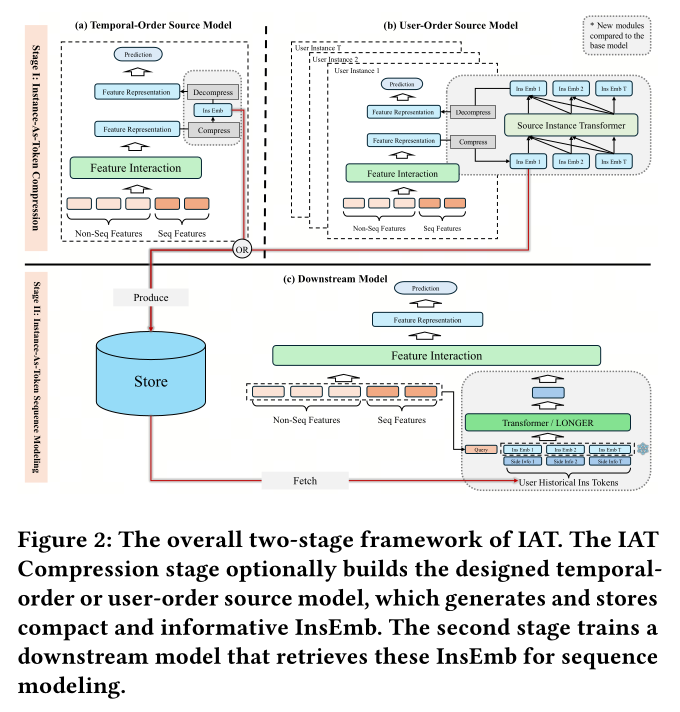
1.2.3 Stage I: IAT Compression
此阶段构建
source models以获得compressed instance representations。我们专注于key component从而用于InsEmb generation,即两种不同的压缩方案。
a. Temporal-Order Source Model
为了生成
an instance的紧凑representation,一个直观的解决方案是:简单地利用通过complex feature interaction所获得的representation,即前面公式中定义的feature representation。直接存储这样的representation不可避免地会带来过高的存储开销和传输开销。因此,我们在base ranking model中添加了一个compression layer和decompression layer。假设原始维度为compression dimension为compression module表示如下:其中:
ReLU、GELU。
feature representation,而InsEmb。InsEmb的维度远小于原始维度,即InsEmb通过一个额外的轻量级MLP进行投影以保留原始维度:其中:
然后,
decompressed feature参与final prediction和loss optimization,确保compressed InsEmb(即high-value information。该架构如Figure 2 (a)所示。
b. User-Order Source Model
值得注意的是,上述
temporal-order source model是逐个压缩training instances的,得到的InsEmb只能包含单个training instance的信息。此外,与base model相比,compression module可能会略微降低模型性能,这可能会损害所得到的InsEmb的质量。为了生成更高质量的InsEmb,我们设计了user-order source model,该模型引入了一个Source Instance Transformer: SIT,并使每个instance能够在避免未来信息泄露的同时感知同一用户的historical behaviors。User-Order Training Instances:与temporal-order source model不同,user-order source model需要重新组织training instances,以加速source model training和InsEmb generation。通常,a ranking model的training instances是根据all user behaviors的时间戳来存储和训练的。然而,这导致同一用户的historical behavior sequence items产生大量的冗余存储和计算。在batch training stage,一些近期工作提出根据user-order instances来训练模型(《Make It Long, Keep It Fast: End-to-End 10k-Sequence Modeling at Billion Scale on Douyin》、《Actions speak louder than words: Trillion-parameter sequential transducers for generative recommendations》),这显著提高了效率而没有性能下降。具体来说,我们在特定时间范围内按user ID来聚合training instances,然后根据时间顺序对每个用户的instances进行排序。在实际操作中,实际的batching策略需要根据users’ historical training instances的数量将其分割成固定长度的batches,并可选地填充dummy instances。但是,为了公式简洁,我们在下文中假设一个batch仅包含单个用户的所有historical training instances。Source Instance Transformer:假设给定的用户有historical training instances,我们将它们组织在同一个batch中,并按前面的公式获得compressed representations,记为training instances的batch size。然后,我们提出Source Instance Transformer: SIT来增强representation能力,如下所示:其中:
transformer架构。Reshape操作将整个batch的compressed representations(即items的单一序列。这items由带有causal mask functiontransformer module来处理,确保每个compressed InsEmb只能访问past instances的信息。
例如,如
Figure 2 (b)左侧所示,user instance 1是最新的training instance,它可以访问来自所有过去training instances的信息流。然后,所得到的final prediction和loss optimization。值得注意的是,我们保存SIT之前的compressed embedding(即InsEmb,而不是保存与
temporal-order source model相比,user-order source model具有以下优点:增强
Source Model的性能。SIT使得同一用户内的instances之间能够进行信息流动,这可以显著提高base model的性能,如实验研究所示。然而,temporal-order source model与base model相比可能会经历轻微的性能下降。增强
InsEmb的Sequence Modeling能力。user-order source model不仅生成紧凑且信息丰富的InsEmb,而且在SIT的帮助下隐式地提升了InsEmb的sequence modeling能力。相比之下,temporal-order source model是为每个training instance而单独压缩representations,从而失去了user-order source model的效果。
c. Training Paradigms of Source Model
我们采用了一种训练范式,它同时纳入了
batch training stage和stream training stage,后者在real-time training instances上运行。如Figure 3所示:temporal-order source model逐个压缩training instances,这与training instances的组织方式无关,在batch training stage和stream training stage保持一致。然而,如前面章节所述,user-order source model在batch training期间依赖于user-order training instances。在streaming training期间,the batch of instances通常来自不同用户,构建user-order instances较为困难。因此,我们需要在streaming stage稍微修改user-order source model的训练方法。具体来说,模型架构保持不变,但
batching strategy不同。我们将a streaming batch的compressed representations记为batch size。这instances来自不同的用户。为了获得SIT所需的historical InsEmb,我们直接从store中为每个用户检索之前的instances的InsEmb,记为SIT计算如下:其中:
stop gradient操作。SIT的concatenated inputs。
最后,我们利用
decompression layer和后续pipelines保持不变。总之,在streaming batch中,只有instances的InsEmb(即InsEmb是从store中获取的,如Figure 3 (b)所示。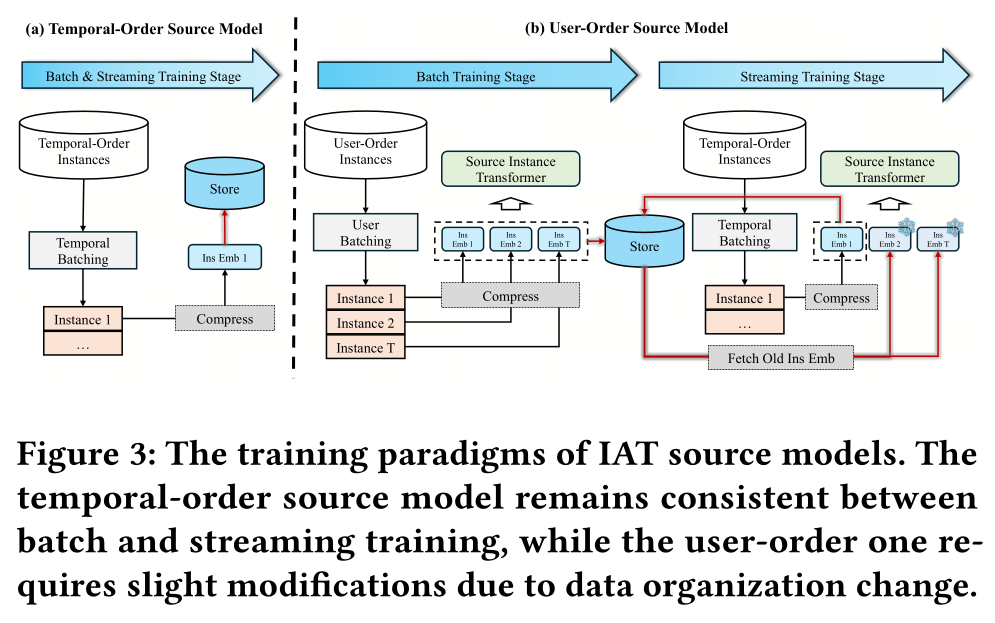
1.2.4 Stage II: IAT Sequence Modeling
在本节中,我们将详细介绍如何利用
stored InsEmb来促进下游任务。除了source models产生的信息丰富的InsEmb之外,一些core side information也可以被存储并用于sequence modeling。Core Side Information:尽管InsEmb包含了数千个特征的compressed information,但它并未显式地涵盖training instance labels、时间戳和其他task-related information。此模块根据实际场景可选地使用。side information通过常规feature engineering方法来处理,其embedding representation记为batch size,这是因为,在
IAT Compression阶段,每个target item的label是模型未知的,且需要被预测的。但是在IAT Sequence Modeling阶段,每个historical item的action_type是已知的(对应于item label)。InsEmb Adaptation Mechanism:stored InsEmb保持在低维且紧凑的空间中,应投影到高维空间以实现更好的scaling和feature space matching。因此,我们在下游模型中引入了一个adaptation MLP,从而将InsEmb与下游feature space进行对齐:其中:
adaptation MLP的参数。store中获取的历史InsEmb,其维度为
为什么要从
store中获取历史的InsEmb?因为每个InsEmb对应于一个target item,而每个target item又对应于用户的一个historical item。Instance-As-Token (IAT) Sequence:我们通过拼接InsEmb和core side information来构建IAT sequence,如下所示:其中
sequence modeling的IAT sequence embedding。Query Token Construction:IAT sequence是纯user features,而现代sequence modeling方法需要一个query token,该token包含candidate items信息以进行matching prediction。为了更好地与紧凑的InsEmb对齐,我们拼接下游模型的sequential feature tokens和non-sequential feature tokens,并将其压缩为query,即:其中:所获得的
query其他的
query token construction方法在实验中进行了研究。IAT Sequence Modeling:前面公式中获得的query tokenIAT sequence将首先被投影到相同的维度空间,然后可以根据场景需求,在下游模型中由任何主流的sequence modeling network进行建模,包括但不限于LONGER(《Longer: Scaling up long sequence modeling in industrial recommenders》)或Transformer。我们还在实验章节中进行了一些实验研究,以验证modeling results在feature interaction中的合适位置。在实践中,我们发现将
modeling results作为input token集成到upper complex feature interaction(例如,RankMixer《Rankmixer: Scaling up ranking models in industrial recommenders》、TokenMixer-Large《TokenMixer-Large: Scaling Up Large Ranking Models in Industrial Recommenders》)中可以获得最佳性能,如Figure 2 (c)所示。在
streaming training阶段,source model和down-stream model都采用实时流式更新。source model地独立更新,最新的InsEmb实时同步到下游模型,确保模型预测的时效性。
1.2.5 Storage Architecture Design
Figure 4详细说明了IAT的存储架构,包括以下步骤:(1):source model处理training instances并生成相应的InsEmb,然后以InsID为key将其写入到embedding parameter server: Emb PS。(2):同时,feature extraction module将(UID, InsID, Side Information)元组输出到一个message queue,该队列被异步保存到高性能的key-value storage system。UID指的是hashed user ID。存储系统按时间戳对InsID sequence进行排序,并将其截断为长度historical instance sequence。(3):当请求到来时,下游模型首先通过the key of UID从高性能key-value storage system中检索the sequence of InsID and Side Info。该序列根据request timestamp和一些任务相关规则进行截断。(4):通过the key of InsID list从Emb PS进一步检索InsEmb,然后按照公式IAT sequence,用于下游的sequence modeling。
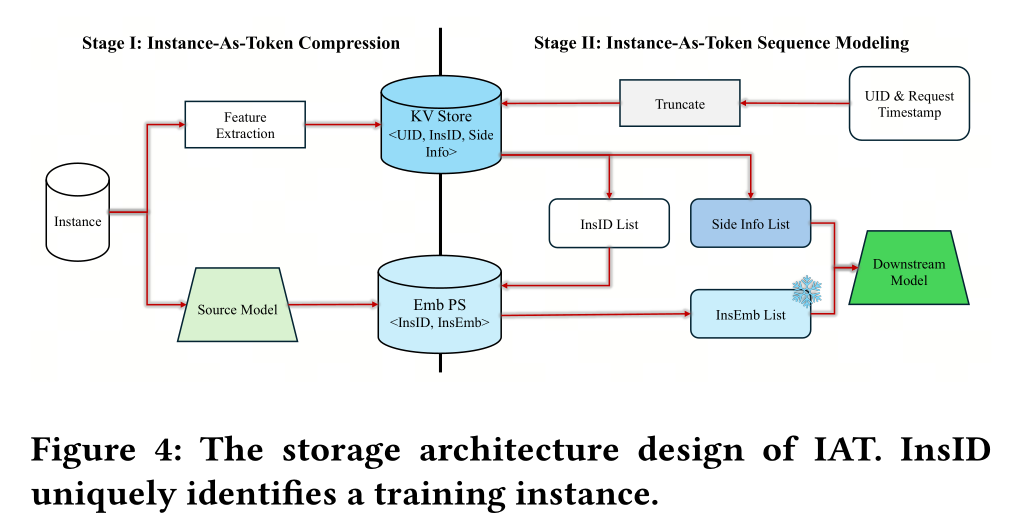
InsID的构建:InsID是training instance的唯一标识符,可以通过hashing a combination of timestamps and task-related IDs来构建,(例如,在线广告推荐系统中的request ID和creative ID)。PS存储成本估算:PS中InsEmb的存储成本是可量化和可控的。使用FP32(每个元素4 bytes)来存储InsEmb,总存储需求计算如下:其中:
training instances的数量。historical instances的保留天数。InsEmb维度。
此公式同时考虑了每日
training instances数量和历史数据保留周期,使得存储估算更符合实际工业场景。例如,存储约数亿samples per day、64维InsEmb、为期两年的数据,大约需要几十TB的存储空间。
1.3 实验
数据集:实验是在从真实世界广告系统收集的工业级
CVR prediction dataset上进行的。该数据集包含连续4个月的训练数据,training instances总数量达数百亿,代表了广告行业真实的大规模推荐场景。特征空间包括user features、item features、contextual features和traditional behavior sequence features,其中sequence features仅保留sparse core side information(例如,ID、category、action type)。所有训练数据通过移除敏感的user/item information和哈希化feature IDs进行匿名化处理,确保模型训练和评估期间没有隐私泄露的风险。baseline方法:base model架构符合Problem Statement章节的介绍,同时我们为traditional behavior sequence选择了三种主流的工业sequence modeling方法(即DIN,LONGER,Transformer),以全面验证IAT sequence的有效性和灵活性。对于所有模型的
feature interaction,我们统一采用RankMixer作为feature interaction module,以消除由不同feature fusion策略引起的差异。对于每个
base model,我们训练相应的source model和downstream model with two kinds of IAT sequence(即Temporal-Order IAT和User-Order IAT),报告它们相对于相应base model(仅具有traditional hand-crafted behavior sequence)的AUC增益。具体而言,所有实验均在具有数百个节点的分布式
GPU集群上使用batch size
评估指标:为了全面评估模型的有效性和效率,我们报告性能指标和模型效率指标。
我们采用
AUC和LogLoss作为性能指标,这些指标在工业CVR prediction任务中被广泛使用。同时,我们报告
dense parameters和training FLOPs作为主要的效率指标。
我们主要报告
downstream models的性能,在某些情况下也提供source models的指标。超参数:
在
temporal-order source model中,feature representation的原始维度(即6,000,压缩后的维度为user-order source model的压缩后的维度相同,即SIT采用2 layers of transformer,模型维度为64,intermediate size of FFN为128。读者猜测,
6000。在
user-order source model的batch training阶段,SIT的input length与batch size相同,如公式而在
streaming training阶段,我们将SIT的长度限制为256,即对于
source models,我们保存64维的compressed representation作为InsEmb,如Figure 2所示。downstream model获取InsEmb并将其适配到维度我们对公式
在下面的不同实验研究中,某些设置会略有变化。此外,
traditional behavior sequence的长度固定为512。
1.3.1 整体性能
我们首先通过将所提出的
IAT集成到三种主流的工业sequential modeling架构(即DIN,LONGER和Transformer)中,全面验证了其有效性和灵活性。我们将这些架构应用于建模base model中的traditional behavior sequences,而仅在下游模型中使用Transformer进行IAT sequence建模。在真实场景中,这三种选择是基于可用计算资源和约束条件选择的。
a. Source Models 的性能
我们分别训练了
temporal-order model和user-order model以生成两种类型的InsEmb。temporal-order source model由于引入了compression模块,AUC略有下降0.05%。同时,
user-order source model获得了0.6%的AUC增益,因为引入的SIT增强了historical user instances之间的信息流动。
这里没有图表来给出结果?
然而,
user-order source model不能直接部署用于serving,因为它会产生过高的资源成本,并且online operation面临实际限制。为什么
user-order source model不能直接部署用于serving?因为在线服务路径上会引入用户级长序列计算和大量历史状态访问。user-order source model比temporal-order多了Source Instance Transformer (SIT)。SIT的输入不是一个实例,而是同一用户的历史实例序列,形状类似B × T × D。论文中流式训练时T=256、B=1024、D=64。Transformer注意力复杂度随序列长度平方增长,在线QPS下,每个请求都要做这种用户级序列前向,计算量和显存都很难承受。
b. Downstream Models 的性能
利用这两种类型的
InsEmb,我们探索了它们提高下游模型性能的能力。下游模型的性能和效率结果总结在Table 1中,其中"+Temporal/User IAT"示我们在base model中添加了由temporal-order source model或user-order source model生成的IAT sequence。在所有三种序列架构中,集成
IAT sequence的模型始终优于其对应的base model。尽管temporal-order source model本身经历轻微的性能下降,但对下游模型AUC的提升高达0.15%,这验证了IAT sequence modeling的优势。在真实场景中,
0.1%的AUC gain被认为是显著的。根据我们的经验,直观比较,向base model中引入长度为256的手工序列(hand-crafted sequence)很难获得0.1%的AUC gain。带有
user-order IAT的模型始终获得AUC的相对提升(高达0.31%)和LogLoss的降低(高达-0.67%),同时仅伴随模型参数和FLOPs的适度增加。这些实验表明,IAT sequence在各种sequential modeling范式中都是有效的。
这里的
base model不是source model,而是下游排序模型,它包含传统的序列特征,但不包含IAT序列。“
user-order source model获得了0.6%的AUC增益“,这里的base model就是Transformer-based Base模型。它的效果反而最好。但是,由于它无法上线,因此,IAT的作用就是把source model的能力压缩、传递到可在线部署的下游模型中。牺牲一部分离线AUC增益,换取在线可行性和成本可控,这正是两阶段IAT框架的设计目的。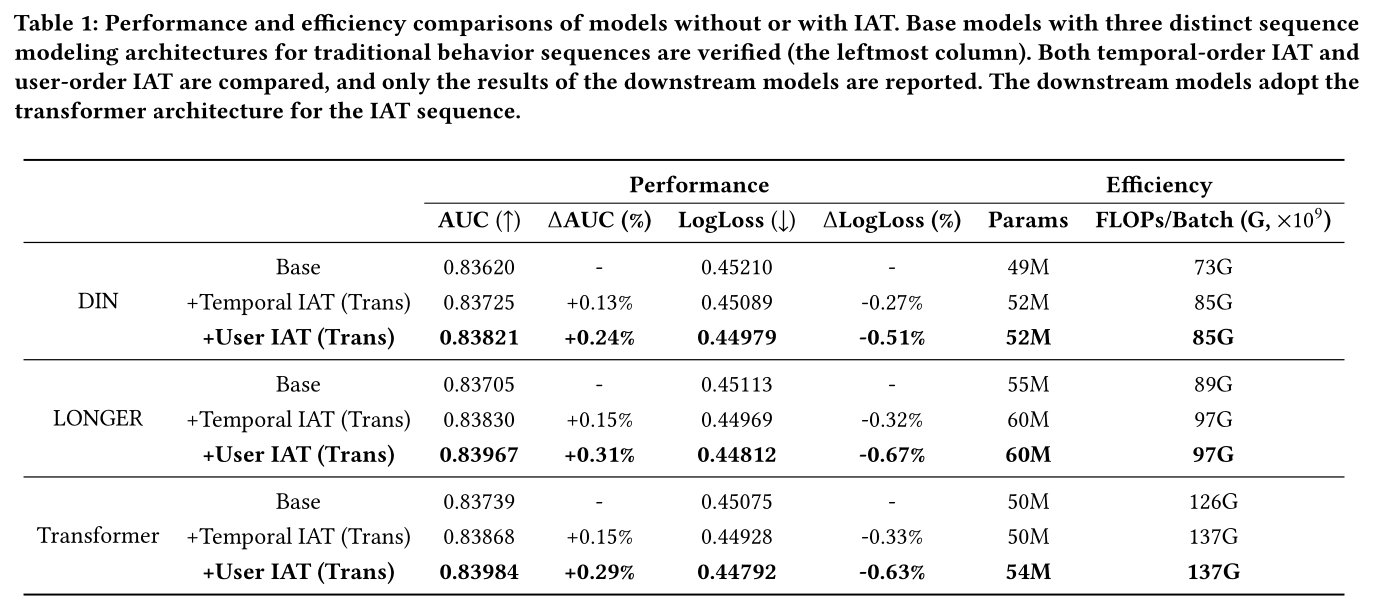
我们观察到,将
IAT sequence modeling架构与SIT in the user-order source model进行对齐可以获得更好的结果。具体来说,我们固定base model中的traditional behavior sequence由Transformer建模,并使用DIN、LONGER和Transformer分别对IAT sequence进行建模。如
Table 2所示,LONGER和Transformer带来了显著的AUC提升和LogLoss降低,而使用DIN对IAT进行建模仅带来微弱的增益。这表明modeling IAT by series of transformer architectures可能更为合适。实际上,
LONGER利用Perceiver(《Perceiver: General perception with iterative attention》)技术和其他一些模块(例如,global token、token merge)来减少繁重的计算负担,这个负担是因为Transformer对long sequence应用full attention而带来的。在随后的实验中,除非另有说明,traditional behavior sequences和IAT sequences均使用Transformer架构进行建模。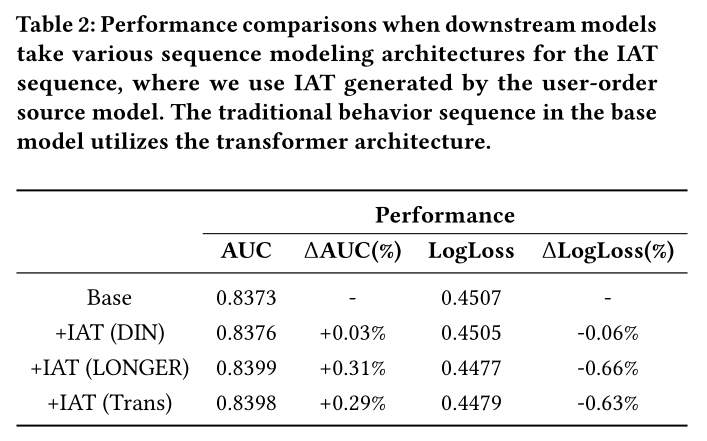
我们进一步展示了对
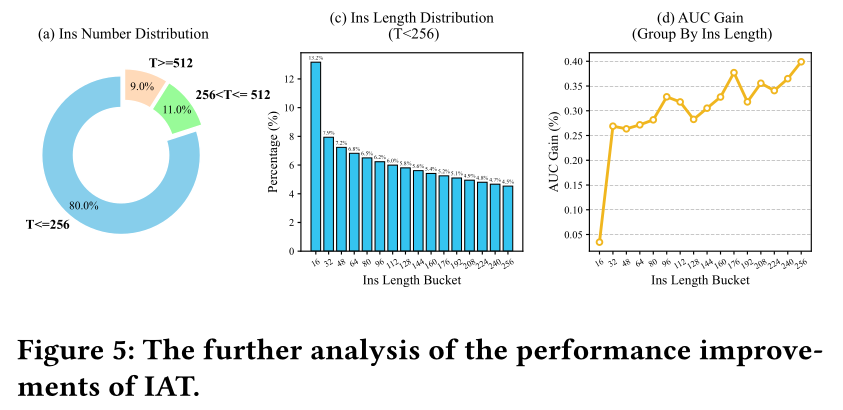
user-order IAT的AUC gain的一些分析。如
Figure 5 (a)所示,大约80%的用户拥有的historical training instances少于256个。这就是我们将下游模型的IAT sequence最大长度设置为256的原因。Figure 5 (b)显示了长度小于256的IAT sequence的实际长度分布。如
Figure 5 (c)所示,如果我们按IAT sequence长度对training instances进行分组,可以发现较长的IAT sequence会带来更显著的AUC gain,最多约为0.4 %。
1.3.2 Scaling Up Studies
Scaling Up the Base Model:所提出的IAT框架可以普遍应用于各种类型的base model。随着先进的scaling方法(《TokenMixer-Large: Scaling Up Large Ranking Models in Industrial Recommenders》、《Scaling recommender transformers to one billion parameters》)的发展,我们持续更新工业场景中的online base model,引入更多dense parameters(Dense Scaling),延长historical behavior sequence的长度(Seq. Len. Scaling),并利用更复杂的feature interaction方法进行scaling up(Feat. Int. Scaling)。结果列于Table 3。总体而言,带有
user-order IAT sequence的下游模型获得了显著的性能提升,特别是当模型scale到1B参数时,即使微小的增益也变得更加困难和有价值。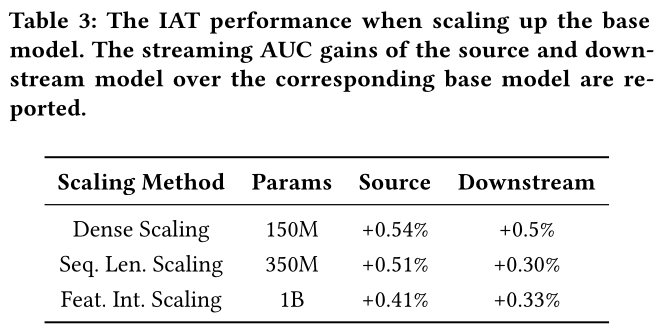
Scaling Up the Source Model:然后我们探索user-order source model中SIT的scaling up。我们用SIT的input dimension、SIT的transformer layers层数、以及下游模型中最终使用的InsEmb的compressed dimension。相对于base model的AUC gain绘制在Figure 6中。增大
InsEmb的维度、或增加transformer layers层数为source models带来了显著的增益,即AUC gain从0.52%提升到0.80%。下游模型的性能也分别得到了明显提升。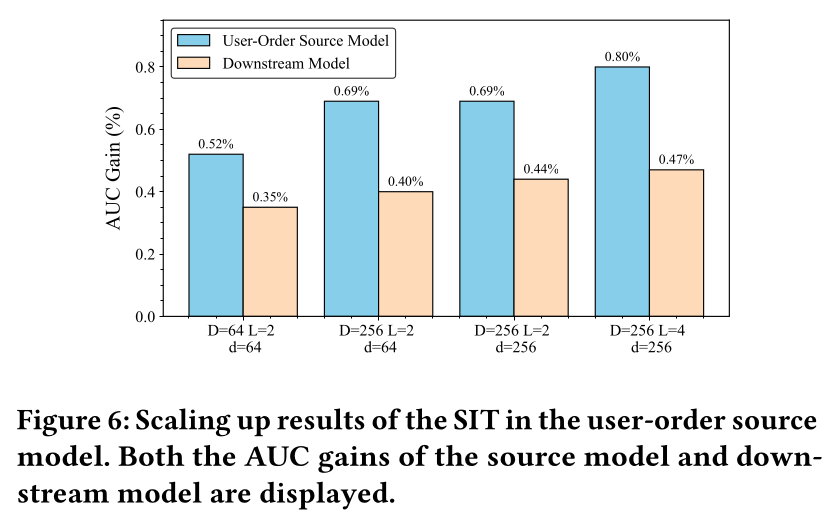
Scaling Up the Downstream Model:对于下游模型中的user-order IAT sequence modeling,我们针对不同的maximum IAT sequence length(即32、64、128、256和512)探索了transformer layers层数(即1、2和4),并绘制了AUC gain相对于maximum IAT length或FLOPs per batch的scaling law。下游模型transformer architecture的scaling符合标准的scaling law,曲线绘制在Figure 7中。值得注意的是,随着层数增加,下游模型展现出更好的scaling能力。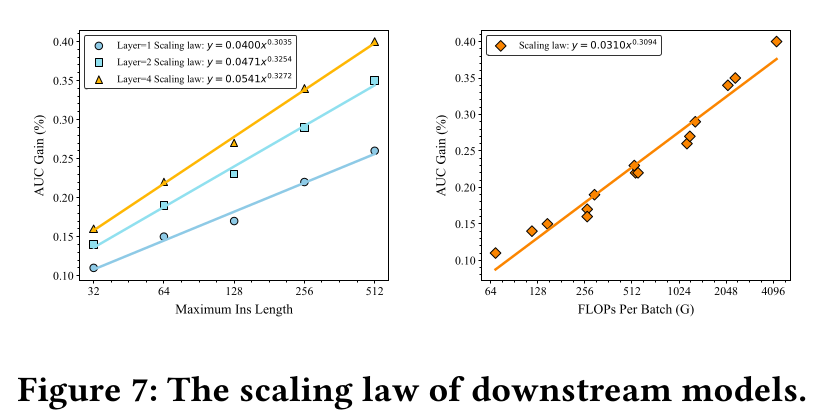
1.3.3 Ablation Studies
然后,我们在
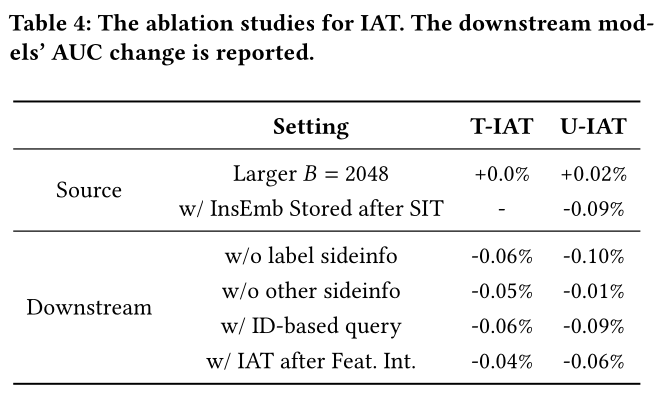
Table 4中对IAT的某些设置进行了消融研究,包括source models和downstream models的设置。对于
source models,我们首先将batch size1024改为2048,这对temporal-order IAT: T-IAT没有影响,但略微提升了user-order IAT: U-IAT的性能,因为在user-order batch training stage,一个batch可以覆盖每个用户的更多historical instances。保存
SIT模块之后的InsEmb而非之前的InsEmb会降低下游性能,因为SIT之后的InsEmb由于attention机制丢失了一些基本信息并变得更加相似。IAT sequence包含InsEmb和一些core side information: sideinfo,例如表征behavior actions的multitask labels、以及其他一些task-related side information。我们在实践中使用了5种其他类型的side information。丢弃
label side information会导致明显的AUC下降,因为InsEmb包含了关于labels of training instances的少量信息。丢弃
other sideinfo对temporal-order IAT有不良影响,但对user-order IAT的性能没有影响。
我们也尝试使用由
some ID features of a candidate构建的更简单的query,而不是compressing the sequential and non-sequential tokens(公式AUC分别下降了0.06%和0.09%。最后,我们观察到
IAT sequence modeling在下游模型中的位置也很重要,将其放置在feature interaction module(例如,RankMixer)之前,相比较于之后,可以获得更好的结果。
消融研究的更多细节列在附录中。
1.3.4 Online A/B Results
我们通过在真实世界广告场景上同时训练
temporal-order source model和user-order source model来生成IAT sequence。然后我们将所生成的IAT sequence应用于广告场景本身以及其他几个工业推荐场景。In-Domain A/B Results:将IAT sequence应用于广告场景本身展示了所提出IAT的领域内可迁移性(in-domain transferability)。核心收入指标,包括Advertiser Score: ADSS和Advertiser Value: ADVV,报告在Table 5中。base model是一个已经在线上服务了很长时间的强大的广告排序模型。显然,IAT在这些指标上带来了统计上显著的提升。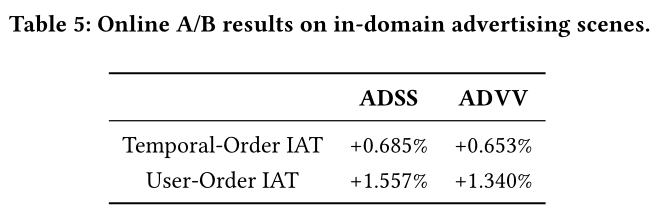
Cross-Domain A/B Results:当将所生成的IAT sequence应用于其他下游场景时,IAT也展现出了强大的泛化能力,包括商城广告的CVR prediction、信息流广告的CTR prediction和CVR prediction、非闭环广告(non-closed-loop advertising)的CVR prediction以及直播电商的CT-CVR prediction。广告的核心指标包括ADSS和ADVV,而电商场景则报告GMV。如Table 6所列,IAT在所有场景中均取得了显著的提升。这里没有说明是
User-Order IAT还是Temporal-Order IAT。读者猜测应该是User-Order IAT。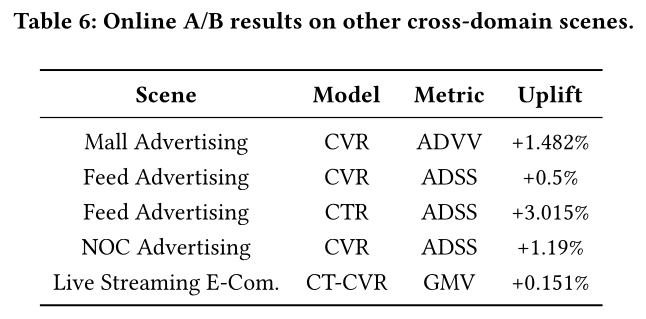
1.4 结论
我们提出了一种名为
Instance-As-Token: IAT的新型两阶段sequence modeling框架,取代了传统的手工sequence engineering。IAT的第一阶段构建一个temporal-order source model或user-order source model,将每个用户historical instances的丰富特征压缩成紧凑且信息丰富的embeddings(即InsEmb)。然后,下游阶段利用这些
InsEmb进行SOTA的sequence modeling。
大量的离线和在线实验证明了所提出的
IAT在提高模型质量和业务关键指标方面的优越性。所提出的IAT已在多个工业推荐系统中全面部署。未来的工作将进一步提高IAT的效率,包括:(1):探索单阶段框架以降低训练复杂度。(2):采用更先进的压缩技术以进一步减少存储和传输开销。
1.5 附录
A.1 消融研究细节
我们详细说明正文中介绍的消融研究如下。
在我们的场景中,除了
InsEmb之外,我们还使用一些side information,形成用于IAT sequence modeling的InsToken。side information通常包含两个部分:Label Side Information:用户的historical training instance的multi-task labels,例如,用户是否购买了clicked item。这些labels与user behaviors高度相关,而InsEmb仅压缩bottom feature representations。因此,我们将label side information视为重要特征,可以无缝地与InsEmb结合,以实现更好的sequence modeling。Other Task-Related Side Information:在我们的广告场景中,timestamps的一些类型对于sequence modeling也很重要,这些类型能够描述a user’s behavior的归因逻辑(attribution bution logic),我们也考虑了这些side information。
side information根据实际场景是可选的,side information可以由ID features来表示,并在模型中通过embedding tables进行建模。在我们的模型中,仅存储和使用此类side information的hashed values。然后,我们展示了
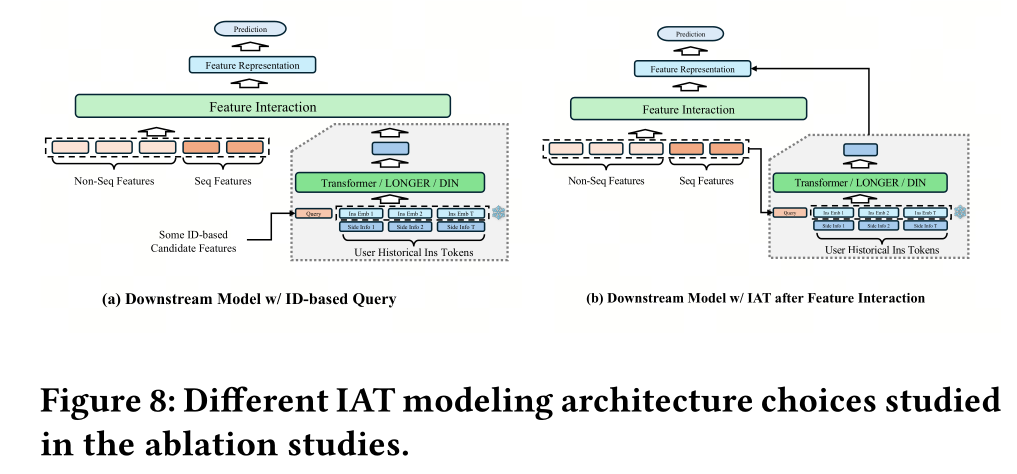
IAT sequence modeling的另外两种变体,它们分别研究了query construction和IAT position的重要性。这两种选择如Figure 8所示。然而,这两种架构都遭受明显的性能下降。首先,因为
IAT sequence中的InsToken包含信息丰富的信息,因此最好使用也涵盖informative features of the candidate的query token。其次,将
output token放置在复杂feature interaction module之前可以导致各种bottom tokens之间更全面的信息流动,这更有利。
A.2 User-Order Source Model 的流式训练
在流式训练阶段,输入到
Source Instance Transformer: SIT的是一个序列,其中最近的元素是当前实例的InsEmb(由compression layer来生成),其余元素是属于同一用户的historical instances的IInsEmb。该序列按顺序排列,当前实例的InsEmb作为第一个元素,随后是历史实例(按逆时间顺序)。SIT严格遵循因果约束,以确保每个元素只能访问过去实例的InsEmb。正文仅提供了一种获取historical InsEmb的方法,我们将在下面详细介绍另一种方法及其优缺点。为了获得
SIT所需的historical InsEmb,我们提出了两种具有不同trade-offs的实用方法:Method 1: Store Retrieval:直接从PS中检索用户之前的InsEmb(其中优点:计算成本低,速度快,适用于流式训练场景。
缺点:依赖于过去
training iterations所生成的historical InsEmb,这可能与最新的模型参数不一致。
Method 2: Recomputation:检索之前的source model的前向传播重新计算其InsEmb。优点:使用最新的模型参数重新计算
InsEmb,消除了陈旧历史值的差异,确保了高的建模准确性。具体来说,只允许对历史InsEmb进行前向传播而不进行梯度反向传播,而当前InsEmb保持正常的梯度流。缺点:显著增加了计算成本(例如,当
256倍),仅适用于具有足够计算资源或延迟要求较低的场景。
鉴于
Method 2由于historical InsEmb的重新计算而引入了过高的计算开销,我们在实践中采用Method 1(Store Retrieval)作为默认方法。
A.3 User-Order Source Model 的进一步性能增强
最后,我们考虑一种更复杂的训练方法来增强
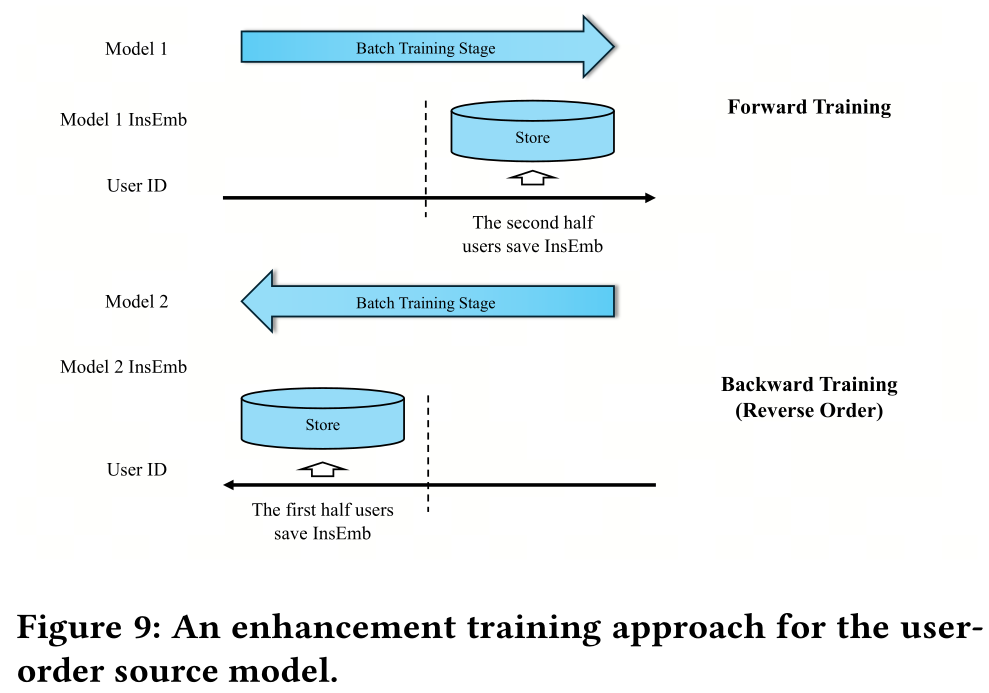
user-order source model的性能。因为在user-order source model的batch training阶段,training instances是按用户排序的,earliest trained users可能产生较弱的InsEmb,因为source model可能尚未收敛,而finally trained users’ InsEmb可能受益于收敛且更好的source model。也就是说,one-pass user-order training可能导致不同用户之间的不公平。因此,我们建议在两个独立的jobs中训练user-order source model,并在这两个jobs中采用完全相反的顺序。Figure 9提供了说明。一个模型按正常的用户顺序处理
training instances,但仅存储the InsEmb of the later user IDs。相比之下,另一个模型按相反的用户顺序处理
training instances,也仅存储the InsEmb of the later user IDs。
我们还进行了一些实验研究,以验证这种
two-pass范式的优势。one-pass user-order source model本身获得了约0.6%的AUC gain,而所提出的two-pass user-order source model进一步获得了高达0.8%的AUC gain。如果用单模型训练两个
epoches,仍然只能让一半用户在第二个epoch的训练后期生成InsEmb,另一半用户在第二个epoch的前期生成,质量仍然不均匀。