一、 LLaTTE [2026]
《LLaTTE: Scaling Laws for Multi-Stage Sequence Modeling in Large-Scale Ads Recommendation》
我们提出了
LLaTTE(LLM-Style Latent Transformers for Temporal Events),一种用于production ads recommendation的scalable transformer架构。通过系统性实验,我们证明了推荐系统中的sequence modeling遵循与LLM类似的predictable power-law scaling。至关重要的是,我们发现semantic features改变了scaling curve:它们是scaling的一个前提条件(prerequisite),使模型能够有效利用deeper and longer architectures的容量。为了在严格的latency constraints下实现continued scaling的收益,我们引入了一种两阶段架构,将large, long-context models的heavy computation卸载到异步的upstream user model。我们证明了upstream improvements可预测地迁移到downstream ranking tasks。作为Meta部署的largest user model,这种multi-stage framework在Facebook Feed和Reels上带来了4.3%的conversion提升,且serving开销极小,为在工业推荐系统中利用scaling laws建立了一个实用的蓝图。sequence modeling和recommendation systems的融合为人工智能开辟了新的前沿。现代推荐系统,特别是在广告和内容平台中,每天处理数十亿次user interactions,因为每个用户在产品、广告和内容中的旅程形成了一个丰富的时间序列,编码了user preferences和user intent。虽然大型语言模型(Large Language Models: LLMs)已经证明deep sequence models可以通过predictable scaling laws(《Scaling Laws for Neural Language Models》)实现卓越的性能(能力随着模型大小、数据量和计算量的power-law functions而提高),但production推荐系统在很大程度上仍然局限于较浅的sequence architectures(《Self-Attentive Sequential Recommendation》、《BERT4Rec: Sequential Recommendation with Bidirectional Encoder Representations from Transformer》、《Behavior Sequence Transformer for E-commerce Recommendation in Alibaba》)。尽管
user behavior的顺序性(sequential nature)和the potential for similar scaling benefits,这种gap依然存在。挑战是双重的:(i):将deep sequence models的计算需求与production serving的严格延迟要求相协调,在这些系统中必须在毫秒内对数百个candidates进行排序。(ii):弥合传统的基于Factorization Machin: FM的模型(《Wukong: Towards a Scaling Law for Large-Scale Recommendation》)和基于Transformer的序列模型之间的架构鸿沟。FM-based models擅长从大量sparse and dense feature spaces(user IDs, item IDs, request and contextual features)中学习,但缺乏sequential modeling能力。而
sequence models捕获时间动态(temporal dynamics),但难以有效整合对production性能至关重要的高维non-sequence features。
如何在
production约束下有效scale sequence models同时保留两种范式的优势,并在这个hybrid regime中利用predictable scaling laws,仍然是一个连接research和实际部署的挑战。为了解决这些挑战,我们将研究围绕三个研究问题展开:
RQ1:我们如何设计集成了FM-based architectures的sequence models,以同时利用sparse collaborative signals和temporal dynamics?RQ2:推荐系统是否表现出与LLM类似的predictable scaling behaviors,具有可识别的trade-offs、capacity bottlenecks和data quality impacts?RQ3:我们如何在满足严格的production延迟要求的同时利用scaling benefits?
我们引入了
LLaTTE(LLM-Style Latent Transformers for Temporal Events),一种在我们大规模production系统中部署的架构范式,它解决了所有三个问题。LLaTTE通过两个关键创新实现了高效的scaling,这两个创新将deep sequence modeling与我们的production constraints相协调:Target-Aware Adaptive Transformer:我们的sequence module通过利用Multihead Latent Attention: MLA(《DeepSeek-V2: A Strong, Economical, and Efficient Mixture-of-Experts Language Model》)将non-sequence sparse features和candidate information整合到extended query tokens中。该架构支持adaptive pyramidal output extraction,这可以选择性地用于渐进式地降低计算复杂度。这种设计与FM-style modules无缝集成,使我们能够在严格的production inference budgets内利用deep sequence processing的scaling gains。Multi-Stage Architecture:为了在严格的延迟约束下获取scaling benefits,我们引入了一个upstream阶段,该阶段运行大型LLaTTE encoders,由high-value user events来触发,从而异步生成和缓存compressed user embeddings(这个compressed user embeddings不受request-time latency的限制)。online ranking阶段将这些cached embeddings与由a lightweight LLaTTE counterpart处理的fresh, short-horizon sequential signals相结合。两个阶段共享共同的sequence architecture,但在截然不同的规模上运行。具体来说,upstream model消耗FLOPs大于45倍的the sequence FLOPs of its online counterpart。这种不对称性使我们能够将绝大部分sequence computation卸载,而不影响online serving latency。
通过涵盖模型
depth、模型width、序列长度、data enrichment via content understanding model features、以及cross-stage transfer dynamics的系统性实验,我们对推荐系统环境中的foundational scaling behavior questions提供了全面的答案,揭示了几个关键见解:(i):性能遵循predictable log-linear scaling laws,sequence length作为一个主要的杠杆(a primary lever)。(ii):data enrichment(如semantic content embeddings)不仅仅是additive的,而是更陡峭scaling curves的先决条件,有效地将scaling laws弯曲到sparse ID signals所允许的范围之外。(iii):upstream modeling的改进可预测地迁移到online ranking阶段,具有高迁移率(约50%),即使在严格的information bottleneck下也验证了我们multi-stage design的有效性。(iv):模型width扮演了容量瓶颈(capacity bottleneck);在depth scaling变得有效之前,必须建立足够的width。
这些发现表明,当架构约束(
architectural constraints)得到适当解决时,推荐系统可以从类似于LLM的scaling laws中受益。我们的
production部署验证了这些发现,证明两阶段架构在我们主要的revenue-generating models上实现了0.25%的Normalized Entropy改进,且serving开销极小。总之,我们的架构创新和empirical scaling laws为在大规模production推荐系统中scaling sequence models提供了一个系统框架。
1.1 相关工作
我们的工作涉及三个研究领域:推荐系统中
transformer-based sequence modeling、神经网络的scaling laws、以及用于production部署的多阶段架构。我们将回顾每个领域并定位我们的贡献。Sequence Modeling in Recommendation:早期的序列推荐方法使用循环神经网络(
RNN)来建模sequential behavior。GRU4Rec(《Session-based Recommendations with Recurrent Neural Networks》)开创了RNN用于session-based recommendation。随后是各种
LSTM变体(《Sequential User-based Recurrent Neural Network Recommendations》)。
self-attention机制的引入标志着该领域的重大进步。SASRec(《Self-Attentive Sequential Recommendation》)和HLLM(《HLLM: Enhancing Sequential Recommendations via Hierarchical Large Language Models for Item and User Modeling》)将self-attention应用于next-item prediction,实现了并行处理和更好的long-range modeling。BERT4Rec(《BERT4Rec: Sequential Recommendation with Bidirectional Encoder Representations from Transformer》)采用masked item prediction适配了双向Transformer,而S3-Rec(《S3-Rec: Self-Supervised Learning for Sequential Recommendation with Mutual Information Maximization》)为序列推荐引入了self-supervised pretraining。
Target-aware attention机制对于production CTR prediction也至关重要。DIN(《Deep Interest Network for Click-Through Rate Prediction》)引入了由target item加权的attention.随后由
DIEN(《Deep Interest Evolution Network for Click-Through Rate Prediction》)通过interest evolution modeling进行了扩展。
近期工作探索了整合
sequential features和non-sequential features的不同架构选择。HSTU(《Actions Speak Louder than Words: Trillion-Parameter Sequential Transducers for Generative Recommendations》)、OneTrans(《OneTrans: Unified Feature Interaction and Sequence Modeling with One Transformer in Industrial Recommender》)和LONGER(《LONGER: Scaling Up Long Sequence Modeling in Industrial Recommenders》)主张采用pure sequence-based architectures的架构。而
InterFormer(《InterFormer: Effective Heterogeneous Interaction Learning for Click-Through Rate Prediction》)则提出在每一层交错sequence computation和non-sequence computation。
然而,这些方法需要与特定架构紧密耦合,限制了
independent scaling of sequence modules的灵活性,并阻碍了跨在线和离线阶段轻松分离model inference。这种架构刚性使得production系统只能使用相对较小的sequence models处理有限的上下文。
Scaling Laws:《Scaling Laws for Neural Language Models》证明了language model性能与模型大小、数据集大小和计算预算遵循power-law关系。虽然近期工作已在推荐系统中探索了scaling(《OneTrans: Unified Feature Interaction and Sequence Modeling with One Transformer in Industrial Recommender》、《Wukong: Towards a Scaling Law for Large-Scale Recommendation》),但这些研究通常要么单独考察各个scaling维度,要么考察它们的复合效应,而没有系统研究不同scaling axes如何交互。此外,它们忽视了data richness和data composition等关键维度,这些对于大规模production推荐系统尤为重要。我们通过建模depth、width和feature richness的联合交互(joint interaction)来解决这个问题,识别scaling behavior发生根本性转变的关键阈值。Multi-Stage Architectures in Production RecSys:Multi-stage architectures将representation learning与task-specific prediction分离,已成为production推荐系统中建模的一种实用范式。这些方法旨在平衡模型表达力与online serving的严格延迟要求。Embedding-based的方法预先计算user representations,供online ranking models使用。Pinnerformer(《PinnerFormer: Sequence Modeling for User Representation at Pinterest》)从sequential engagement data中学习user embeddings。这个user embedding是使用一个transformer,在engagement windows上的dense all-action loss训练而来。SUM(《Scaling User Modeling: Large-scale Online User Representations for Ads Personalization in Meta》)提供了一个框架,通过异步inference在数百个production models之间共享user representations。
这两种系统都将上游计算与
online serving解耦,使得能够使用比实时latency budgets所允许的更大的模型。TransAct(《TransAct: Transformer-based Realtime User Action Model for Recommendation at Pinterest》)引入了一种混合架构,将precomputed embeddings与real-time processing of recent user actions相结合。该系统通过Transformer处理recent actions(precomputed embeddings来捕获长期兴趣。TransAct V2(《TransAct V2: Lifelong User Action Sequence Modeling on Pinterest Recommendation》)使用candidate-anchored nearest neighbor search和custom GPU kernels,将real-time component扩展到更长的序列(另一种方法使用
retrieval-based designs,这种方法在每个request内同步执行。SIM(《Search-based User Interest Modeling with Lifelong Sequential Behavior Data for Click-Through Rate Prediction》)引入了GSU-ESU范式,其中General Search Unit: GSU首先检索relevant behaviors,然后Exact Search Unit: ESU单元应用target-aware attention。TWIN(《TWIN: TWo-stage Interest Network for Lifelong User Behavior Modeling in CTR Prediction at Kuaishou》)通过确保两个阶段使用相同的relevance metrics来改进stages之间的一致性,在Kuaishou扩展到behaviors。TWIN V2(《TWIN V2: Scaling Ultra-Long User Behavior Sequence Modeling for Enhanced CTR Prediction at Kuaishou》)通过hierarchical clustering compression扩展到lifecycle-scale sequences。
尽管有这些进展,先前的
multi-stage工作尚未探索遵循predictable scaling laws的系统性model scaling。这些系统通常沿单一维度scaling(例如TransAct V2中的sequence length),同时整体保持模型相对较小。在这项工作中,我们展示了一个统一的scaling框架同时适用于real-time and asynchronous upstream ranking settings。我们系统研究了increasing model capacity across multiple dimensions、以及allocating capacity between online and upstream stages是如何影响production推荐系统的性能。据我们所知,这是第一个为这种hybrid upstream-downstream architectures建立empirical scaling laws的工作。此外,我们严格量化了stages之间的transfer ratio,提供了一个度量标准来衡量scaling laws如何有效地穿越inference bottleneck。
1.2 预备知识:Ads Recommendation Stack
我们考虑一个标准的
multi-task ads ranking problem,其中模型预测engagement概率,例如点击率(click-through rate: CTR)和转化率(conversion rate: CVR)。这些calibrated probabilities用于下游ranking和auction pricing。Task:给定用户candidate adrequest contexta vector of engagement probabilities:其中:
prediction heads集合。Feature Structure:我们沿两个轴对input features进行分类。按特征来源,我们区分:
(1):用户特征(2):广告特征(3):user-ad交叉特征historical interactions)。(4):上下文特征surface)。
按特征类型,特征被处理为:
Sparse IDscategorical entities被映射到embeddings。Dense featuresprecomputed embeddings(例如,来自content encoders)。Float attributescontinuous variables)。Sequencesordered lists of temporal events)。
User Sequences:User behavioral sequencelist of actions。每个actionaction type、item ID、surface type、可选的content embeddings和其他metadata。在我们的实验中,序列长度500到5000个actions不等。Objective and Evaluation:我们使用加权的multi-task binary cross-entropy loss进行训练。我们的主要评估指标是归一化熵(Normalized Entropy: NE)的相对改进。NE定义为average log loss除以the entropy of the empirical CTR:其中:
ground truth观察到的经验正例率(empirical positive rate)。NE是工业推荐任务中的标准指标。
1.3 Experimental Backbone: The LLaTTE Paradigm
为了系统研究
recommendation中的scaling laws,我们需要一个既代表现代production系统、又足够高效以scale到massive contexts的架构。我们采用模块化设计,称为LLaTTE(LLM-Style Latent Transformers for Temporal Events),它综合了efficient sequence modeling的最佳实践。该架构(
Figure 1)由三个组件组成:(i):编码user behavioral histories的Sequence Module。(ii):将sequence summaries与static features整合的Non-Sequence Module。(iii):用于预测的Task Heads。
注意:
Upstream User Model生成的user representation,被用作于Online Ranking Model的Dense Features。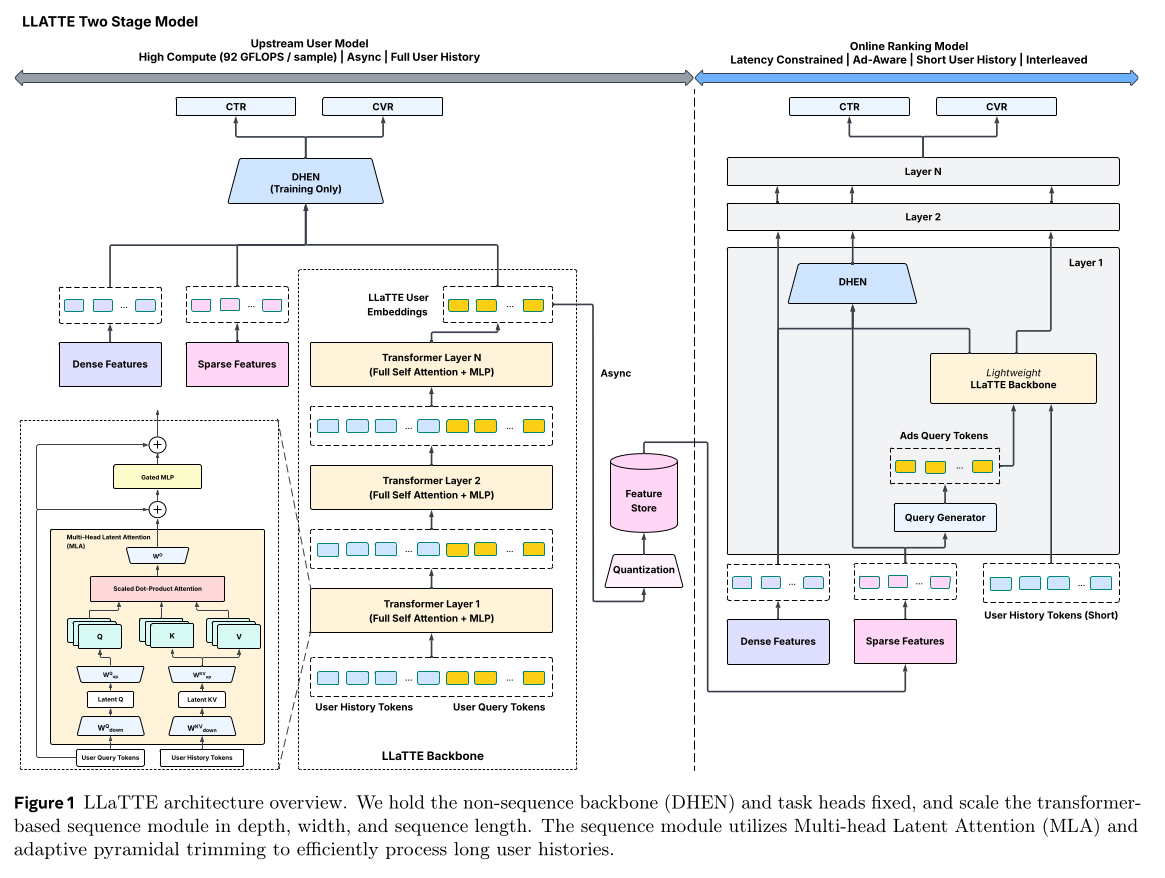
DHEN的架构如下:
Compute Allocation:在我们的production setting中,sequence module在large-scale upstream model中占total inference FLOPs的90%以上,而lightweight sequence module counterpart约占online ranking model FLOPs的30 %。在后续scaling实验中,我们默认将研究重点放在large-scale upstream model上,其中改变Sequence Module的容量lightweight online ranking model可能实现的更广泛的compute FLOP range内探索scaling behaviors。Non-Sequence backbone和Task Heads在整个过程中保持固定,以隔离Sequence Module scaling的影响。layer num,代表模型depth;width;
1.3.1 Non-Sequence Backbone
non-sequence module实现了标准的DHEN-style架构(《DHEN: A Deep and Hierarchical Ensemble Network for Large-Scale Click-Through Rate Prediction》),这是一种结合heterogeneous feature interaction modules的deep ensemble network。它处理所有non-sequential features、以及由Transformer产生的sequence summariesSparse categorical features被嵌入并与dense/float features拼接起来。concatenated features通过feature interaction networks,产生unified representationPrediction heads是shallow MLPs,产生概率:这里的
Transformer Layer最后一层的输出。在最后一层,它输出query token num)个representations。
1.3.2 Sequence Module
sequence module是我们scaling study的焦点。为了在production约束下scaling到长上下文(lengths > 1000),我们采用了一种Target-Aware transformer,具有两个关键的efficiency optimizations:多头潜在注意力(Multi-head Latent Attention: MLA)和自适应金字塔形输出(Adaptive Pyramidal Output)。该模块分五步操作:
1) Tokenization:将每个actiona token vector2) Fusion:appendquery tokens以形成我们为
online model编码the query tokens with user-ad candidate context我们为
upstream model编码the query tokens with user-only contextad candidate context尚不可用。
这种灵活的编码使得同一架构能够桥接
offline阶段和online阶段。3) Latent Attention:使用MLA(《DeepSeek-V2: A Strong, Economical, and Efficient Mixture-of-Experts Language Model》)应用到Transformer以减少内存占用。参考附录部分。
4) Pyramidal Reduction:在deeper layers选择性地移除older tokens(《OneTrans: Unified Feature Interaction and Sequence Modeling with One Transformer in Industrial Recommender》)。这将计算集中在recent events和query tokens上,允许模型在context length和FLOPs之间进行权衡。5) Readout:从the final query-token representations中抽取fixed-size summaries。
这种自适应设计(
adaptive design)允许我们在整个技术栈中部署不同风格的LLaTTE,同时保持统一的建模范式。在异步的
upstream阶段,我们部署high-capacity的变体,其消耗的sequence FLOPs是main ranker的90%集中在Sequence Module),利用full self-attention最大化representation quality。相反,
online ranking models采用激进的金字塔修剪(pyramidal trimming)以满足严格的延迟预算。
该架构由标准化组件组成;完整规格见附录
A。
1.4 Scaling Framework and Methodology
为了严格量化推荐中
scaling的好处,我们超越了临时的architecture search,采用系统性的scaling框架。与LLM(其中input text distribution通常被视为固定)不同,推荐系统允许我们沿architectural dimensions和input information densities两方面进行scale。我们将
scaling behavior表述compute budgetsequence module的compute budget并以FLOPs来衡量。当information density保持恒定时,我们假设归一化熵(Normalized Entropy: NE)的改进(相对于我们强大的production baseline)与计算量遵循幂律关系(power-law relationship),建模为对数线性(log-linearly):其中:
scaling coefficient(效率)。我们研究四个主要的
scaling的轴:1) Model CapacityTransformer depthembedding widthobjective是:确定最大化parameter efficiency的纵横比sparse-feature regime中,在depth scaling变得有效之前是否存在关键的width thresholds。2) Temporal Horizoninformation horizon)的直接代理。我们考察延长history events3) Information Density:标准scaling laws假设同质的token distribution。我们通过改变tokenssemantic richness)来挑战这一点。我们将sparse ID-based tokens与tokens enriched with dense semantic embeddings from foundational content encoders进行比较,将signal quality视为缩放系数4) Cross-Stage Transfer Efficiency:为了量化跨阶段效率(cross-stage efficiency),我们引入了迁移率(Transfer Ratio)large up-stream model的改进如何转化为production online ranking loss的改善。该指标考虑了所有production干扰因素,如异步inference latency惩罚。其中:
offline user modeling task中的loss reduction。online ranking task中的loss reduction。
该指标使我们能够确定哪些
scaling axes最能通过多阶段架构中固有的information bottleneck而保留gains。
1.5 实验
1.5.1 实验设置
Training infrastructure:所有scaling实验都在同一个大规模production recommendation task上进行,使用专有的工业训练平台。如前所述,我们的实验在大型upstream model上进行,以研究最大可达到的FLOP horizon,超越online model的计算极限。模型使用混合精度在128 NVIDIA H100 GPUs上训练,并使用FlashAttention(《FlashAttention: Fast and Memory-Efficient Exact Attention with IO-Awareness》)以提高内存和吞吐量效率。除非另有说明,每个configuration在采样自production traffic distribution的30 billion examples上训练229K steps。Evaluation metric:我们使用归一化熵(Normalized Entropy: NE)报告所有结果。我们报告相对于strong production baseline的NE相对降低百分比(%),较低的NE值表示更好的性能。在我们的内部数据集上,NE降低0.02%被认为具有统计显著性,并足以产生可衡量的收入影响。
1.5.2 Scaling Model Depth and Width
我们首先研究如何在模型
depthwidtha fixed compute budget。我们在固定序列长度grid search。结果揭示了
depth和width之间的非线性关系:当模型较窄时(
depth会产生递减的收益;representation capacity受限于embedding维度。然而,一旦
width达到临界阈值depth scaling变得显著更有效。相反,将计算纯粹分配给
width(固定NE gains。
为了说明这些
regimes,Table 1比较了四种代表性配置。我们包含了一个"Deep-Balanced"变体以展示当depth和width都足够时的scaling behavior。极端或不平衡地分配给
width或depth都会导致递减收益。足够的
width(depth scaling有效的前提,而过大的width而depth不足(例如Balanced configurations最大化性能和计算效率。
受这些观察的启发,我们在研究其他
scaling axes(如sequence length和content features)时,默认采用balanced configurations(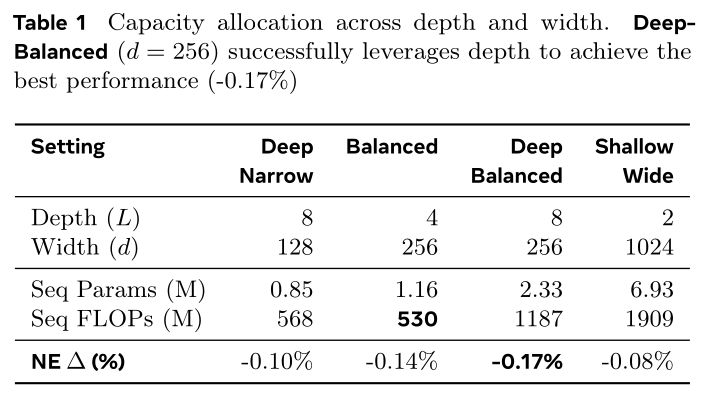
1.5.3 Sequence Length, Composition, and Content
我们现在研究
LLaTTE性能如何随时间视界(temporal horizon)(它与events数量scale、以及如何随着每个event上的semantic content embeddings而scale。Extending the temporal horizon:我们在固定width的条件下,对depthsequence horizonFigure 2所示,在所有depth上,NE随user histories持续提高ranking quality。additional context的incremental benefit在很大程度上取决于模型容量。Deeper models在NE gains,这反映在Figure 2中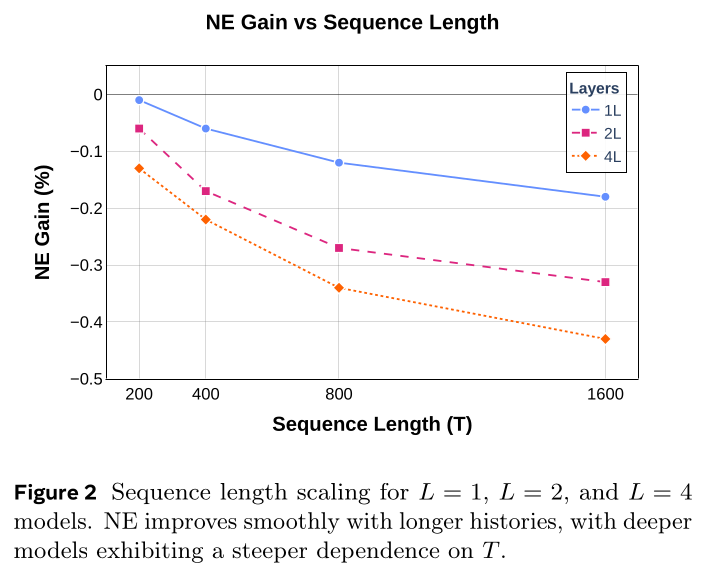
Attention-score probability analyses也揭示了long contexts的效用。The cumulative attention probability distributions over positions(Figure 3)表明,a non-trivial fraction of attention probability分配在整个200-1600 token range内,而不是狭隘地聚焦于most recent events,这表明中期历史和长期历史对predictions具备有意义的贡献。这项研究的细节见附录(见A.4节)。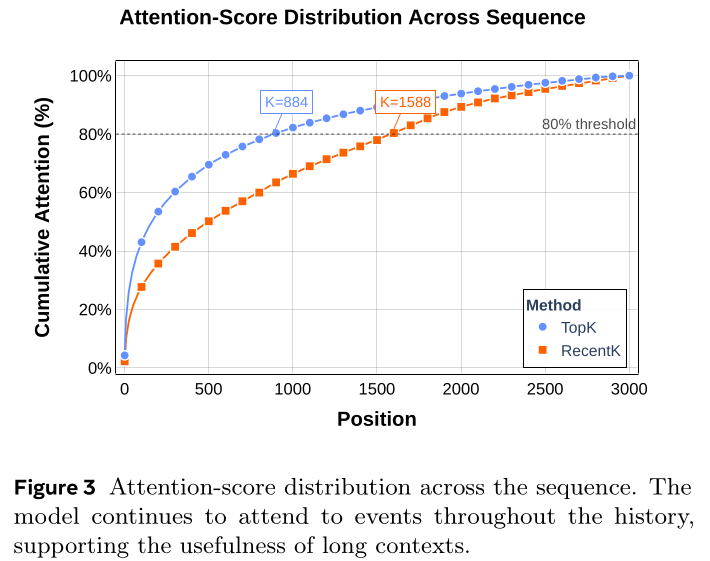
Balancing freshness and signal strength:我们接下来研究固定长度下序列的composition。在这种设置中,user histories结合了high-frequency, lower per-event signal actions(ad views)和low-frequency, high-value actions(conversions)。我们固定sources之间的分配(Table 2,上半部分)。views and conversions的balanced mixture表现最佳。两种极端情况都明显次优。
Pure-view sequences表现不佳,因为它们包含许多low-signal events。low-signal event:即这些事件包含了很少的关于用户兴趣的信号,例如ad views。Pure-conversion sequences虽然由非常高价值的events组成,但性能也会下降,因为conversions在时间上是稀疏的:filling a length-1000 sequence with only conversions迫使模型依赖older events,而这些older events可能不再反映current intent。相比之下,Views提供了dense and recent coverage。
表现最佳的
allocations结合了the high per-event signal of conversions和the temporal freshness provided by frequent views。
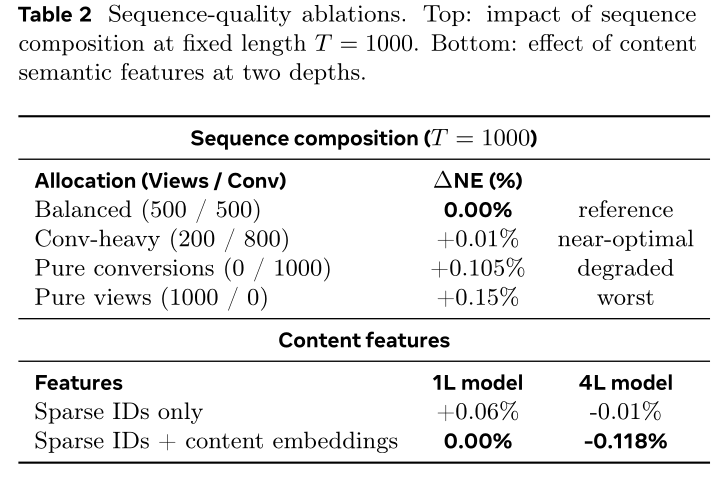
Content-aware scaling: strong content features bend the scaling curve:最后,我们研究feature richness如何与architectural scaling进行交互。除了sparse IDs外,我们还引入了由fine-tuned LLaMA models以及处理heterogeneous multimodal signals(如文本和图像)的Content Understanding models所生成的dense content embeddings,并在不同depths比较了models with and without these features(Table 2,下半部分)。有两个观察结果:
首先,在没有
content features的情况下,将depth从一层增加到四层仅产生微小的改进:the 4-layer ID-only model仅略好于1-layer baseline。这对应于非常平缓的scaling斜率,表明additional capacity主要用于memorizing ID patterns。其次,当启用
LLaMA content embeddings时,相同的4-layer configuration实现了显著更大的增益,并且the relative benefit of content对于更deeper的模型明显强于较浅的模型。
这些结果表明,
strong semantic content features不是可以忽略的附加物(a marginal add-on),而是effective scaling的前提条件。The presence of semantic features实质上改变了compute–NE curve的斜率:with ID-only inputs,depth and sequence-length scaling很快出现递减收益。而
with content-enriched sequences,相同increases会转化为显著更大的NE gains。
从这个意义上说,
LLaTTE的scaling law本质上是content-aware的;孤立地分析模型大小和计算量不足以预测性能。
1.5.4 Global Compute Scaling
最后,我们汇总上述实验以考察
global compute scaling。Figure 4在对数尺度上绘制了relative NE gain与sequence compute budgetsequence FLOPs衡量)的关系。结果表明,
recommendation性能与计算量遵循可预测的power-law关系。我们对经验数据拟合了一个对数线性模型(log-linear model):其中
scaling系数scaling策略决定。我们观察到每个轴的不同行为:Sequence Length:该维度表现出最陡的scaling斜率。延长temporal horizon始终产生每单位计算量(per unit of compute)最大的性能改进,表明模型有效利用了long-term history。然而,这伴随着logging and materializing longer user engagement histories的额外成本。Model Depth:增加depth提供了稳健的scaling behavior。一旦模型width被充分scale up,增加层数为提高ranking quality提供了可靠路径。Model Width:width在架构中扮演基础性角色(foundational role)。虽然scaling斜率相对于depth或length较平缓,但足够的width对于最大化其他维度的容量至关重要。Content Quality:如Figure 4所示,semantic features的存在显著增强了其他所有维度的scaling laws。Content-enriched models相比their ID-only counterparts(黑色线)表现出更陡的斜率,表明high-quality semantic features是模型从increased compute中extract value所必需的。
这些发现确立了
sequence-based recommendation是一种scalable的范式,能将计算转化为可预测的performance gains。我们在下一个章节中利用这个scaling hierarchy,在production约束下优化我们的multi-stage architecture。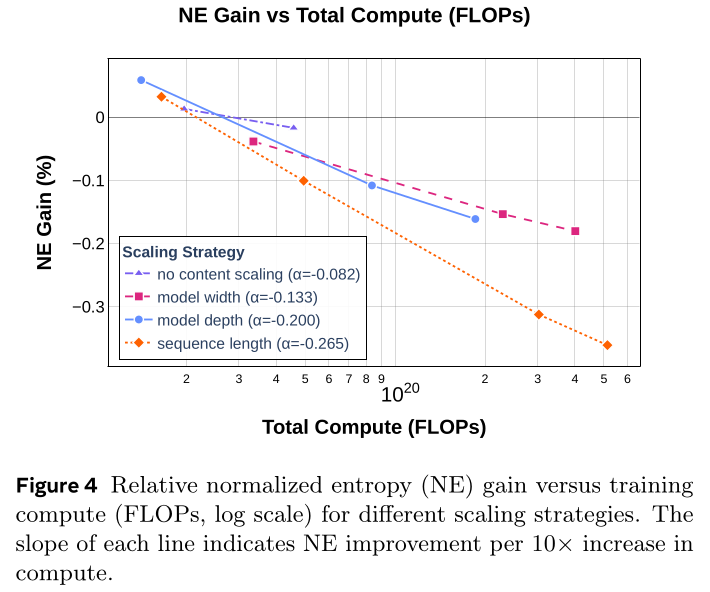
1.6 Multistage Sequence Model: Towards Maximizing RoI in Production
1.6.1 Motivation and architecture
第
1.5.4节表明,随着我们scale depth,特别是scale sequence length,ranking quality持续提高。然而,production ranker每天在严格的latency budget下服务数万亿次requests,这限制了deployed sequence module只有少数几层,并且每个source(即engagement type)的horizon大约为events/tokens。为了在不违反latency约束的情况下从有利的scaling curves中受益,我们采用了一个multistage架构。The latency-constrained downstream model保持紧凑,并联合关注user sequences features和ad/context features。An asynchronous upstream user model使用相同的LLaTTE架构处理更长的histories,但仅使用user-side features,并发布cached user embeddings,ranker在request时刻消费这些embeddings。
这种
separation引入了一个严格的information bottleneck,因为upstream encoder必须将数千个historical events总结为a single fixed-size vector(在我们的生产部署中,fixed-bandwidth bottleneck如何影响scaling laws。
1.6.2 Upstream scaling laws
我们首先单独描述
the upstream user model的scaling behavior。使用与第1.5.4节相同的log-linear拟合程序,我们将估计到的斜率作为NE improvement,它是upstream sequence FLOPs的函数。Table 3 (top)总结了upstream斜率和downstream斜率之间的比较。Table 3a报告了针对total model FLOPs的scaling slopes。downstream model在所有维度上都表现出显著更陡的斜率。然而,这种差异反映了一种结构不对称:在downstream ranker中,sequence module仅占total FLOPs的约30%;而在upstream model中,sequence module占total FLOPs的约90%。因此,在downstream setting中,Scaling the sequence module产生更大的relative improvement per total FLOP。为了隔离
sequence module的内在scaling efficiency,Table 3b报告了针对sequence-only FLOPs的斜率。这种比较揭示了depth and width scaling efficiency在两个设置中是一致的。关键区别在于sequence length:upstream scaling仅保留了约50%的downstream efficiency。这种差距产生的原因是:upstream encoder缺少candidate context,迫使upstream encoder将user history压缩为a generic representation,而不是执行candidate-aware attention。因此,只有与candidates相关的long-range signals能够穿过瓶颈。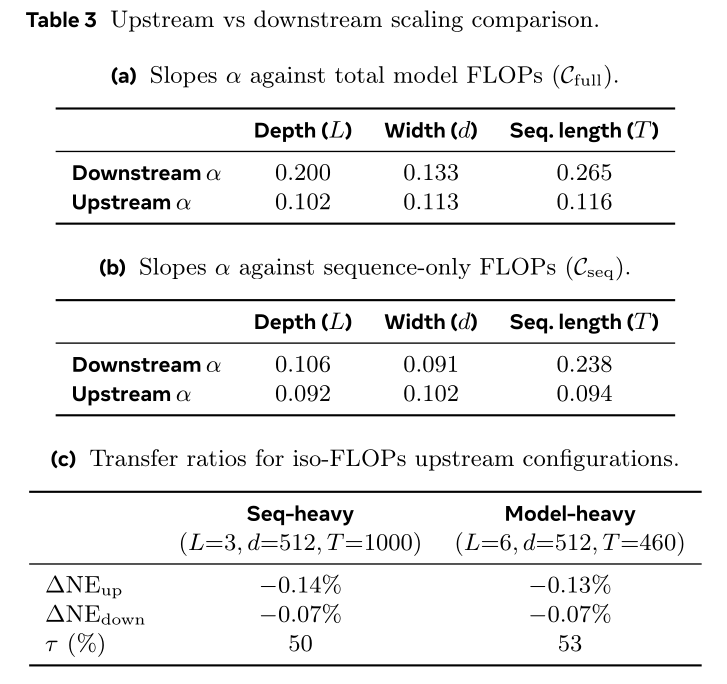
1.6.3 Transfer efficiency
为了量化我们多阶段架构的效率,回顾迁移率
upstream representation quality转化为downstream ranking accuracy的转化率。例如,
Table 3c中的Seq-heavy configuration展示了这种关系:升级upstream encoder产生0.14%的upstream improvement,这转化为downstream ranker0.07%的改进,对应迁移率Benchmarking Transfer Efficiency:将收益从asynchronous upstream models迁移到online rankers本质上是损耗性的(lossy)。几个结构性因素通常将迁移效率限制在25% - 30%范围内:massive upstream encoders与compact downstream rankers之间的容量差距(capacity gap)。asynchronous inference引入的陈旧性(staleness)。以及将
user histories压缩为fixed-size user embeddings所带来的信息瓶颈。
在此背景下,我们实验中观察到的约
50%的迁移率是显著的。它表明通过scaling the sequence encoder所捕获的high-level intent signals对compression和temporal delays具有鲁棒性,尽管存在aggressive compression和separation from the online scoring context,仍保留了实质性的predictive value。Architecture Robustness:为了确定specific architectural choices是否影响这种效率,我们比较了两种具有matched compute budgets(约12 GFLOPs/sample)的upstream configurations,代表不同的scaling优先级:Sequence-heavy:Model-heavy:
如
Table 3 (bottom)所示,两种模型实现了类似的upstream gains(-0.14% vs -0.13%),并且关键的是,相同的downstream gains(-0.07%)。这表明在固定的compute budget下,架构对于depth和sequence length之间的分配是鲁棒的。upstream model的总计算量决定了downstream性能,验证了我们可以在history length和model capacity之间灵活权衡,而不降低迁移率。
1.6.4 Implications for compute allocation
结合
downstream and upstream observations,这产生一个简单策略:Downstream online ranker:将latency budget分配给short sequence lengths and shallow depths,辅以足够的width和rich content features(sequence lengths最高约Asynchronous upstream user model:利用宽松的latency budget来scaletotal sequence-modeling compute。结果表明,downstream性能主要由total upstream compute budget驱动,而非specific allocation between depth and length。因此,我们部署upstream models,其中upstream models的sequence compute budget是online ranker的
这种
two-stage asymmetric strategy使我们在latency-constrained ranker用尽local budget后,仍能继续遵循第1.5.4节中确定的scaling frontier,将additional offline compute转化为predictable online gains。
1.7 Production Deployment
1.7.1 Asynchronous embedding service with online LLaTTE
在生产中,我们部署了
two-stage LLaTTE架构。downstream ranking model继续在线运行compact LLaTTE module,在严格的per-request latency budget下,在万亿级请求规模上关注short user histories(per-source horizon上限约为ad and context features。这个online LLaTTE model捕获fresh user intent signals并利用ad-specific interactions,但有意比第1.5.4节scaling study中考察的模型小得多。为了在不影响延迟的情况下利用更大的
sequence models,我们引入了一个asynchronous embedding service,该service托管upstream user understanding LLaTTE model。Embedding updates不是computed per request;而是由high-value user events(主要是user conversions)触发的。Triggered events在dedicated cluster of H100 GPU hosts上处理,使用针对high-throughput transformer inference优化好的deeper and longer LLaTTE models。作为Meta部署的最大user model,这些upstream encoders仅使用user-side features,生成user representations (embeddings),并将其compressed representations写入a feature store。在request时刻,downstream ranking models将这些embeddings作为dense features读取,并在online downstream LLaTTE ranking model中使用。
1.7.2 Latency and online gains
将
heavy sequence modeling卸载到asynchronous embedding service,这使ranking path上的additional cost保持为a single feature lookup。online downstream LLaTTE model在设计上保持保守(depth和sequence length)。与没有upstream LLaTTE user embeddings的baseline相比,我们观察到P99 ranking latency没有measurable change。来自larger upstream LLaTTE models的extra FLOPs由H100 cluster吸收,该cluster以低得多的QPS运行且heavily batched。在多个大规模
A/B tests中,the combination of the compact online LLaTTE and the upstream LLaTTE user embeddings在我们的旗舰ads ranker上实现了约0.25%的NE reduction,对应于Facebook Feed和Reels上4.3%的conversion提升,年收入的业务影响达数亿美元。这验证了所提出的two-stage scaling策略是一种在严格serving约束下将additional sequence-modeling compute转化为production value的有效方式。
1.8 Conclusion & Future Work
在这项工作中,我们提出了
LLaTTE范式,显著scale up了推荐系统中的sequence learning。通过将大部分计算资源分配给sequence modeling,我们实现了可预测的且稳健的scaling behavior。我们系统地分析了跨standard dimensions(model depth and width)以及less explored factors(sequence length, composition and richness)的scaling,证明optimal scaling需要同时平衡所有这些因素。为了最大化
production impact,我们开发了一种multistage modeling and deployment strategy:一个在user-only features上训练好的计算昂贵的模型,离线且不频繁地运行,同时有效地将这些gains迁移到轻量级的online production model。我们的工作与推荐系统
sequence modeling方面其他显著的行业进展(《OneTrans: Unified Feature Interaction and Sequence Modeling with One Transformer in Industrial Recommender》、《OneRec: Unifying Retrieve and Rank with Generative Recommender and Iterative Preference Alignment》)是并行开发的。这些努力共同表明了sequence modeling在大规模推荐系统中的兴起。展望未来,我们计划探索高效long-context kernels、reinforcement learning、scalable infrastructure solutions以及the upper bounds of scaling laws——因为我们正站在推荐系统LLM-scale时代的起点。
1.9 附录 A : LLaTTE Architecture Details
1.9.1. A.1 Non-Sequence Module
令
embedding lookup for sparse categorical features。我们通过concatenating embedded sparse features, dense features, float features, and sequence summaries来构建initial non-sequence representation:注意,这里
然后我们应用
a feature-interaction network:得到:
在
production,DCN/DeepFM/DLRM风格架构来实例化。
1.9.2. A.2 Sequence Module
Action Embeddings:令ordered sequence of actions,最早的在前。每个actiontoken:形成:
我们对
a subset of hidden dimensions应用additive timestamp encodings。在
Transformer中,每个token(这里是一个用户历史动作)会被表示为一个向量。向量的每一个分量就是一个hidden dimension。在这里,a subset of hidden dimensions指的是:不把时间戳编码加到整个论文采用这种设计可能有以下原因:
保留原始语义:用户行为
token中已经包含了item ID、内容嵌入等丰富语义,如果对整个向量加时间编码,可能会干扰这些语义。只对子集维度加时间信息,可以让其余维度专注于内容表示。参数效率:时间编码只需要覆盖子集维度,减少了参数量和计算量。
解耦时间与内容:让模型在部分维度上专门感知时间,便于学习时间模式(如周期性、衰减等)。
Query Tokens and Fusion:我们引入query tokenssummarize the user–ad request。根据阶段不同,这些tokens可以编码candidate ad features, request context, user-level features, and learned seed tokens(《Perceiver: General Perception with Iterative Attention》)。我们将sequence和query tokens拼接起来:并将
Transformer。Transformer Layers and Pyramidal Schedule:我们应用具有Multi-head Latent Attention: MLA(《DeepSeek-V2: A Strong, Economical, and Efficient Mixture-of-Experts Language Model》)和RMS归一化(《Root Mean Square Layer Normalization》)的L-layer causal transformer。令遵循
《OneTrans: Unified Feature Interaction and Sequence Modeling with One Transformer in Industrial Recommender》,我们在时间维度上使用自适应金字塔调度(adaptive pyramidal schedule)。如果其中
older tokens,减少attention costFFN cost我们使用三种模式:
Full self-attention(all sequence and query tokens。Pyramidal attention(query tokens加上most recent actions。Cross-attention(query tokens;在最后一层使用。
Offline (upstream) models通常使用更多层,这些层采用full self-attention(除了final cross-attention layer)。Online ranking models在final cross-attention layer之前,在early layers使用更激进的pyramidal trimming。Sequence Summaries:final layer在query-token positions输出fixed-size sequence summaries:其中每个
low-rank adapted MLP。
1.9.3 A.3 Multi-head Latent Attention
为完整起见,我们包含
MLA parameterization。对于heads,给定输入一个关键观察是:连续的线性投影可以在代数上吸收到单一矩阵中。具体来说:
这种简化揭示
MLA在数学上等价于latent space上的Multi-Query Attention: MQA(Shazeer,2019),其中queries被投影到多个heads,而key-value representations在compressed latent space中保持共享。重写的方程如下:.
1.9.4 A.4 Attention Weight Distribution
我们研究了
attention weight distribution为了增强
visualization of attention weights,我们在a single-layer transformer LLaTTE backbone中同时减少了the number of query tokens和the number of attention heads。我们提取了每个query token相对于整个user sequence的attention probabilities,并在来自不同user requests的足够多样本上聚合了这些概率。我们的分析表明,模型将更大比例的注意力分配给
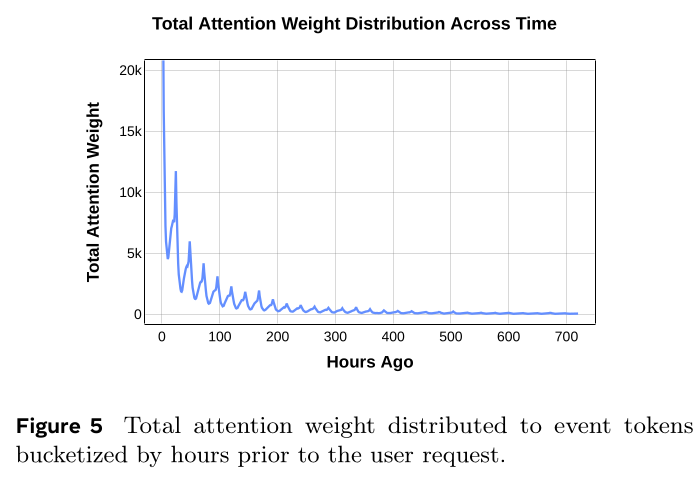
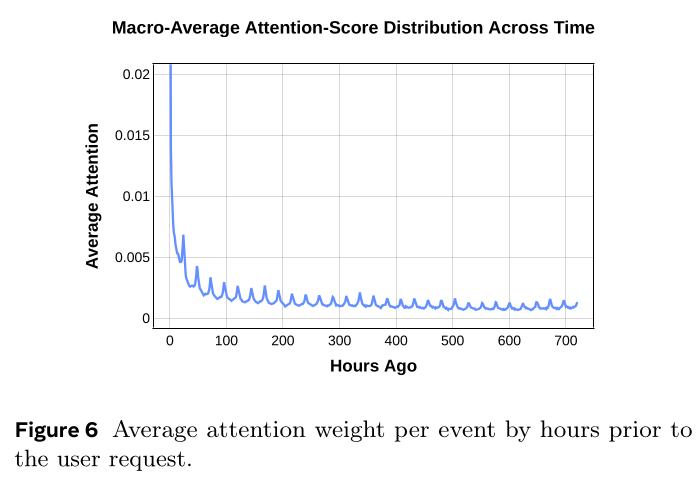
most recent events。然而,它继续对longer-term history分配non-negligible probabilities,表明模型不会完全忽略earlier events(Figure 3)。有趣的是,我们还考察了通过selecting topK event tokens而不是most recent k tokens的cumulative attention weight,这代表了通过selecting k tokens可达到的理论最大cumulative attention weight。此外,我们在
daily level识别出显著的季节模式。如Figure 5和Figure 6所示,attention weight峰值出现在24-hour intervals的尖锐处。这表明个体用户倾向于在一天中的相似时间表现出重复的interests和behaviors。虽然这些发现与我们的直觉一致,但我们认识到对
user behavior与behavioral sequences之间更细粒度的理解仍然是一个开放的探索领域。我们呈现这些初步结果,以鼓励更广泛社区的进一步研究和贡献。