一、 TokenMinds [2026]
《TokenMinds: Pretrained User Tokens and Embeddings for User Understanding in Large Recommender Systems》
工业推荐系统中的
user modeling通常生成dense embeddings,这些embeddings受限于representational constraints:它们固有地采用固定维度的向量。一种新兴的discrete user representation替代方法——使用LLM生成text-based user tokens——捕获的是主题共现(topical co-occurrences)而非deep sequential behavior dynamics,并且产生的outputs难以与item attributes关联。同时,基于Semantic ID: SID的item tokenization已被证明在generative recommendation中能有效提升泛化能力,然而discrete SID-based的user representations在很大程度上仍未得到探索。我们提出TokenMinds,一个工业规模的系统,它将PLUM框架(《Plum: Adapting pre-trained language models for industrial-scale generative recommendations》)从item retrieval扩展到user modeling,通过从pre-trained LLMs改编的一个encoder-decoder架构,同时生成discrete SID-based user tokens和dense user embeddings。这种dual-output的设计提供了离散的、语义上有据可依的user representations的互补优势,同时保持了与现有下游模型(这些模型依赖dense embeddings)的兼容性。此外,shared SID vocabulary自然地扩展到跨场景建模(cross-scenario modeling):通过将长视频行为和短视频行为统一到单个模型中,我们显著降低了training成本和serving成本。我们通过广泛的离线实验和在多个YouTube surfaces的线上launches来验证TokenMinds,通过一种异步infrastructure来服务全量用户流量(数十亿用户),该infrastructure将representation generation与下游scoring进行解耦。以ranking作为主要的下游用例,我们的结果证实了SID-based user tokens在工业规模上的实际可行性,并证明tokens和dense embeddings在不同production ranking systems中提供了互补价值。推荐系统已经从早期的因子分解机(
factorization machines)发展到现代深度学习架构,并且越来越多地从多级级联架构(multi-stage cascaded architectures)转向end-to-end方法。sequential user modeling侧重于利用用户交互过的history,长期以来在实现推荐系统个性化方面发挥了关键作用。Large Embedding Models: LEMs作为主导的工业范式,依赖大规模的embedding tables来表示high-cardinality item IDs。虽然Large Embedding Models在记忆user-item interactions方面有效,但它们在复杂网络上的泛化能力常常受限(《Better Generalization with Semantic IDs: A Case Study in Ranking for Recommendations》)。相反,
Large Language Models: LLMs将其参数预算(parameter budgets)主要分配给神经网络而非大规模embedding tables,在recommendation方面已显示出巨大潜力。近期工作利用它们的reasoning和contextual understanding能力进行feature extraction、Large Embedding Model integration和end-to-end sequence modeling。然而,将LLMs应用于domain-specific recommendations揭示了两个关键瓶颈。首先,
models pretrained on natural language在处理大规模、非文本的ID spaces(例如,数十亿视频)时存在根本性的模态鸿沟(modality gap)。其次,通过将
LLMs与traditional large embedding tables耦合来弥合这一鸿沟,继承了LLMs本应超越的那些局限性:scaling约束、vocabulary变动和有限的表达能力。
为了克服这些瓶颈,
Semantic IDstokenize item为hierarchical discrete codewords(这些codewords源自content semantics),消除了对embedding table的依赖,并通过有意义的碰撞(collisions)提升了泛化能力。在SID解决了traditional representations的scaling和expressiveness的局限性之后,PLUM框架通过Continued Pre-Training: CPT和task-specific post-training,将new SID vocabulary与LLM’s pre-existing knowledge对齐,从而弥合了remaining modality gap。虽然
PLUM框架已被证明对item retrieval有效,但其在sequential user modeling: SUM方面的潜力尚未被探索。在本文中,我们提出了TokenMinds,它扩展了PLUM从而生成SID-based user tokens作为user representations。SID-based representation与using dense user embeddings的常见方法形成对比,后者将a user’s full spectrum of interests压缩到一个或几个固定维度的向量中,可能会丢失细粒度的信号。同时,using LLMs to generate text-based user profiles也日益受到关注。虽然text profiles可以被视为discrete user representation的另一种形式,但它们面临关键局限性:LLMs without pre-training on user behavior signals倾向于捕获主题共现(topical co-occurrences)而deep sequential behavior dynamics(《Lost in Sequence: Do Large Language Models Understand Sequential Recommendation?》),它们的text outputs难以与item attributes in any target domain关联,并且当集成到non-textual downstream systems时会引入modality gaps(《Llm4msr: An llm-enhanced paradigm for multi-scenario recommendation》)。在TokenMinds中,我们通过利用PLUM中的CPT方法,并将model outputs锚定到语义上有意义、且基于recommendation语料库的SID tokens来克服这些挑战。具体来说,
TokenMinds采用encoder-decoder架构——这是generative retrieval中广泛使用的范式——但将其重新用于一种新颖的dual-output设计:decoder生成SID-based user tokens,而encoder处理sequential user features并同时产生dense user embeddings,确保与使用dense embeddings的现有下游模型兼容。以ranking作为主要下游用例,我们研究如何将SID-based user tokens正确地集成到production ranking models中。为了在严格的latency约束下为数十亿用户服务该模型,我们在异步serving infrastructure之上部署TokenMinds,该infrastructure将繁重的representation generation与real-time scoring解耦。除了单场景
user modeling之外,由于TokenMinds在从pre-trained LLM所继承的shared token space中运行,它自然地支持两个进一步的扩展。首先,诸如
textual search queries之类的heterogeneous signals可以轻松地与watch histories在input sequence中交织起来。其次,
shared SID vocabulary为长视频(long-form video: LFV)和短视频(short-form video: SFV)之间的跨场景建模提供了天然桥梁,这两个场景具有不相交的video ID spaces和不同的消费模式。我们在每个watch前添加scenario-specific condition tokens (LFV/SFV),使单个模型能够在按时间交错排列的cross-scenario sequences上进行训练。在推理时,我们引入了multi-context decoding:encoder在单次前向传递中产生a shared user representation,decoder通过以不同的scenario prefixes为条件生成scenario-specific user tokens——有效地实现了scenario-aware output而无需多模型开销。
我们总结贡献如下:
Dual-Output架构:我们提出TokenMinds,一个为大规模工业推荐系统设计的统一的user modeling架构。其新颖的dual-output机制联合生成标准的dense continuous embeddings和discrete SID-based user tokens。Tokenized User Representations & Adaptation:我们提出了一种SID-based discrete tokens的新颖application从而用于user representation,并确定了在下游模型中适配它们的最优策略。虽然TokenMinds支持各种下游任务,但本文侧重于ranking integration,我们在其中展示了tokenized representations在工业规模上的实际可行性,并证明了dense embeddings和discrete tokens可以捕获互补信号,放大了性能提升。Cross-Scenario Modeling:我们引入了一种高效的modeling范式,原生地整合了cross-scenario content training and serving。通过在单个框架内联合建模根本不同的场景(LFV和SFV),与维护separate models相比,我们将上游训练计算量减少了50%,serving计算量减少了31%,同时保持了core engagement质量,并在两个场景中显著改善了fresh content metrics。Industrial-Scale Deployment:我们通过广泛的离线评估和在production ranking systems上的线上A/B testing验证了TokenMinds,在core user metrics上实现了高达+0.11%的统计显著提升,在core engagement metrics上实现了高达+0.62%的提升。TokenMinds已在多个主要YouTube surfaces的生产环境中部署,在全量用户流量上服务LFV和SFV推荐。
1.1 相关工作
Sequential User Modeling:sequential recommendation已经从RNN(《Session-based Recommendations with Recurrent Neural Networks》)和CNN(《Personalized Top-N Sequential Recommendation via Convolutional Sequence Embedding》)演变为强大的Transformer-based的模型,如SASRec(《Self-Attentive Sequential Recommendation》)和万亿参数transducers如HSTU(《Actions Speak Louder than Words: Trillion-Parameter Sequential Transducers for Generative Recommendations》)。尽管架构复杂,这些模型从根本上依赖于atomic item IDs的大规模的continuous embedding tables。最近,
Semantic IDs: SIDs已成为item representation的一种有吸引力的替代方案,它能增强泛化能力(《Recommender systems with generative retrieval》、《Better Generalization with Semantic IDs: A Case Study in Ranking for Recommendations》)并提高样本效率(《Plum: Adapting pre-trained language models for industrial-scale generative recommendations》)。在用户侧,
dense continuous embeddings是工业界user representation的主流标准(《Longer: Scaling up long sequence modeling in industrial recommenders》、《Pinnerformer: Sequence modeling for user representation at pinterest》、《Empowering General-purpose User Representation with Full-life Cycle Behavior Modeling》)。最近
LLM-based的方法试图将preferences总结为natural language profiles(《Recommendation as language processing (rlp): A unified pretrain, personalized prompt & predict paradigm (p5)》、《Idgenrec: Llm-recsys alignment with textual id learning》、《Palr: Personalization aware llms for recommendation》),但这些方法倾向于捕获topical co-occurrences而非user’s sequential dynamics(《Lost in Sequence: Do Large Language Models Understand Sequential Recommendation?》),并且在non-textual downstream systems中面临modality gaps的挑战(《Llm4msr: An llm-enhanced paradigm for multi-scenario recommendation》)。discrete, SID-based token的user representations在很大程度上仍未得到探索。我们的工作通过将
SID范式从items扩展到users来填补这一空白,生成紧凑的discrete user tokens,同时继续输出dense embeddings以与现有下游系统兼容。
Generative Recommendations:generative recommendation将traditional embedding-table-based paradigm重新构建为sequence-to-sequence任务,例如PLUM(《Plum: Adapting pre-trained language models for industrial-scale generative recommendations》)、GenRank(《Towards large-scale generative ranking》)和GPR(《GPR: Towards a Generative Pre-trained One-Model Paradigm for Large-Scale Advertising Recommendation》)。我们的工作将
PLUM框架从retrieval扩展到user modeling。retrieval models用于预测下一个即时items,然而user modeling在更长的时间窗口内捕获更广泛的spectrum of intents。它利用更粗粒度的semantic granularity来识别distinct areas of interest,避免了严格映射回specific individual items的需要。与
GPR不同,后者将user representation与下游任务指标和policy optimization对齐,我们将learning of user representations与specific downstream training objectives解耦,以提供对用户兴趣的通用理解。与此同时,
LIGER(《Unifying generative and dense retrieval for sequential recommendation》)和COBRA(《Sparse meets dense: Unified generative recommendations with cascaded sparse-dense representations》)证明了sparse semantic IDs和dense embeddings为retrieval提供了互补的item representations。然而,两者都仅在item level操作。TokenMinds将这种sparse-dense互补性从items扩展到users,通过统一的encoder-decoder架构同时生成discrete SID-based user tokens和continuous embeddings。在线上部署
heavy generative models面临着现实世界系统的scaling瓶颈。近期工作通过优化线上架构本身来解决这一问题,例如HSTU(《Actions Speak Louder than Words: Trillion-Parameter Sequential Transducers for Generative Recommendations》)的高效transducers、LONGER(《Longer: Scaling up long sequence modeling in industrial recommenders》)的optimized representations、或parallel generation方法(《Generating long semantic ids in parallel for recommendation》)。由于这些模型在real-time scoring期间执行大量计算,严格的computational budgets通常将它们限制在广告(《Cross-Scenario Unified Modeling of User Interests at Billion Scale》、《GPR: Towards a Generative Pre-trained One-Model Paradigm for Large-Scale Advertising Recommendation》)等子领域,而非核心自然流量(core organic traffic)。为了支持数十亿用户,
TokenMinds采用了一种不同的infrastructural方法,利用异步的User Behavior Service: UBS框架(《Short-form Video Needs Long-term Interests: An Industrial Solution for Serving Large User Sequence Models》),该框架将representation generation与scoring解耦。
Cross-Scenario Modeling:在不同场景之间建模user behaviors仍然是现实世界推荐系统中的关键挑战(《A survey on cross-domain recommendation: taxonomies, methods, and future directions》)。早期方法利用
multi-source user histories来提升特定场景(如CTR prediction)的性能(《Mixed information flow for cross-domain sequential recommendations》、《Mlora: Multi-domain low-rank adaptive network for ctr prediction》)。最近,采用
foundation model范式的工业框架在统一multi-scenario behaviors方面显示出有希望的结果(《Cross-Scenario Unified Modeling of User Interests at Billion Scale》、《GPR: Towards a Generative Pre-trained One-Model Paradigm for Large-Scale Advertising Recommendation》。虽然这些方法通常将不同场景中的
user behaviors投影到shared continuous space中,但TokenMinds更进一步,同时生成统一的intent embedding和scenario-specific discrete token representations,使下游模型能够利用scenario-aware user signals。
1.2 TokenMinds Framework
我们首先介绍
TokenMinds的概述,包括设计背后的直觉。然后我们详细描述如何同时生成SID-based discrete user tokens和dense user embeddings。之后我们考虑具有不同格式数据的跨场景情况。然后我们讨论SID-based user token在下游模型中的适配,并以serving system的介绍结束本节。
1.2.1 系统概述
我们采用
sequence-to-sequence: seq2seq框架用于TokenMinds,如Figure 1所示。User behavior signals被tokenized为sequential input,并被a pre-trained foundation model处理,以同时产生dense user embeddings和discrete SID-based user tokens。由于foundation models先前未接触过我们的视频语料库,我们遵循PLUM(《Plum: Adapting pre-trained language models for industrial-scale generative recommendation》)进行Continued Pre-Training: CPT,以使new SID modality与模型的现有知识对齐(在实验章节中进行了消融实验),然后进行Supervised Fine-Tuning: SFT从而用于user modeling。下面我们描述inputs、resentations和架构。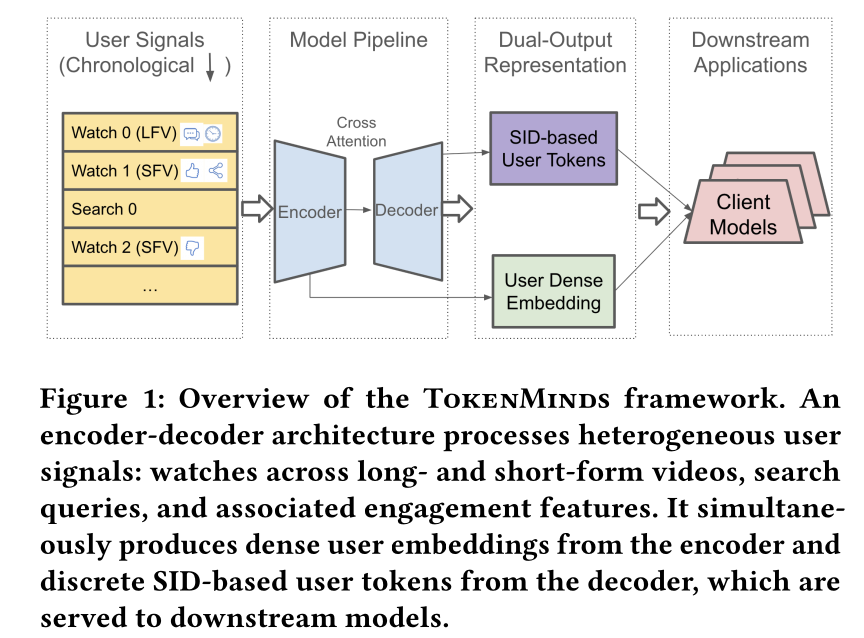
User Data:我们整合了不同的user behavior signals,如textual search queries、以及跨多个recommender applications(例如,从首页直接推荐,由what to watch next等特色功能建议)的watch histories。这些behavioral data包括user histories中的时间信号和engagement信号,如interaction timestamps和likes or dislikes。Video Representation:我们不用随机分配的video IDs: VIDs来表示每个视频,而是用Semantic ID: SID(《Recommender systems with generative retrieval》)来表示:通过一个Residual-Quantized Variational AutoEncoder: RQ-VAE(《Plum: Adapting pre-trained language models for industrial-scale generative recommendation》)从视频的content features导出的a hierarchical sequence of discrete codewords。SID为user modeling提供了两个关键优势:从头部到尾部视频上更好的泛化能力(
《Better Generalization with Semantic IDs: A Case Study in Ranking for Recommendations》)。以及更好的时间稳定性(
temporal stability),因为VID随着语料库的演变而遭受vocabulary变动,这在建模长期user histories时问题会被放大。
Foundation Model Architecture:虽然decoder-only models在generative recommendation中很流行,但我们采用encoder-decoder架构,原因有二。首先,众所周知,
encoders能在完整的user history上捕获更全面的sequential patterns(《Generative Recommendation with Semantic IDs: A Practitioner’s Handbook》),可以自然地从此类contextualized representations中抽取dense user embeddings,而decoder自回归地生成discrete SID-based user tokens。其次,该架构提供了部署灵活性:
encoder和decoder可以解耦从而用于serving(《Extremely Long User History Modeling at Instagram》、《OneRec Technical Report》),将low-frequency heavy encoder用于history compression,将high-frequency lightweight decoder用于more recent behaviors。一个
cutoff timestamphistory windowwatches)和future windowwatches)。encoder负责处理decoder负责处理decoder又不需要重读全历史,因而可以轻量。
在训练期间,
decoder通过cross-attention关注full encoder output,并学习为targeted watches生成SID tokens。在serving时,我们提取dual-outputs:encoder outputs通过pooling(例如,last-token或mean pooling)得到dense user embedding。通过对
decoder应用beam search从而生成multiple SID sequences来产生discrete user tokens,每个SID sequence被截断为粗粒度前缀(coarse-grained prefix) 从而作为a single user token。粗粒度前缀就是:一个完整
Semantic ID序列的前codewords组成的前缀,而不是完整SID。在TokenMinds里,视频的SID由RQ-VAE生成,完整长度是TokenMinds实际只保留前实验表明,使用完整的
我们也可以通过限制
decoder cross-attention仅关注少量的output embeddings from encoder(例如,learnt or attention pooled)。然而,这限制了模型的表达能力,可能降低decoding性能。为了缓解这一问题,可以引入具有constrained cross-attention的auxiliary decoding任务。
1.2.2 Model Training
在
Figure 2中,我们可视化了the training for one user example,其中用户的watches按时间顺序呈现并馈入模型以预测multiple near-future watches。为清晰起见,这描绘了基础的单场景情况;跨场景condition tokens和search query integration的扩展在后续章节中描述。例如,input sequence'A12 B278 C23 D77'表示a video’s hierarchical SID的truncated L-token prefix(tokens如'100.0s'、'20%'和'IOS'编码了数值特征和文本特征(例如,watch time ratio和device platform)。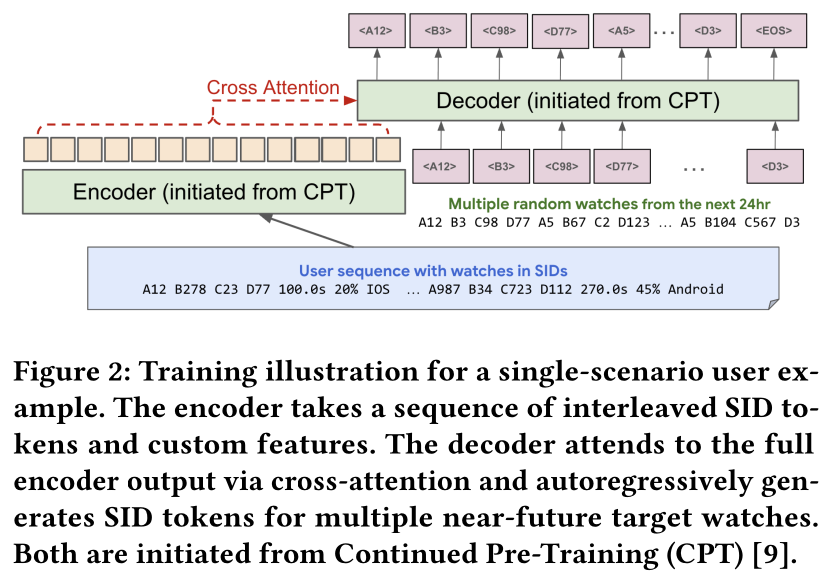
符号:
设
watch sequence。一个
cutoff timestamphistory windowwatches)和future windowwatches)。每个
watchSID来表示:给定watchcontent embeddings,一个具有codebook levels的RQ-VAE产生a full codeword sequenceprefix-L codes(SID hierarchy以更粗粒度来表达视频,以鼓励diversity并缓解memorization问题(《OneRec Technical Report》)(参考消融实验)。
Input Tokenization:每个watchprefix-L SID作为hard tokens与non-SID features(编码为hard tokens或soft tokens)相结合。hard tokens通过对dense features进行分桶、或将categorical/text features映射到vocabulary来获得。soft tokens通过独立地embedding每个feature,拼接resulting representations,并通过MLP将concatenation投影到embeddings来产生。
transformer layer的输入都是embeddings。对于
hard tokens,它们被嵌入,然后将output embeddings馈入transformer layer。对于
soft tokens,它们直接被馈入transformer layers。注意,它不会被作为target,因此不需要计算它的loss。
论文主实验里取
watch只用一个soft token来表示所有non-SID特征。论文也提到,用1个soft token会牺牲约5%离线recall,但能大幅缩短序列长度。Training Objective:我们采用两个与standard next-watch prediction的关键的偏离,两者都在实验章节中通过消融实验验证。首先,我们采用前瞻采样(
look-ahead sampling)(《Cross-Scenario Unified Modeling of User Interests at Billion Scale》):不是预测immediate next watchfuture windowtargets,防止过拟合到immediate watches,并通过近似near-future interests来改善泛化。其次,同时预测
multiple targets比single-target training提高了训练效率。
形式上,
TokenMinds最小化:其中:
sampled targets的索引。prefix-L SID tokens上计算。engagement reward,它鼓励多样化的、高价值的consumption。它被表述为multiple user signals的组合。按根据rewards的比例来采样training examples(《Plum: Adapting pre-trained language models for industrial-scale generative recommendations》)并在上述公式中平等地加权它们,在计算上比应用不同的加权权重更高效。
注意,上述公式仅适用于
decoder outputs;encoder仅通过decoder的cross-attention layers来接收梯度,这隐式地监督encoder产生support accurate SID generation的representations。
1.2.3 Cross-Scenario Modeling
上述架构为每个内容场景(
content scenario)独立地训练和服务。为了将它们整合到单个模型中,我们需要考虑长视频(long-form video: LFV)和短视频(short-form video: SFV)消费之间的关键差异。SFV以连续浏览的方式消费,无需显式的click发起,因此与LFV相比产生更强的反馈循环(feedback loop)。此外,用户兴趣并非按视频格式隔离;近一半的用户同时参与
SFV和LFV,并且它们的SID共享significant vocabulary overlap(例如,the first two prefixes大约有40%重叠)。这表明用户在LFV和SFV中的兴趣存在重叠。开发一个统一模型可以提高计算效率,促进transfer learning,并捕获更全面的user preferences视图。
Unified Training:为了构建the unified input sequence,我们在每个watch之前添加discrete condition tokens(例如,<LFV>、<SFV>)以区分content scenarios。由于TokenMinds在从a pre-trained LLM继承来的a shared token space中运行,textual signals可以自然地与SID-based watch tokens交错。我们通过对search queries的每个search query之前添加a <Search> token来利用这一点,将它们按照时间顺序与watch sequence交织在一起(在实验章节进行了消融实验)。示例:
<Search> NBA highlights<LFV> SID_A1 SID_A2 SID_A3 SID_A4 soft_A<SFV> SID_B1 SID_B2 SID_B3 SID_B4 soft_B<Search> cooking recipe<LFV> SID_C1 SID_C2 SID_C3 SID_C4 soft_C这样,在每个
search开头都有一个<Search> token;每个长视频开头都有一个<LFV> token;每个短视频开头都有一个<SFV> token。所有的search、长视频、短视频都按照发生的时刻进行排序,交织在一起。对于
training objective,我们将the random sampling of future target watches(见前面的章节)扩展为uniformly include both SFVs and LFVs。Condition tokens被排除在loss之外,因为预测它们过于简单,且若纳入其中会降低SID prediction quality。在跨场景统一训练中,未来
target watches的采样要均衡覆盖长视频和短视频,避免场景偏置。而
<LFV>、<SFV>这类场景条件tokens只作为输入条件,不计算损失。因为预测它们太简单、信息量低,纳入loss会分散模型容量,最终损害SID user token的预测质量。
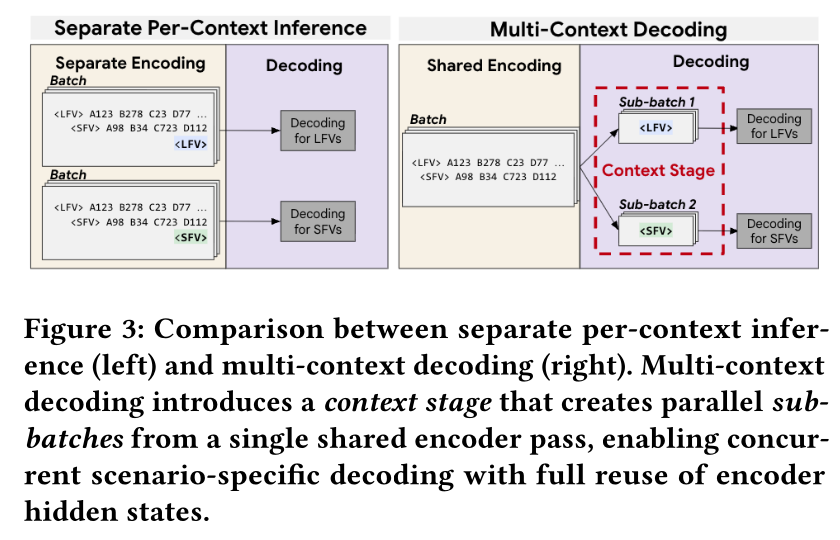
Multi-Context Decoding:A unified model应该在serving时为每个context生成scenario-specific user tokens。一种朴素的方法需要为每个context单独进行inference runs,冗余地处理user history,抵消了a unified model的效率提升。这里的意思是,分别以
<LFV> token和<SFV> token作为condition token,来解码生成结果。用户历史是同一份,但encoder被跑了两次。我们提出
multi-context decoding来消除这种冗余。给定a shared encoder pass over the user history,我们引入a context stage,将decoding划分为并行的sub-batches,每个target context一个sub-batch。每个sub-batch以其各自的condition token来初始化,并通过beam search来独立地解码,而所有sub-batches完全地共享来自a single encoder pass的encoder hidden states。如Figure 3所示,这使得a single prefill pass能够进行并发的、context-specific的解码——从相同的cached user representation同时生成LFV user tokens和SFV user tokens。这里的解决方案是:
先做一次共享的
encoder pass。然后在
encoder输出之后、decoder解码之前,加一个context stage,把解码请求按目标场景分成多个并行的sub-batch:sub-batch 1:目标场景LFV,用<LFV>初始化。sub-batch 2:目标场景SFV,用<SFV>初始化。
每个
sub-batch内部独立做beam search,生成该场景的多个SID序列。
1.2.4 Downstream Adaptation
将
SID-based user tokens集成到下游模型——特别是需要dense vectors的传统LEMs——需要将discrete tokens投影到a continuous embedding space中。我们评估三种token-to-embedding的方法(《Better Generalization with Semantic IDs: A Case Study in Ranking for Recommendations》):(1):Prefix Embedding Mapping:将每个predicted L-prefix SID映射回original content embeddings(这个content embeddings就是SID的embedding)。由于多个视频可能collapse为相同的coarse-grained prefix,我们对sharing the predicted prefix的所有视频的original embeddings进行均值池化,以获得SID embedding。(2):N-gram Embedding:将每个predicted SID sequence分割为固定长度的N-gram sub-words(例如,对于codeword pairs),每个N-gram sub-word被映射到a learned embedding。SID representation是the sum of its sub-word embeddings。(3):SPM Embedding(《Subword regularization: Improving neural network translation models with multiple subword candidates》):类似于N-gram,但使用SentencePiece从item distributions中学习variable-length sub-words。
我们将
(2)和(3)统称为Learnable Embeddings: LEs,因为两者都使用随机初始化的embedding tables,与下游模型一起被端到端地训练,与(1)的static mapping形成对比。N-gram Embedding和SPM Embedding的效果要比Prefix Embedding Mapping更好。而N-gram Embedding和SPM Embedding之间效果差不多。在
serving时,beam search为每个用户产生SID sequences,每个SID sequence代表一个predicted future interest。为了形成a single user vector,我们通过池化(例如,attention-weighted池化、均值池化、最大值池化、或top-k concatenation)聚合对应的SID embeddings。所有策略产生相差无几的下游性能,表明收益主要来自tokens本身包含的信息,而非aggregation choice。这
SID embeddings代表了上述
encoder-derived dense embeddings和token-derived SID embeddings都可以作为下游模型的direct input features,或作为cross-attention layers中的key-value pairs,其中candidate items对user representations进行关注(attend)。
1.2.5 Serving System
为了克服十亿用户规模下的
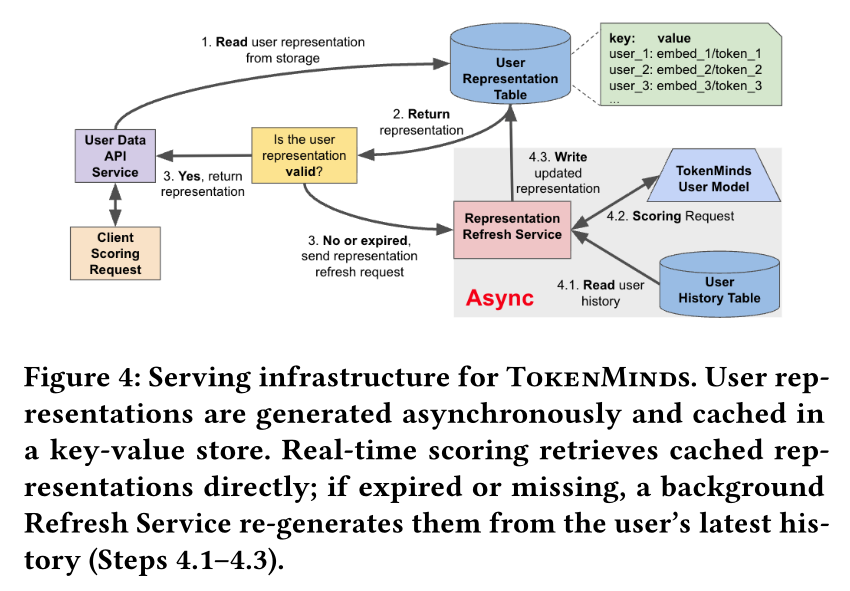
high serving costs和latency,我们将user representation generation与real-time down-stream inference解耦,如Figure 4所示。基于User Behavior Service: UBS框架(《Short-form Video Needs Long-term Interests: An Industrial Solution for Serving Large User Sequence Models》)构建,TokenMinds异步生成user embeddings和user tokens,并将其缓存在快速的key-value store中。real-time models在scoring期间检索这些cached representations,无论TokenMinds的底层复杂性如何,都保持恒定的延迟和成本。当a scoring request到达时,客户端检查有效的、未过期的representations:如果可用,则获取它们并直接馈入下游模型。
否则,立即触发后台刷新:
Representation Refresh Service读取用户最新的watch history,通过exported TokenMinds model运行inference,并将updated representations写回缓存。
1.3 实验
我们首先详细说明
TokenMinds的实验设置,然后从离线指标和downstream integration的线上评估考察recommendation quality。最后,我们分享来自additional studies的经验。我们尝试回答以下问题:RQ1 (Token Adaptation & Viability):如何将SID-based discrete user tokens最优地适配用于下游continuous models;并且当部署在工业规模的recommendation surfaces上时,它们是否能产生measurable improvements?RQ2 (Complementary Values):TokenMinds的dual-output性质是否通过同时生成continuous embeddings和discrete tokens来提供互补的价值?RQ3 (Cross-Scenario Modeling Impact):统一cross-scenario modeling范式(联合训练LFV和SFV)能否在不影响下游recommendation quality的情况下实现计算效率提升?
1.3.1 Experiment Set-up
Model:TokenMinds采用基于Gemini V1.5的encoder-decoder架构,包含一个370M-parameter Mixture-of-Experts (MoE) encoder和一个370M-parameter dense decoder。两者都从Continued Pre-Training (CPT) checkpoints(《Plum: Adapting pre-trained language models for industrial-scale generative recommendations》)初始化。Training:TokenMinds在YouTube LFV and SFV watch histories interleaved with textual search queries的数据上训练,使用为Gemini生态系统开发的内部JAX和Pathways框架。我们采用continuous training,在最新的daily data上,从而捕获fresh engagement signals,每天处理数百万样本,这比通常需要billions of interactions的traditional LEMs更具样本效率。对于每个
user sample,我们使用most recent 1,200 watches interleaved with S=10 search queries,最大input sequence length为1,024 tokens(在后续章节中进一步分析)。每个watch由一个condition token、prefix-L=4 SID tokens、和用于non-SID features的M=1 soft token组成;using a single soft token以大约5%的offline recall为代价,显著减少了sequence length。Target selection从24-hour look-ahead window中采样最多watches。通过对学习率在grid search,我们发现linear warmup with cosine decay and cyclic restarts(《Language models are few-shot learners》、《Sgdr: Stochastic gradient descent with warm restarts》)达到了peak same-day performance,但在continuous training下,a constant learning rate对day-to-day distribution shifts更为鲁棒。Serving:TokenMinds通过异步的processing infra具备24-hour refresh cadence。对于每个用户:我们从
encoder提取a 1,152-dimensional dense embedding。并通过
beam search来解码B=40 SID sequences(20 sequences用于LFV,20 sequences用于SFV),所有sequence都使用prefix length L来形成user’s discrete token representation。
1.3.2 Representation Quality
本节中的所有模型都在相同数据上训练至收敛,以确保公平比较。
Token Accuracy and Training Ablations:我们评估TokenMinds generated tokens的预测准确性,并对关键training design decisions进行消融。我们在两种协议下评估token accuracy:Session Recall:使用近乎完整的historyinput并预测final watchCold-Start Recall:使用truncated historyinput并预测从future windowwatch。
所有变体都在两种协议下进行评估以确保可比性。在两种情况下,我们生成
top-10 SID sequences(prefix length L)并计算Recall@10。Table 1报告了结果以及三个消融实验,每个消融实验移除一项training innovation,同时保持evaluation固定:(1):w/o Multiple Targets:将sampled targets从1。(2):w/o Look-ahead Window:用标准next-watch prediction(inputtargetlook-ahead sampling。(3):w/o SID Truncation:trains and encodes inputs with full-length SIDs(prefix-L;在评估时,predictions仍在prefix-L granularity上进行比较以确保指标可比性。
所有三项都降低了准确性,其中
look-ahead removal、以及full-length SIDs对冷启动性能尤其有害(分别相对下降-10%和-17%),确认了temporal look-ahead sampling和coarse-grained prefixes对于泛化到immediate session之外是必不可少的。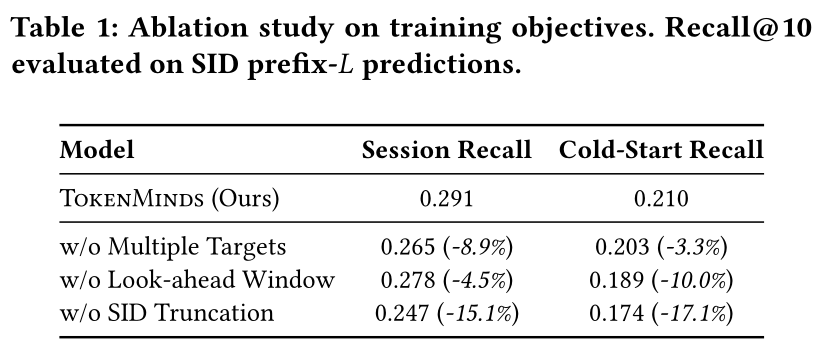
Initialization Strategy:为了验证the choice of initializing from a CPT checkpoint(《Plum: Adapting pre-trained language models for industrial-scale generative recommendations》),我们与两个基线进行比较:a general-purpose Pre-Trained Gemini checkpoint (without SID-specific grounding)、以及随机初始化。Table 2显示了这些基线在with and without search queries的配置下的比较。我们观察到CPT始终优于Pre-Trained Gemini,Pre-Trained Gemini又优于随机初始化。这证实了在CPT期间the semantic grounding of SIDs对下游task-specific fine-tuning有益,超出了base LLM本身的general sequence modeling能力。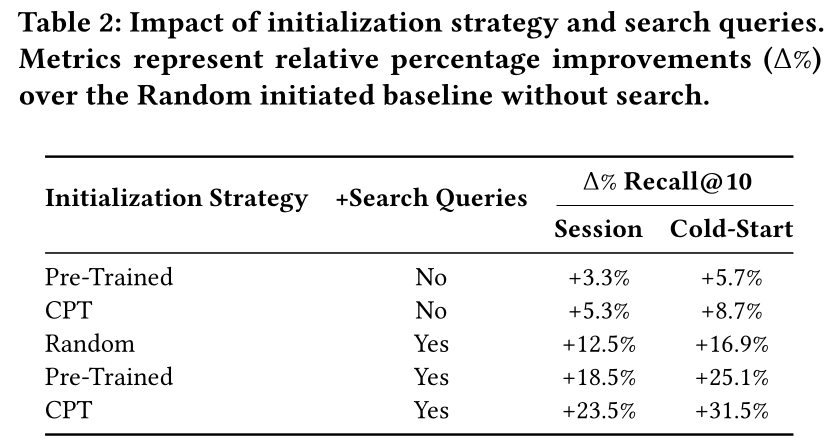
Impact of Search Queries:为了量化search queries的贡献,我们将our full model与a variant trained without search signals进行比较。如Table 2所示:添加
queries在所有初始化策略下持续改善recall,确认了explicit textual intent提供了超出watch history之外的补充信号。既然
search queries有效,那么为什么只选择queries?两个原因:最大输入长度只有
1,024 tokens,watches已经占了大头。所以tokens预算下,给search queries分配的一个合理配额。如果再增加search queries,每个query本身会tokenize成多个文本tokens,还会加<Search> token,就会挤掉watches。只取 “最近的”
search queries,更早的搜索时效性差。最近的10 searches已经能覆盖短期显式意图,再往前翻,边际信息价值下降。
此外,
search的收益通过更强的initialization被放大,表明an LLM backbone with aligned SID representations更能够利用textual search signals与behavioral watch histories相结合。
Token Diversity:在确立了预测准确性并确定了一些关键的驱动因素之后,我们接下来验证这种性能不是通过redundant beams来实现的。由于每个decoded SID作为下游模型的a distinct interest signal,beam collapse——多个beams收敛到近乎相同的outputs——将严重限制representational capacity。我们使用两个指标评估多样性(
diversity):SID Token Collision Rate:测量位置token的频率,high collision表示semantic beam collapse。SID Prefix Duplication Rate:统计直到位置prefixes的数量,high repetition表示isolated exploration of a single branch。
我们在
5K users的样本上评估这些指标,将generated tokens与ground-truth watches from the same look-ahead 24-hour window进行比较。为确保尽管规模差异仍能公平比较,我们对较大集合(ground-truth watches or generated SIDs)进行降采样以匹配smaller set的大小。为减少subsampling的方差,每次比较时,我们对larger set重复降采样10次,并报告平均similarity分数。different token indices下的结果Cumulative Distribution Function: CDF绘制在Figure 5中,表明TokenMinds达到了与ground-truth distribution相当的prediction diversity,确认了beam search产生diverse interest signals而不会坍缩为redundant outputs。实线是
ground-truth,虚线是ours。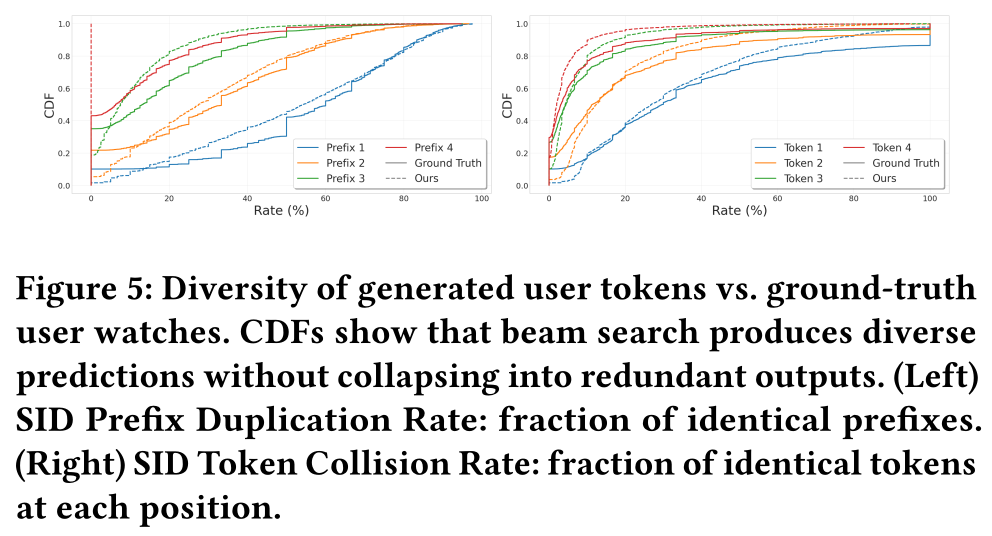
Embedding Quality:我们在2K random sampled users上评估embedding consistency。对于每个用户,我们从其full history生成an embeddingwatches生成一个扰动的变体a random user’s embeddingembeddings在轻微history扰动下保持稳定,同时在用户间保持区分性。
1.3.3 Online Performance
我们通过线上
A/B实验评估TokenMinds的现实世界影响,将用user embeddings和user tokens集成到多个production ranking models中。虽然TokenMinds已部署在YouTube的ranking system、retrieval system和LLM-based production systems中,但本文侧重于ranking integration。所有实验均在a seven-day period内进行。我们在LFV和SFV中报告两个关键quality metrics上的性能:Engaged Users和Satisfied Engagement。在本小节,表格内的粗体数字表示在95%置信度下具有统计学显著性。Token Adaptation Pivot Study:在投入大规模计算到full-scale dual-output architecture之前,我们使用一个轻量级的110M model在SFV surface上进行了线上转折研究,以确定最优的token adaptation策略。如Table 3所示,我们比较了静态的Prefix Embedding Mapping: EM与Learnable Embeddings: LE——具体来说是Unigram (N = 1)用于SFV,匹配该surface上现有的item tokenization。LE始终优于EM,确认了allowing downstream models to learn a specialized embedding space能产生更好的task adaptation(《Better Generalization with Semantic IDs: A Case Study in Ranking for Recommendations》)。在LFV platform上使用SPM-based LE进行的auxiliary evaluations显示出相同的趋势。因此,我们在所有后续full-scale evaluations中专用地使用LE,回答了RQ1的前半部分。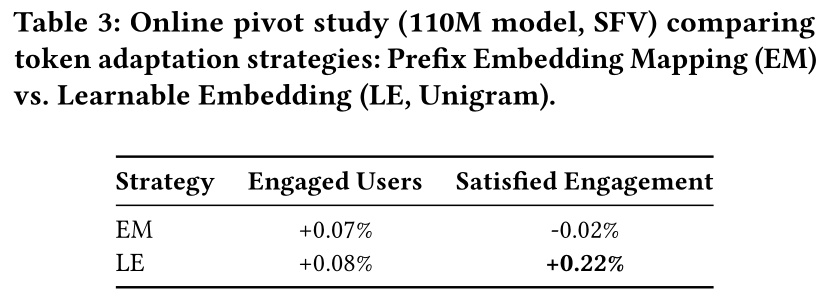
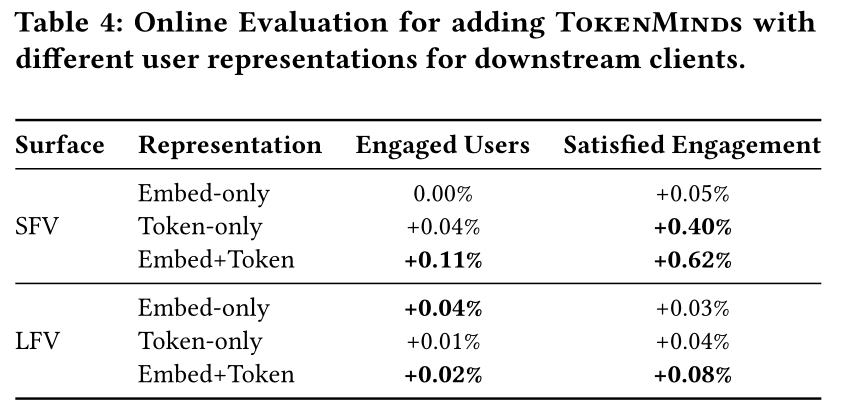
Downstream Quality:为了评估TokenMinds的各自部分的影响和互补的影响,我们比较了单独添加continuous embeddings、单独添加discrete SID-based tokens(通过LE)、以及同时添加两者。Table 4报告了primary SFV surfaces和primary LFV surfaces的结果。我们得出两个关键发现。首先,
SID-based user tokens在production systems中提供了additive value,直接回答了RQ1的后半部分。除了Table 4中的primary surfaces,仅在另外两个LFV surfaces上的token-only integration在Engaged Users方面实现了+0.04% / +0.16%的统计显著提升,在Satisfied Engagement方面实现了+0.07% / +0.11%的提升,进一步确认了泛化性。其次,同时部署
embeddings和tokens产生了放大的增益,验证了RQ2关于这两种模态的互补性质、以及我们的dual-output架构。
Downstream Cost:对于joint token and embedding generation,TokenMinds大约需要339ms per user,完全在后台处理中被吸收。每个用户的discrete token representation仅需1,280 bytes——而dense embedding需要4,608 bytes——存储减少了72%。在serving时,系统在来自多个production surfaces的1.44M read requests per second中达到了96.4%的cache hit rate。将pre-computed embeddings作为features所引入带来的计算成本可忽略不计;token integration开销详见Table 5。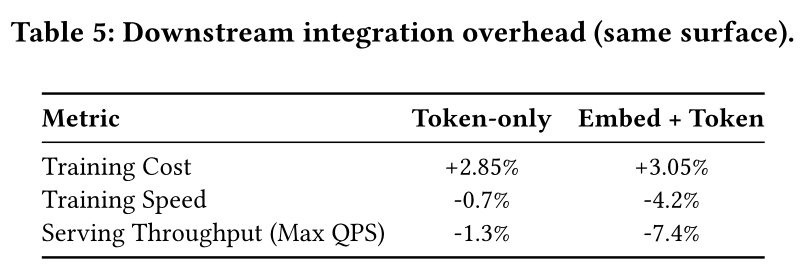
Cross-Scenario Modeling:我们评估the unified cross-scenario model与两个基线:a LFV-only model(仅在LFV data上训练)用于quality comparison。separately trained LFV and SFV models用于efficiency comparison。
从
Table 6(Panel B)来看,将LFV和SFV整合到单个框架中产生了可观的成本节约。训练计算减少了
50%,因为一个模型取代了两个模型。上游
serving成本减少了31%,因为multi-context decoding在场景间共享a single encoder pass(481 chips),而不是running two full model passes(总共698 chips)。下游
integration cost保持中性,因为the unified model产生的outputs形状与LFV-only baseline相同。
在质量方面,
Panel A显示用unified representations替换LFV-only baseline持续改善了freshness指标(Fresh Engagement衡量用户与新视频的interaction),而没有降低core engagement指标。值得注意的是,the unified model在相同的fixed-length input sequence中处理LFV watches和SFV watches,几乎将可用的LFV history减半。尽管有这种减少,core metrics仍保持中性这一事实表明,来自SFV interactions的cross-scenario signals补偿了reduced LFV context——这确认了the unified paradigm在实现显著效率提升的同时不损害质量。LFV-only模型中,inputs仅仅包含LFV视频,因此在相同input length下,LFV视频数量相比Cross-Scenario Model翻倍。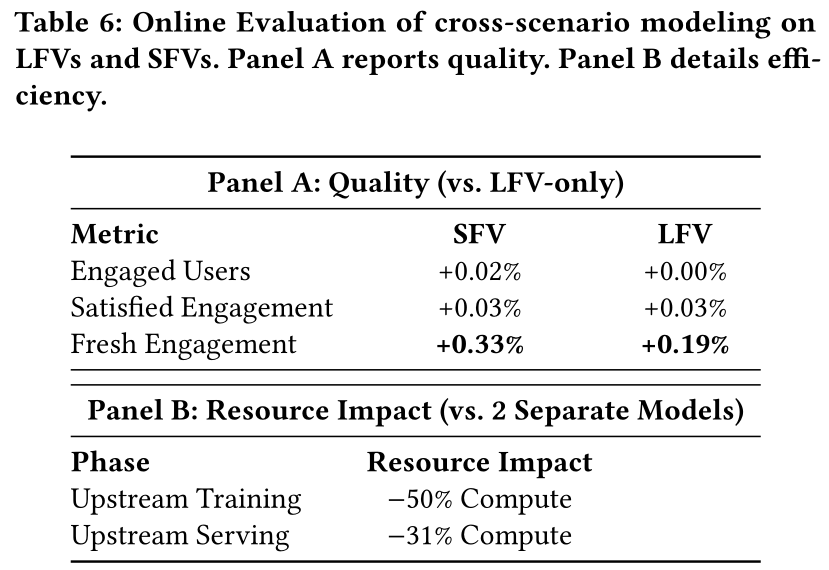
1.3.4 Scaling Studies
为了优化计算效率,这些研究采用
an accelerated offline evaluation protocol(《Plum: Adapting pre-trained language models for industrial-scale generative recommendations》):模型在7 randomly shuffled days上训练,并在连续的第8天进行评估。Model Variants & Capacity Allocation:我们探讨architectural design和capacity allocation对模型质量的影响。受限于可用的pre-trained Gemini checkpoints,我们研究三种warm-started变体:a Balanced MoE model:370M Enc / 370M MoE Dec。a Balanced Dense model:370M Enc / 370M Dense Dec。an Unbalanced Dense model:420M Enc / 110M Dense Dec。
我们围绕
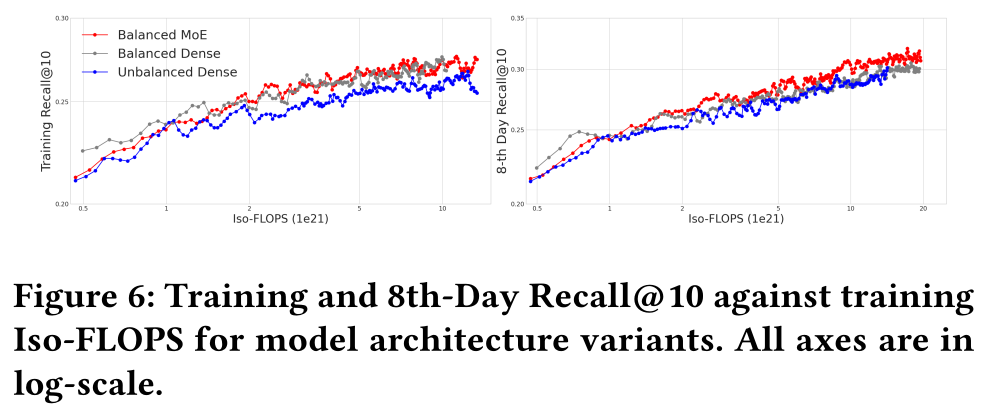
Balanced Dense anchor对学习率网格搜索Balanced Dense anchor的学习率除以10到乘以10)。Figure 6显示了LFV的Training和8th-Day Recall与Iso-FLOPS的关系(SFV因趋势相似而省略)。虽然
the Unbalanced model显示的Training Recall低于the Balanced Dense baseline,但它达到了相差无几的8th-Day Recall。这为异步serving策略打开了大门——将较重的encoder以较低频率刷新以获取稳定的user embeddings,与较轻的decoder以较高频率刷新从而捕获recent behaviors相结合。此外,在相差无几的
FLOPS下,the Balanced MoE decoder在8th-Day Recall上优于Dense对应物,确认了sparse expert routing在泛化到future user behaviors方面提供了切实的优势。
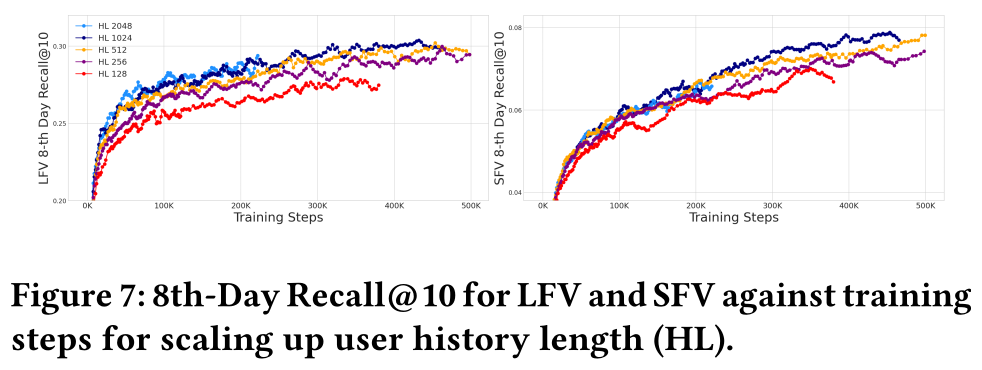
Input Length Scaling:虽然现代user modeling通常受益于long-term watch histories(《DV365: Extremely Long User History Modeling at Instagram》),但开发compute-optimal models需要理解scaling dynamics。我们分析了用户历史长度(history length: HL)的影响。如Figure 7所示:LFV和SFV的8th-Day Recall@10在大约1K watches处开始饱和。扩展到
2K watches在SFV上产生相差无几或略微下降的性能。
Batch Size Scaling:我们评估了4K、8K和16K的batch sizes,使用8K作为anchor configuration并进行了广泛调优好的学习率,并通过标准的《Language models are few-shot learners》)扩展到其他batch sizes。相对于4K baseline,8th-Day Recall@10在8K时提高了+2.5% / +5.5%(SFV/LFV),在16K时提高了+7.6% / +13.7%。与PLUM(《Plum: Adapting pre-trained language models for industrial-scale generative recommendations》)中的发现一致,较大的batches加速了收敛,并在相同的training window内产生了更强的representations。这突显了在硬件容量允许的情况下最大化batch size对于compute-optimal training的重要性。
1.4 结论
我们介绍了
TokenMinds,一个通过从pre-trained LLMs改编的a unified encoder-decoder architecture来生成discrete SID-based user tokens和dense user embeddings的框架。Cross-scenario modeling进一步将LFV和SFV统一在a shared SID vocabulary下,采用multi-context decoding,大幅减少了上游计算。作为
YouTube上已部署的系统,TokenMinds证明了SID-based user tokens是production ranking systems的可行的representation。将这些tokens与dense embeddings相结合产生了放大的性能增益,确认了dual-output design的互补的价值。我们的消融实验进一步验证了CPT initialization的重要性、以及search query signals对SID-based user modeling的协同效益。这些结果表明,离散的、语义上有据可依的
user representations为scaling user modeling到超越dense embeddings alone的representational constraints之外提供了一条有希望的方向。